
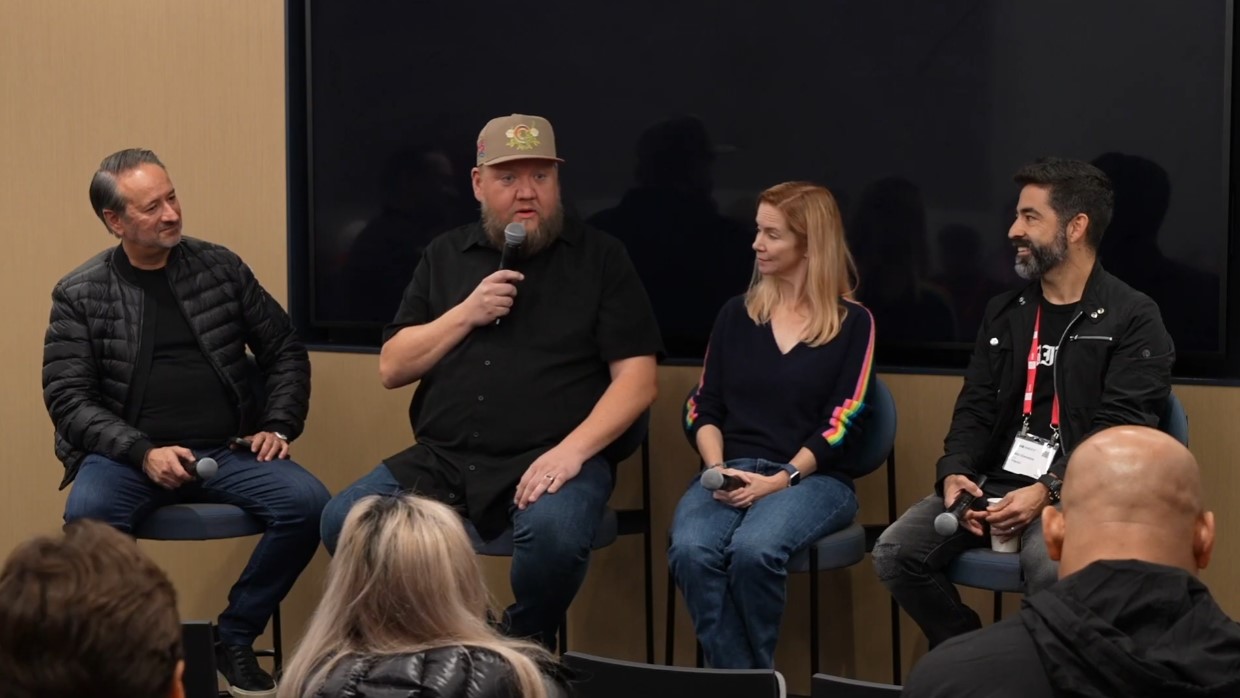
While the industry has weathered crashes and console transitions before, the current upheavals feel different between layoffs, funding pullbacks, and shifting platform priorities and are creating a risk-heavy market.
At GamesBeat Next last month in San Francisco, CA, the panel Thriving in the Storm: Building Sustainable Game Businesses in a Risk-Heavy Market brought together four veterans who have seen multiple cycles come and go: Mark Stanley (founder and CEO of Syndicate of Play), Adam Boyes (founder of Vivrato), Ben Granados (co-founder of PUBLSH), and Jen MacLean (co-founder of Dragon Snacks Games).
Stanley opened by acknowledging how different the industry is today: “What we did in the last 20 years just does not apply anymore.”
Instead of nostalgia for the old playbook, the group focused on unlearning assumptions, seeking out experienced voices, and reinforcing business fundamentals in a market where risk is higher and margins for error are smaller.
Unlearning the Old Playbook
Boyes argued that relying on past patterns is dangerous. “Rearview mirror right now is probably a bad idea,” he said. “I think we’re in brand new uncharted territory.” Rather than reflexively embracing or rejecting every new platform or technology, he urged developers to “explore these things with curiosity” — whether that is Roblox, mobile, AI, or new funding structures.
Granados pointed out that younger players do not think in the genre labels many developers obsess over. “If you are 26 years and younger, you don’t even see genre,” he said. For them, it comes down to whether the game is fun, social, and where their friends are. Data and internal frameworks built for Gen 2–4 console cycles, he argued, are “probably flawed and… antiquated” if they do not reflect how audiences actually consume games now.
MacLean added that even console cycles themselves are changing. “What we have seen in the past cycles of consoles is not relevant to what we will be seeing in the next cycles,” she said. Graphics and exclusives matter differently, and “what we wanted from Gen 2, Gen 3, Gen 4… is not what the audience wants now.”
At the same time, the panel stressed that experience still has value, as long as it is applied deliberately. MacLean described how Dragon Snacks did a skills gap analysis, then recruited advisors to fill specific holes: “We said, ‘what don’t we know that we need to know?’”
Battle-tested tips
When the conversation shifted to practical survival tips, Granados framed it as balancing creativity and commercial reality. “The name of the game is still being pro-creative without being anti-business,” he said. That means having a clear north star for product positioning, knowing exactly who the audience is, and “building toward audiences versus trying to build a product and then try to go fill an audience in later.”
MacLean stressed there is “no substitute for getting people playing the game super, super early even though it hurts.” Dragon Snacks has been running multiplayer playtests in Discord since early in development, and recently discovered their combat was merely “okayish” according to playtesters.
“You don’t want anything to be okayish,” MacLean said. “They need to love it or hate it.” That uncomfortable feedback sparked a redesign that dramatically improved response.
Boyes said many problems start at the very beginning. He always asks three questions: “Why did you make this game? Who is it for? And are you building a business or a game?” He sees teams under-asking for funding, overscoping features, and failing to define co-founder responsibilities. “If you don’t do all that heavy lifting at the very beginning,” he warned, “that’s when stuff starts to fall apart.”