
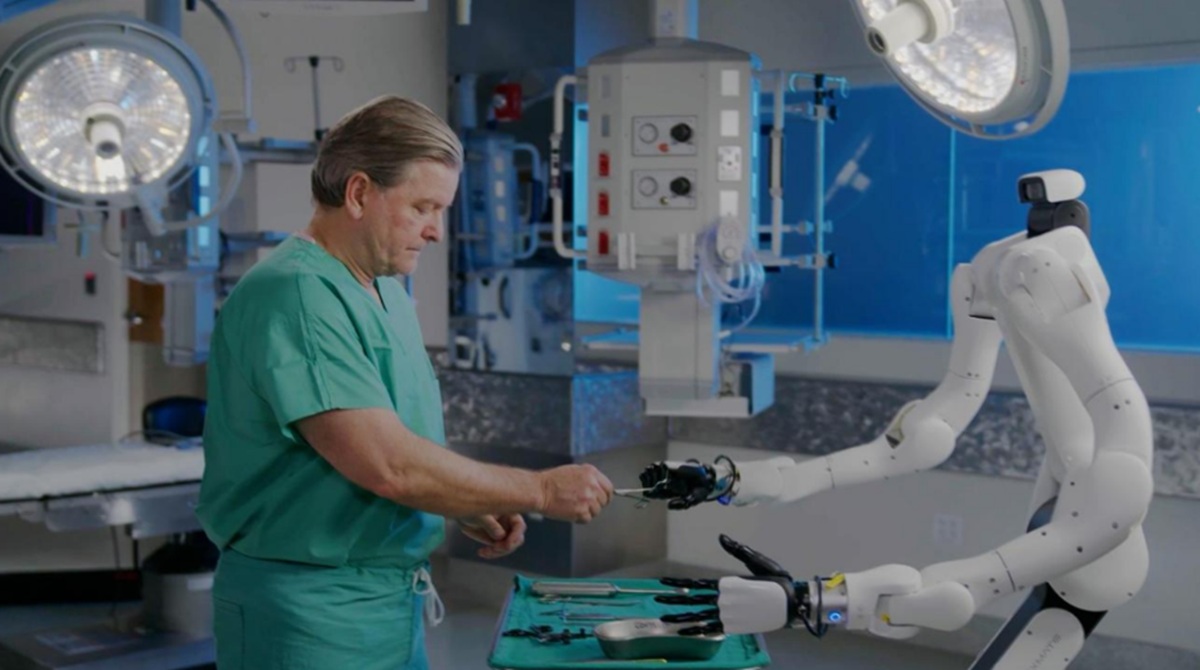
Nvidia released open physical AI models for healthcare robotics at the Nvidia GTC event today.
Surgical robotics leaders including CMR Surgical and Johnson & Johnson MedTech, along with surgical physical AI platform developers PeritasAI and Proximie, are among the first to adopt healthcare-specific physical AI tools unveiled at GTC.
For years, AI in healthcare has lived primarily on screens, analyzing medical images and
predicting patient outcomes. Today, it moves beyond the screen and into the physical
world as Nvidia launches the first domain-specific physical AI platform for healthcare
robotics.
Leaders and innovators in surgical robotics — including CMR Surgical, Johnson & Johnson
MedTech, Moon Surgical and Rob Surgical — are adopting Nvidia’s healthcare-specific
physical AI tools to accelerate workflows including synthetic data generation, robotic
policy evaluation and digital twin creation.
PeritasAI is integrating these technologies to build a physical AI platform for surgical operations, integrating robots and multi-agent intelligence to sense, coordinate and act in
real time. Another physical AI platform developer, Proximie, is developing vision language
models that can support surgical teams in the operating room.
Announced at GTC, these tools provide the robust, open infrastructure developers need to
transform care delivery with a new generation of healthcare robots. They include:
● Open-H, the world’s largest healthcare robotics dataset. Built with about three dozen collaborators, Open-H represents the real-world diversity and complexity of surgical procedures, providing over 700 hours of surgical video to accelerate the development of advanced, generalizable robotic systems.
● Cosmos-H, an open model family including Cosmos-H-Surgical, based on Nvidia Cosmos for domain-specific, physics-based synthetic data generation at scale. Featuring three models that generate surgical video from prompts, reference images or videos, and paired robot kinematics, Cosmos-H enables developers to augment real datasets with lifelike simulations — and evaluate robotic policies by predicting the future state of surgical environments.
● GR00T-H: This vision language action (VLA) model, based on Nvidia Isaac GR00T N,
processes text commands describing clinical tasks and generates motion commands, known as action tokens. Trained on Open-H, the model can be used to train and evaluate robots developed to perform complex physical actions in healthcare environments.
● Rheo: This developer blueprint, available within the Isaac for Healthcare developer framework for AI healthcare robotics, enables developers to create physically accurate simulations of hospital environments. It can be used to safely develop and test automation strategies at scale by simulating clinical workflows, medical device interactions, human movement and hospital logistics.
Surgical robotics, imaging and hospital automation leaders are already using Nvidia
physical AI technology for healthcare robotics:
● CMR Surgical is contributing close to 500 hours of surgical video to Open-H to help
pretrain GR00T-H. The company is also using Cosmos-H to generate physically accurate synthetic surgical data and evaluate new robotic policies.
● Johnson & Johnson MedTech is using a Cosmos-based foundation model and anatomical simulation in Isaac for Healthcare to generate and enhance data for post-training workflows for the MONARCH Platform for Urology.
● PeritasAI, is using Isaac for Healthcare and Rheo to train humanoid robots and VLA models that bring embodied intelligence into surgical environments — supporting surgical teams through real-time situational awareness, sterile coordination and intelligent management of instruments, implants and operating room workflows. This work is in collaboration with Lightwheel and Advent Health Hospitals.
● Proximie is using Cosmos-H to train multimodal vision language models that combine operating room images with intraoperative video. These models power real-time AI agents that provide surgical insights and orchestration across the surgical pathway. Additional adopters of Nvidia healthcare robotics technology include Moon Surgical and Rob Surgical.
Open-H, Cosmos-H and GR00T-H are now available on GitHub and Hugging Face for
developers to post-train and adapt for specific surgical scenarios. These tools pair with
Nvidia Isaac for Healthcare and the Rheo blueprint to power simulation pipelines for the
training and evaluation of surgical robots.