
The industry is still arguing about AI in game development in the abstract. Nobody is arguing about a specific game they’ve already sunk 200 hours and counting into. That distinction matters. The first genuinely great game built heavily with AI will force players to judge the technology against something they actually enjoyed.
I see this discussion through two lenses, one as a gamer and one from the business side, and they don’t always agree. The business position is that AI tooling is already in most pipelines and will be in all of them. The gamer position is that I want the games I play to be good. What I haven’t worked out is why those two things are supposed to be in conflict.
Imagine a publisher the size of EA or Ubisoft ships something that sells and reviews very well, and then confirms a year later that most of it was built with AI. If a game is good, it is good. Few players will go back and revise their opinion of something they enjoyed because of how it was made.
Mobile Is Going to Hit This Point First
Development cycles are shorter, teams iterate faster, and mobile players care far less about production methods than PC and console audiences. It also helps that the industry has spent years insisting mobile is not “real gaming” anyway, so there is less of a purity test to fail. The moms, dads, and grandparents who make up a huge share of that audience are not reading credits. They care whether the game is engaging for their 20-minute commute.
Part of what makes the current backlash feel so decisive is that the AI-generated games people encountered first were frankly not so great. A wave of slot clones and fast-built store filler, designed for algorithms rather than players, gave everyone an easy target. It’s easy to object to something that is both synthetic and poor. It gets considerably harder once the quality gap closes, and on mobile it is closing quickly.
The Line Worth Drawing Is About How AI Gets Used
Using AI to speed up coding, asset production, localisation, or QA is a production decision. Every studio makes hundreds of those, and players have never been consulted on any of them.
Generating someone’s likeness or cloning their voice without permission is a different category of problem. That is taking something that belongs to a person.
Those two arguments keep getting made as though they are one argument, and the confusion helps nobody. Film has made the consent question especially visible because human performance and likeness sit at the centre of the product. Games can raise exactly the same issues, particularly in performance-heavy titles, but AI in games also touches code, QA, localisation, concepting, and other parts of production that have nothing to do with reproducing a person’s identity.
That is why the consent question needs real legislation and enforcement, while AI-assisted production needs a much more specific set of boundaries than a blanket judgment on the technology itself.
Blanket AI Labels Will Become Less Useful
Steam already asks developers to declare AI use, and the open question is whether Apple and Google follow. The more interesting question is whether it will matter. A label is only useful while it separates one group of games from another. Once AI sits somewhere in nearly every production pipeline, “made with AI” stops being information and becomes decoration, as it has for every other blanket disclosure the app stores have tried.
A tag that told players what the AI actually did would be worth having. Generated voice performance and optimised shader code aren’t remotely the same disclosure. The problem is that a useful disclosure system is also a much harder one to define and police.
A Mech Suit Still Needs a Pilot
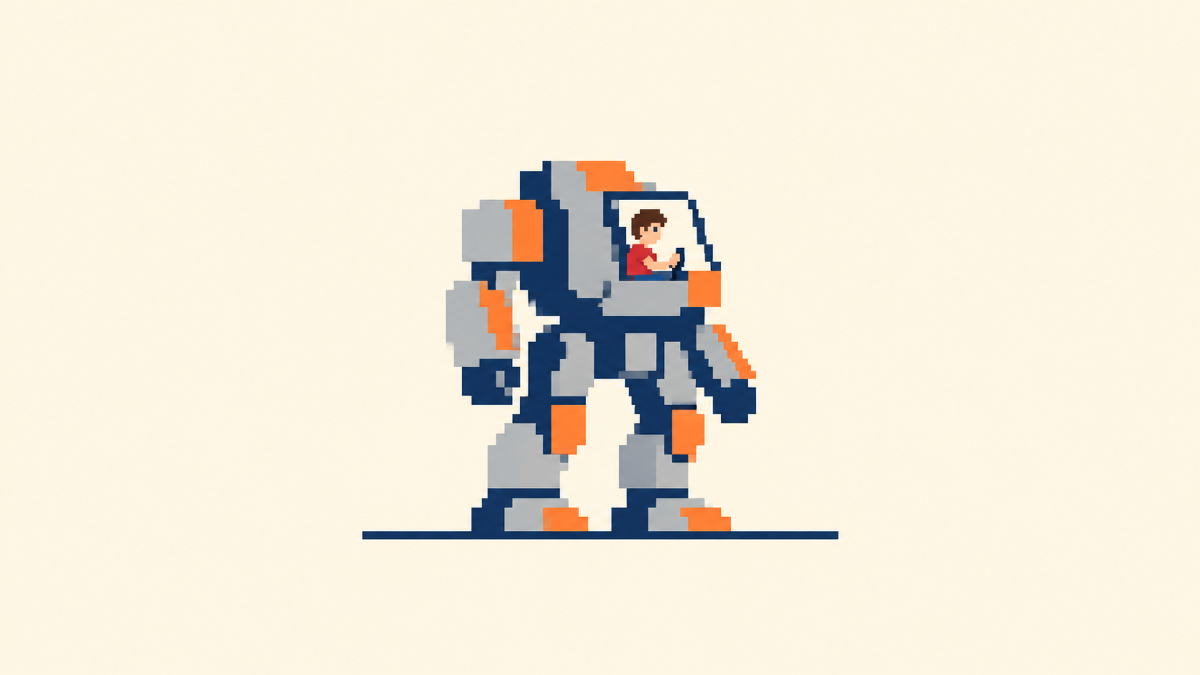
Some executives will read this as a headcount question. That’s the reading I’d argue with hardest. AI is a tool. It’s a mech suit for the people in a studio, letting a team move faster, hit harder, and cover more ground than it could on foot. Nobody mistakes the suit for the pilot.
Tooling can turn out a hundred versions of an asset. Knowing which one makes a player laugh is still a human job.
The better outcome is a ten-person team being able to attempt the kind of game that previously required forty, or a forty-person studio being able to build something that was previously out of reach. After years of redundancies, a blanket position on AI hits hardest at studios with the fewest resources. A large publisher can throw more people at a production problem. A small studio can’t.
Gaming won’t settle this debate by deciding whether AI belongs in development. That question is becoming less useful as adoption grows. Players will settle it by deciding which uses they find acceptable, and they will make that call about a specific game they already like, on a storefront, in the middle of a release week. Not on a panel.
The industry has a narrow window to define those boundaries while the conversation is still theoretical. Studios, platforms, and players need clearer distinctions around consent, disclosure, and acceptable production use before commercial success starts defining those boundaries for them. Once the first genuinely great AI-heavy game is sitting at the top of the charts, those distinctions will be much harder to draw in the middle of a hit.
By Adam Smart is the Global Director of Product – Gaming at AppsFlyer. He has worked in technical, product and growth roles in the gaming industry for over 10 years, with extensive experience in user acquisition, retention, and monetization.
Editor’s note: The opinions in this story are those of the author and not necessarily those of GamesBeat.