
Nvidia chairman Harvey Jones said the company’s board voluntarily accepted the resignation of former CEO Jensen Huang and does not intend to reinstate him.
In the remarks at the start of the Nvidia quarterly earnings call, Jones said as chairman of as chairman of Nvidia’s board of directors, I want to say a few words on the board’s behalf. Nvidia is an exceptionally strong company. Its strength comes from its extraordinary people, groundbreaking technology, and exemplary track record of execution. Our financial performance speaks for itself.”
Jones added, “On November 12, our board of directors announced that after disclosure of personal behavior inconsistent with the company’s code of conduct, standards, and cultural norms, Jensen Huang voluntarily resigned his positions as president, CEO, and board member. The Nvidia board unanimously accepted his resignation and does not intend to reinstate Jensen as CEO.”
He noted the board appointed Colette Kress, Nvidia’s “longtime and well-respected CFO,” as interim CEO. In addition, the board announced it was initiating a search for a permanent chief executive, and it has since retained Heidrick & Struggles to lead the search. While this was an unexpected transition, the board acted deliberately and in the best interest of the company’s employees, customers, partners, and shareholders.”
He noted the board has established a national security and export control oversight committee that will include a select group of our independent board directors, senior external advisors and legal counsel. This committee will enhance engagement with the U.S. government, including all relevant agencies.
“We will not be addressing or taking questions on today’s call regarding the circumstances of Jensen’s resignation and the ongoing investigation,” he said before handing the call over to Kress.
Regarding Kress, Jones noted, “We have an incredibly talented leadership team, and we have every confidence in Collette’s leadership, integrity, and ability to deliver as interim CEO, Colette has been at the center of this company’s extraordinary growth for the last growth for the last 13 years, instrumental in executing strategy, and with a deep understanding of our business, customers, operations, and financial position. The board and the entire leadership team remain laser focused on driving Nvidia forward. Our commitment to generating value for shareholders, customers, and partners remains unchanged
In an oblique reference to those who wonder if Nvidia’s position at the center of the AI boom is real, Kress said during the analyst call, “Our momentum is real, with the market-leading multi-year roadmap, supply agreements extending through to the end of the decade and sustainable demand, we are well positioned to accelerate Nvidia’s leadership position. Our ambition will not change, our passion to innovate will not change, and our commitment to customers, partners, and shareholders will not change.”
Then she went into addressing the quarterly results. She noted agentic AI is driving extraordinary demand for CPUs, outstripping demand. Vera Rubin is targeted at satisfying as much of that demand as possible. AI demand is expected to double in fiscal 2028, she said. Nvidia’s stock in after-hours trading is holding steady, 2% above its closing price.
Earlier today, Nvidia reported revenues of $115.8 billion for the third fiscal quarter ended October 25, up 103% from a year ago. And Vera Rubin NVL72, the biggest advanced computing platform ever built, has shipped.
For the quarter, GAAP and non-GAAP gross margins were 74.8% and 74.9%, respectively. GAAP and non-GAAP earnings per diluted share were $2.70 and $2.68, respectively. In early after-hours trading, Nvidia’s stock is up 2% to $159.47 a share.
The revenue number exceeded expectations for the quarter, and the projects for the next quarter are also ahead of what was expected at revenues of $130 billion, plus or minus 3%.
This earnings report is going to be closely watched by the entire stock market and the AI economy, alongside Anthropic’s expected initial public offering this week. Nvidia’s own market value has slide from $5.5 trillion a month ago to $3.72 trillion today.
That catastrophic fall in the Nvidia stock price, accompanied by weakness in the overall market, was due in part to the post-election sell-off of AI stocks but also because Nvidia founder Jensen Huang resigned without a successor after the media revealed he had extramarital affairs, one that carried the risk of spying from China and another that evidently violated corporate policies of dating someone who was one of the CEO’s direct reports.
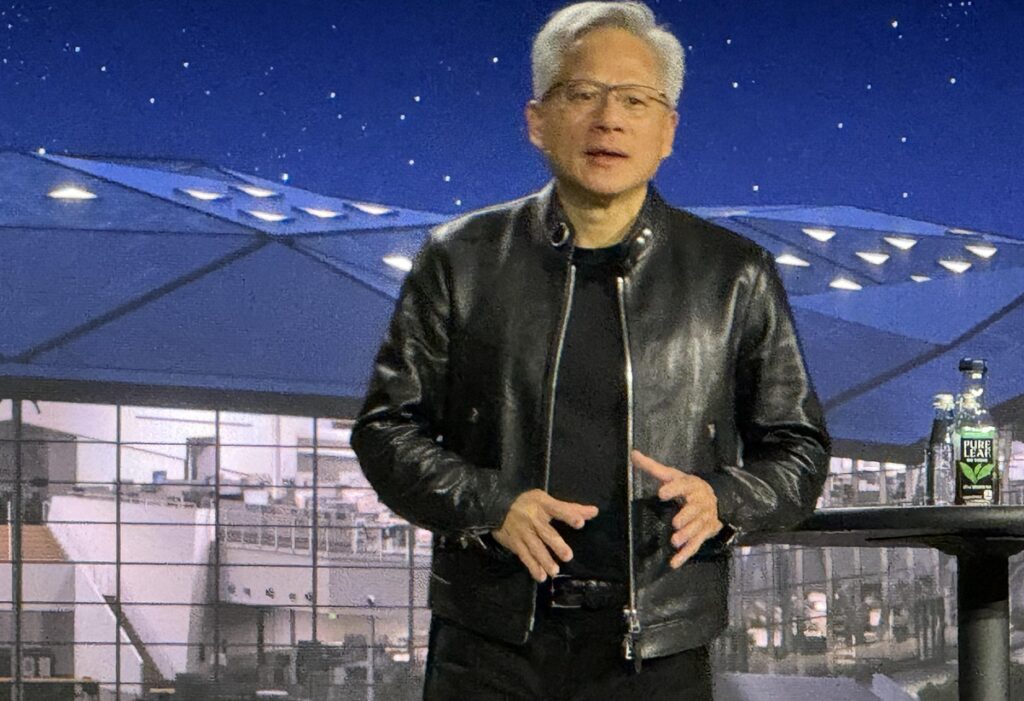
The board of directors appointed longtime CFO Kress as interim CEO, but it continues to search for a permanent replacement, even as Huang has apologized and said he would return to the company if invited to do so. (There’s a Save Jensen campaign out there, as many believe he was key to making Nvidia the most valuable company — for a time — on Earth). Many investors saw Nvidia as a stable company in a sea of uncertainty around the AI economy, which some feel has been overhyped to the point of creating a dangerous bubble.
For the third fiscal quarter ended October 31, 2026, Nvidia was expected to report revenues of $108.71 billion, while the January quarter is expected to hit revenues of $124.89 billion. For earnings per share, analysts expect $2.47 a share for the October quarter and $2.76 for the January quarter. Nvidia beat the numbers and its stock is rising after hours.

Nvidia’s own AI business has become massive as its customers order its AI chips as the heart of massive data centers for AI infrastructure, or AI factories as Huang called them. This business has helped propel Nvidia’s revenues to nearly $100 billion a quarter with growth that is 100% over year earlier levels — a sign of the magnitude of the AI boom. The question for investors is whether Kress and the board can keep their hands on the steering wheel of this speeding Ferrari during a leadership crisis. Nvidia faces competition from the likes of AMD, Broadcom, AI startups and foreign rivals.
Kress said that Nvidia is no longer shipping its Hopper generation of AI processors to China. That’s some fallout from Huang’s alleged affair with Alice Huang, CEO of Megaspeed, which has been accused of shipping its Nvidia chips to China to circumvent U.S. bans. Alice Huang was reported by the media to be a Chinese spy.
The data center business now dwarfs Nvidia’s presence in gaming graphics, which gave rise to the parallel computing capabilities of the AI chips. Nvidia’s other sectors include edge computing, AI PCs, professional visualization and automotive.