
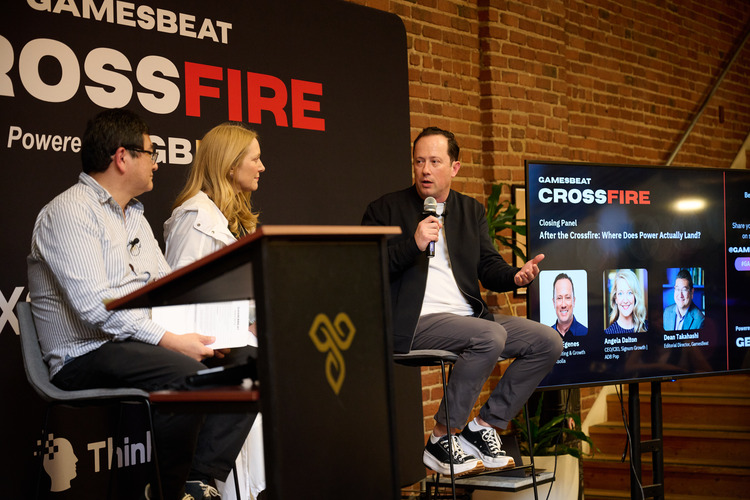
The biggest debates in the game industry rarely end when the panel does. They spark a bigger conversation about who actually holds influence as the business of games continues to evolve.
That question framed the closing discussion at GamesBeat’s Crossfire event, where GamesBeat editorial director Dean Takahashi joined Angela Dalton, CEO and CIO of Signum Growth and AD8 Pop, and Berkley Egenes, Chief Marketing and Growth Officer at Xsolla. The session, titled After the Crossfire: Where Does Power Actually Land?, reflected on a day of conversations about regulation, platforms, and the future of gaming while examining how those forces are reshaping the balance between developers, governments, platforms, and players.
Across the conversation, one idea kept emerging. Power in gaming is spreading across a wider ecosystem rather than concentrating in a single place.
Regulation could open new opportunities
One of the biggest themes throughout the day’s debates was regulation and the role governments will play in shaping the next phase of the industry. Policy changes over the past year, particularly in mobile, have begun shifting how developers operate, including external payment links on Apple’s App Store and alternative billing on Google Play.
“Last year, particularly in the mobile space, was the kind of reckoning of regulation policy changes,” Egenes said. “But opening up the opportunity for all of us as developers to be able to take back control.”
Rather than limiting the industry, thoughtful regulation could expand the ways developers distribute and monetize their games while building stronger relationships with players. Regulation could increase in the near future, especially around user safety and age verification, but it’s likely the industry will develop solutions without fundamentally limiting access.
“I believe there will be technology that can verify users,” Dalton said. “That’s more likely than a scenario where anyone under 18 is simply not allowed on the internet.”
Age verification remains a major challenge
Governments are increasingly focused on protecting younger users online, but implementing safeguards without creating new privacy concerns remains a challenge. Current approaches such as self verification have proven unreliable, pushing regulators and technology companies to search for more effective systems.
“I think there are technologies out there that will allow you to verify whether or not users are over 18 or under 18 without forcing them to reveal [personally identifiable information],” Dalton said. “And those are the ones I think that are going to win.”
Collaboration across the industry will be necessary as companies navigate evolving policies and technical solutions. Working together is essential, as according to Egenes it’s “not an easy landscape to navigate. ”
Games continue to compete for attention
Beyond regulation, the panel also returned to a broader industry challenge: the ongoing competition for players’ attention. Games increasingly compete not just with other titles but with every form of digital entertainment, from social media to video streaming.
“You’re delivering a great experience,” Egenes said. “You’re delivering a way that people can communicate. People connect online into the games and the experience.”
The creative potential of gaming platforms that emphasize user-generated content was also highlighted. These platforms allow players to experiment with design, coding, and storytelling while building communities around shared projects.
“My older son is a software developer now, and he started in Minecraft,” Dalton said. “I hope they’re becoming addicted to learning and creating.”
A broader gaming audience
While gaming has captured the attention of a huge portion of the population, many players are still hesitant to refer to themselves as gamers. The label has negative connotations.
“Even my mom is playing games on her phone,” Dalton said, adding that her mom doesn’t like the term. “And I said, ‘Oh, you’re a gamer.’”
The growth of platforms like Roblox and other social gaming spaces has helped broaden the audience even further, mixing creativity, social interaction, and entertainment in ways that attract players of all ages. The traditional image of a gamer no longer reflects the reality of the modern audience.
“The gamer profile really doesn’t exist anymore,” Egenes said. “The diversity has become more inclusive. It’s more female than it has ever been before in the industry.”This conversation capped a day of wide-ranging debates at GamesBeat Crossfire, including discussions about the importance of platform partnerships, the rise of UGC and the growing urgency around AI adoption. The throughline across those conversations was clear: the forces shaping the future of gaming are becoming more interconnected, and influence is not concentrated in any single corner of the industry.
This post is partner content paid for by the sponsor and created in collaboration with GamesBeat Studio—our custom platform for branded thought leadership. It was produced independently of the GamesBeat editorial team. For more information, contact [email protected]