
OpenAge is a global initiative led by k-ID that launched today at the Family Online Safety Institute (FOSI) Annual Conference.
OpenAge brings together a coalition of technology leaders, policymakers, and digital safety advocates to create the first open, privacy-preserving standard for verifying users’ ages across the internet.
At the heart of the initiative is AgeKey, a reusable digital age credential that aims to make verifying one’s age online as seamless and secure as logging in with a passkey. Built on FIDO Alliance and W3C standards, AgeKey lets users confirm their age once and then reuse that proof across multiple apps and websites without repeatedly sharing personal information. The goal is to strike a balance between protecting children online and preserving privacy and anonymity for all users.
OpenAge’s independent advisory board includes leading figures in online safety and privacy: Baroness Joanna Shields, founder of WeProtect; Stephan Balkam, chief executive officer of the Family Online Safety Institute (FOSI); Bojana Bellamy, president of the Centre for Information Policy Leadership; and David Wright CBE, chief executive officer of SWGfL. Together, they’ll guide the initiative’s development to ensure interoperability, transparency and compliance with global regulatory frameworks.
“Having worked at the forefront of technology and government, I’ve seen the power of
innovation and the responsibility it brings,” Baroness Joanna Shields said in a prepared statement. “The OpenAge initiative proves that safety and privacy can move forward together. For the first time, we have a standard for age assurance that is simple, reusable, and privacy-first. This isn’t just technology, it’s proof we can build a digital world grounded in trust, dignity, and protection for the next generation.”
To bring OpenAge to life, k-ID acquired Opale, a French company behind AgeKey’s original technology. Opale’s system is based on a “double-blind” design framework that prevents any tracking or traceability of where an AgeKey is used.
Instead of storing personal data, the system simply returns a yes/no result confirming whether a user meets a required age threshold, offering a frictionless and anonymous way to meet regulatory obligations.
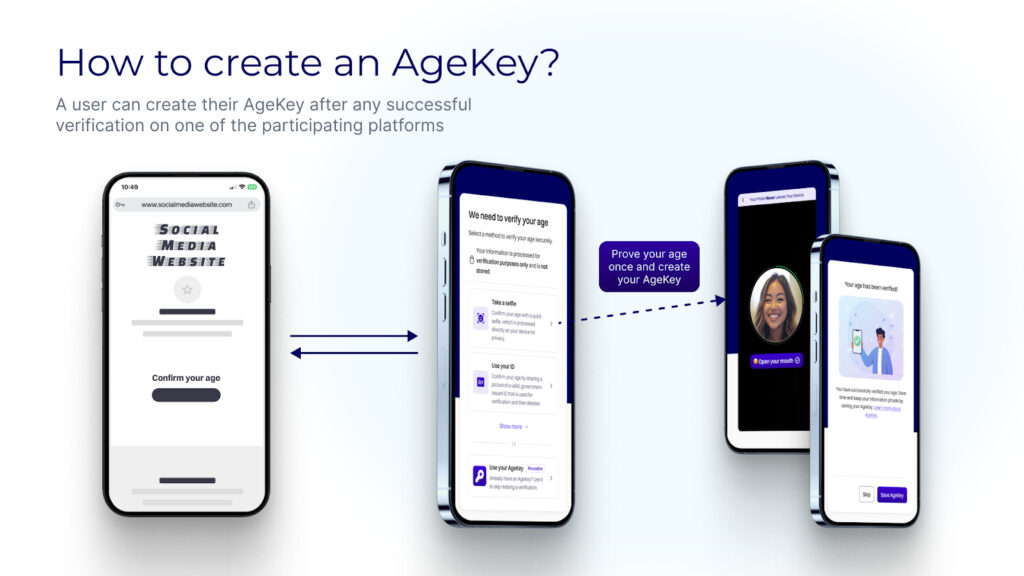
AgeKey supports verification through multiple trusted methods, including digital IDs stored in Apple, Google, or Samsung Wallets, government-ID scans, bank-grade credentials such as ConnectID, and certified facial age estimation. By the end of 2026, roughly 130 million US citizens are expected to have access to digital IDs, paving the way for widespread adoption of AgeKey and similar privacy-preserving verification solutions.
Online safety for children is a major industry concern and a driver behind initiatives like OpenAge. For example, Roblox, one of the world’s largest children-oriented gaming platforms, offers a sobering case study.
As platforms evolve faster than regulatory guardrails, initiatives like OpenAge could ideally provide the kind of industry-wide standardisation that improves safety at scale. With children increasingly immersed in social gaming and virtual worlds, age verification is no longer just a compliance checkbox, it’s a core component of trusted, child-safe digital ecosystems.
Since its early testing phase, AgeKey has already been used more than five million times, reportedly reducing user-verification time by over 95% compared to traditional methods. It’s already integrated into k-ID’s technology stack, with full rollouts planned for major platforms in Australia and Brazil this December to align with new online-safety regulations.
With OpenAge, k-ID hopes to streamline how the internet approaches safety and privacy and proving that protecting children online doesn’t have to come at the cost of user freedom.