
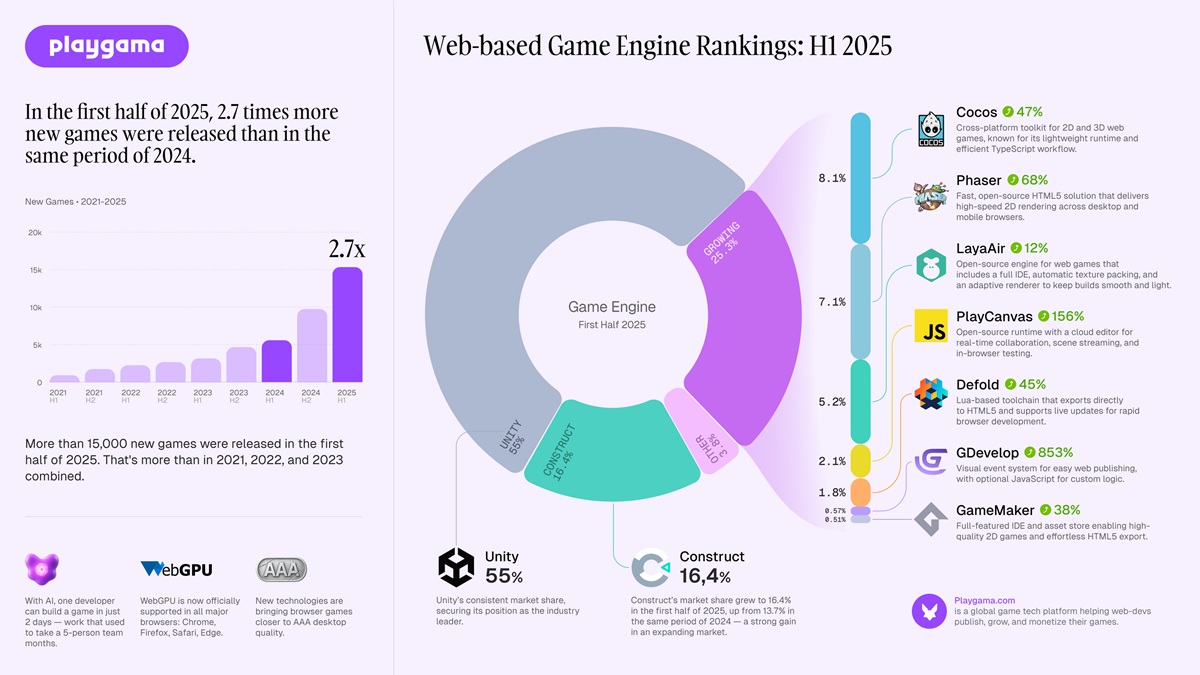
While the global games industry faces stagnation, one segment is breaking the curve: web gaming.
According to market research released by web-gaming platform Playgama, the browser games market has grown 2.7 times over the past year. And it turns out that Unity is the No. 1 game engine for web games, with more than half the market.
Web gaming has also grown 4.9 times more than in the first half of 2023. H1 2023. In Q2 2025 alone, over 15,000+ new games were released.
Dubai-based Playgama.com set out to explore which engines are currently in highest demand, how frequently games are published using different technologies, and what development stacks are shaping the future of web gaming. The analysis is based on data from public sources.
The research shows that Unity remains the market leader, powering 55% of all new web games in Q2 2025. Over the past two years, the company has significantly strengthened its dominance in web game development. Unity’s adoption of WebGPU starting with Unity 6 (released in 2024) is already enabling smoother and higher-fidelity experiences directly in the browser.
Combined with more AI-powered tooling and cross-platform frameworks, the entire stack of web game development is becoming faster, cheaper, and more scalable. Unreal Engine doesn’t show up in the standings as its focus is on more high-end games.
However, Unity’s dominance is increasingly challenged by lighter, more accessible engines such as Construct (16.5%), Cocos (8.1%), Phaser (7.1%), and LayaAir (5.3%).
Construct, the no-code engine that’s particularly popular among solo developers, saw one of the most significant gains — rising from 12% market share in early 2024 to 15% in 2025. By this engine games can be built using a visual editor and block-based logic, which makes Construct easy to use for those who make their first steps in web-gaming.
Phaser is growing alongside the market and carving out its own niche. It stands out for its high performance and, as an open-source solution with an active community, is steadily securing its position in the market.
Engines previously dominant in regional markets, such as Cocos and LayaAir, lost positions over time. While still used for specific use cases, their share declined due to a lack of global support infrastructure and limited access to modern monetization SDKs.
At the same time, a competitive landscape is forming among a plethora of engines, including GDevelop, GODOT, libGDX, Defold, PlayCanvas, GameMaker, and Scratch, each competing for the attention of indie developers and studios entering the space.
Kachmar said the growing interest in web games is driven by the oversaturation of the mobile, PC, and console markets. Competition for traffic in mobile apps has reached its peak — ad auctions are overheated, and advertisers are fighting for ROI with time horizons of one to two years. Meanwhile, the production standards for triple-A titles have become so high that building a major PC or console game now costs a fortune.
“Web games are becoming the new black: the processing power of mobile devices and tablets has nearly caught up with that of average laptops, and new technologies now make it possible to run fully-fledged 3D games directly in the browser,” said Kachmar. “Add AI to the mix, and by 2030, over half of all games could be developed on cross-platform engines with instant web export as default. In this future, every screen becomes a gaming device, and distribution is no longer bound to app stores. The future belongs to cross platform game engines, they’re no longer just a niche for browser titles.”
AI game dev acceleration
As part of the research, the company highlights that game development with AI is accelerating by a factor of five or more. Tasks like documentation, refactoring, and bug fixing are increasingly handled through AI tools.
Internal client surveys point to the growing role of AI in day-to-day development processes. In addition, an analysis of the qualifications of new teams entering the web gaming space shows that more experienced studios are now shifting to the web, driven by strong revenue potential.
With new technologies bringing browser games closer to triple-A desktop quality, these teams see not only technical challenges worth pursuing but also clear economic advantages in building for the web.
According to a16z’s State of AI in Games survey, most studios have yet to adopt AI in production, but expectations are shifting. As adoption accelerates, tools that enable rapid iteration and web-native deployment will only gain ground.
Spreading games around the world
Part of the mission of game engines is to make higher quality games run anywhere using the web. Playgama is inspired at how more than half the traffic to the New York Times web site comes from simple web games like Wordle, and that these web-based platforms never used to think of themselves as game destinations, Kachmar said.
“That’s a great story. Games are mostly everywhere. And I realized, if they would be everywhere, there should be a platform which helps to interconnect all these heterogeneous markets and developers who want their games to be everywhere,” Kachmar said.
“We are in a web game nexus right now. Developers integrate our SDK and then can publish to the web,” Kachmar said. “We are trying to help the devs they way that cinema distributors used to get movies into every single cinema.”
Web shops have also become fashionable now because the courts have reined in Apple in the U.S., where it’s now possible for game developers to escape Apple’s 30% app store fee by advertising inside Apple aps that the devs have lower prices on their own web shops elsewhere.
“We believe we could have triple-A games on HTML5 at some point,” Kachmar said.
Support companies like Playgama are helping developers with publishing matters such as localization, documentation and more, just like game engines are helping the devs with making their games for the web. One of the biggest areas of support needed is marketing to help generate enough demand for web-based games.
With web publishing, Playgama is helping companies distribute their games around the world — to perhaps 150 countries — because the web is an easy destination for publishing games.
0:13:281:11:07
1x
All transcriptions completed