
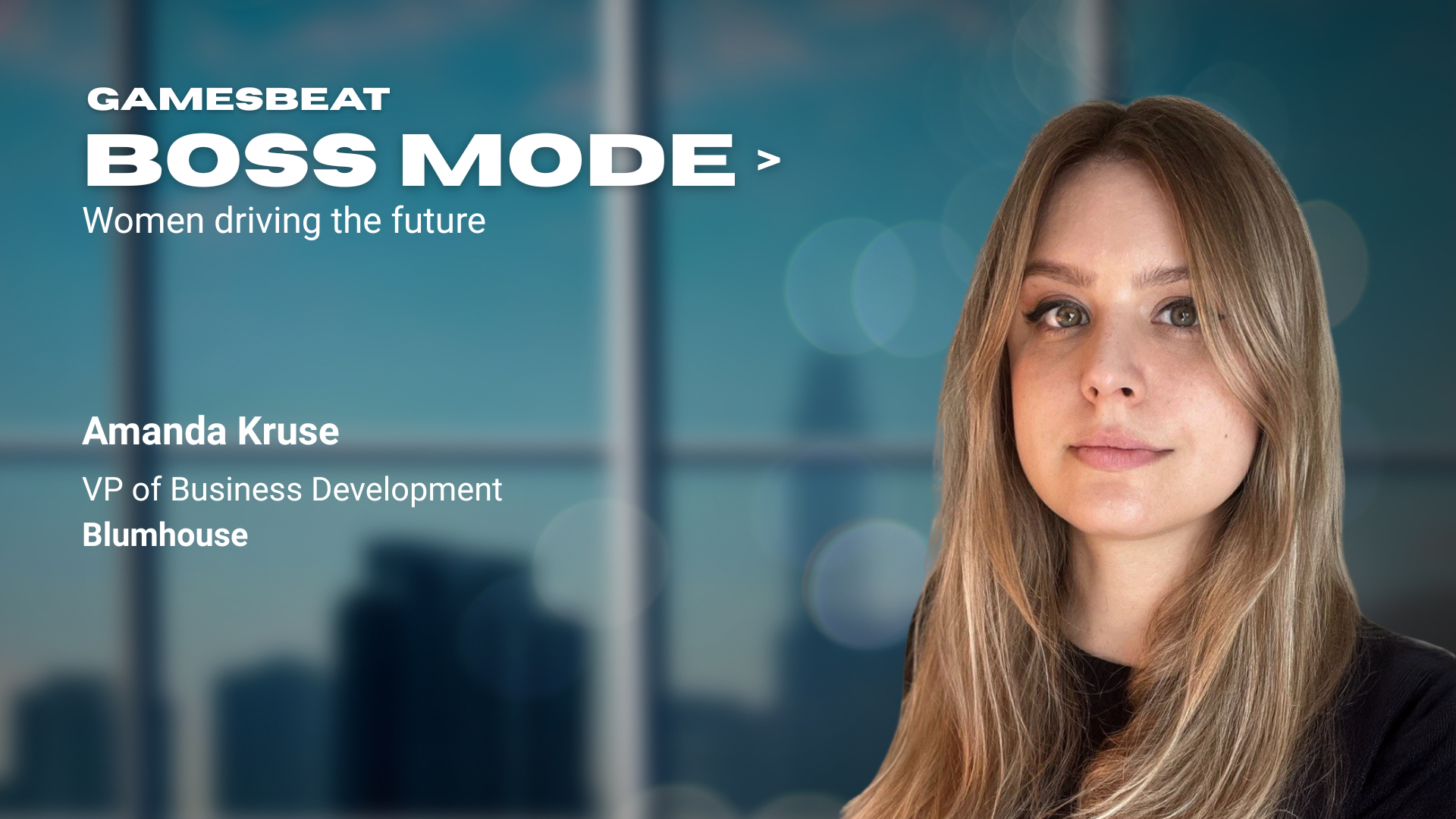
Video games and film — my two great loves, and two industries that are currently leaning into each other more than ever before. When I first met Amanda Kruse, VP of business development for Blumhouse Games, I couldn’t wait to pick her brain on those two things. Kruse came up at Lionsgate and worked at Devolver Digital, so she’s been in both industries separately. Now, with her new role, she’s in both worlds at once.
Kruse was one of my panelists at the Women in Gaming Breakfast at our most recent GamesBeat Summit, where she, alongside my other panelists, spoke at length about leadership and how to develop yourself and your skills. This was a great discussion to have, as it gave us a glimpse of the importance of the self in being a leader.
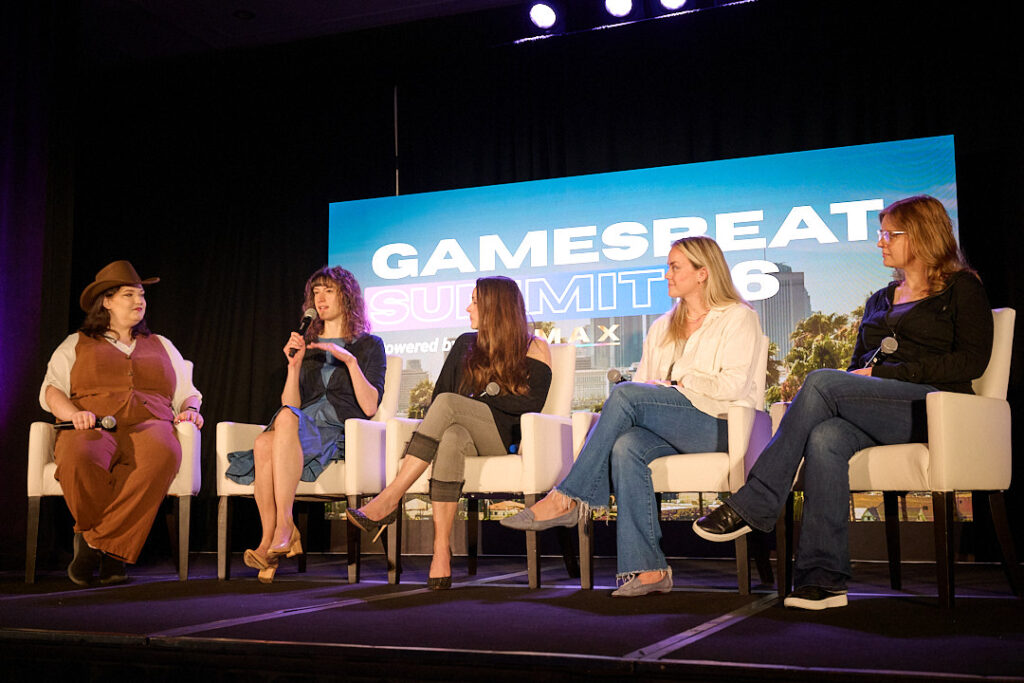
I got the chance to catch up with Kruse after GamesBeat Summit, to ask her some questions I didn’t get the chance to before. Below is an edited transcript of our interview.
GamesBeat: Could we start the interview talking about your background, professionally? I know we talked a lot before GamesBeat Summit, but I don’t think we ever discussed your history with the games industry?
Amanda Kruse: My background has kind of woven between film, TV and games, and I think sort of continues to do so. I started as an aspiring agent at CAA, and very quickly realized I did not want to do that. I was lucky to work for a partner there, and she was keen to promote me. I think that would have been a cool trajectory. But representation is a spooky beast, and it’s not for the faint of heart.
So I went to go work for Lionsgate — that’s where I worked my way up in the film division. I was a genre executive there, which meant that I worked on tentpoles like The Hunger Games and the last Twilight films. At the time, we were well-known for YA, so I did the Divergent series and anything else we could put together. I chased a lot of things that I inevitably lost against Blumhouse. We were neck-and-neck with Jason [Blum, CEO of Blumhouse] to get the Five Nights at Freddy’s franchise, and it went to Jason — totally makes sense!
I came up during a period at Lionsgate where The Hunger Games was ending, and John Wick had yet to take off. So we were wondering what was going to keep the lights on. And as the resident nerd, that put me in a senior place very young. If there was a comic book thing or a video game thing, they said, “Amanda knows about that.” So even if I wasn’t the main decision-maker, I was at all of these tables, which was super, super cool.
Still, I was struggling to get promoted because there were a lot of junior execs at Lionsgate, and my promotions would trigger a lot of other promotions. They said, “Well, what if we made you a split exec between games and film?” And I said, “Absolutely!” I got a VP title, and I started building the games business, which was really, really cool! But it was crazy. On the one end of my life, I was doing EVP work in the games industry, putting deals together and things like that. Then, on the other end of my life, I was still a relatively junior film executive.
I chose games in the end because I was having more fun and I was traveling the world. And frankly, as much as I’m a film lover at heart; from a community standpoint, there’s an optimism and love for the work in games that is more persistent, in my experience.
GamesBeat: How did you go from Lionsgate to Devolver? What was the trajectory there?
Kruse: I left to become one of the partners at a company called Hive Mind, and Hive Mind is most well-known for being the producers of The Expanse (which they got on the air before me) and then The Witcher (which is something that I was there for). The whole idea of it was that it was a very genre-focused, largely tv-based company.
If there was a comic book thing or a video game thing, they said, “Amanda knows about that.” So even if I wasn’t the main decision-maker, I was at all of these tables, which was super, super cool.
I think [The Witcher] was one of the things that created the sort of trend we’re on now, where video game adaptations are cool. Whenever I pushed those before, it was not cool.
[Here Kruse mentioned that she was part of the initial team that worked on the Borderlands film, but disavows it completely. This is not relevant to the interview, but I thought everyone should know, for the sake of my own amusement, that she said this on the record.]
GamesBeat: That’s something that fascinates me, is how a film can go from the pitch that’s greenlit to theaters.
Kruse: I know people say that about games, too, but I will tell you that every game I’ve ever been part of shipping has looked a lot more like the product I signed than every movie I’ve ever been part signing. The end product of most movies is very different.
GamesBeat: I had intended to ask you how games are different from film, and you’ve already sort of answered that. I think this is stuff that people in film generally don’t think about if they want to transition into games. I don’t think they know what to do.
Kruse: Oh, I lost my mind. The fastest a film ever goes is five years, and anybody who tells you it can go faster than that is probably lying to you. The fastest a TV show ever goes is three, right? Maybe somebody can counter me on this and come up with a couple of examples otherwise, but it will be the exception and not the rule.
For me, the thing that was so intoxicating about going into games was, you saw the pitch, you signed it and it was going. When you work in the movie business, you saw the pitch, you sign it, and then you go through this crazy cycle of a bajillion drafts, and then you do a bajillion different director attachments or cast attachments or whatever else.
GamesBeat: So getting back to video games, what can you tell me about your current position? What does your current day-to-day look like?
Kruse: I head up Blumhouse’s games division, and I’m having the best time. Blumhouse is such a cool place to work! I loved being at Devolver, but I’m really pumped to be back in an ecosystem where there are risk-taking experts in everything. I think that’s more akin to the ecosystem I had at Lionsgate, where I was very collaborative with the film and television groups.
When I worked at Devolver, I also headed up film and TV, in addition to heading up the label Big Fan. So cool that they let me do that! Everyone was so supportive, but it’s also exhausting to be the guy on all of it. You know what I mean? You could do anything you want, you just have to actually do all of it. That’s a lot, right?
I’m kind of carving our next path forward in chapter two of us being a publisher. We founded in 2023, and I think we’ve learned a lot. At our roots, Blumhouse is an indie film company, and the model — and this is not a secret I’m exposing here — was to take a lot of interesting bets on auteur creators. A big part of what I want to do with the originals is get back to that. We signed a lot of things with established creators in round one. That’s very cool, but it’s not totally what I want to do with round two. I’m interested in that younger set of creators coming into games, doing smaller and interesting things.
On the other side of my business, we have a really interesting relationship with our licenses that is not normal. Most production companies in Hollywood do not control the licensing for their IP, and we don’t own the copyright to our IP. Our biggest relationship is with Universal. We have a long-standing, awesome deal with them, and they do most of our film and television shows. But if you look at who owns the copyright for The Purge or M3gan, it’s definitely them.
What I’ve inherited is that we control the licensing rights for the next several years. If you’re going to sign a M3gan game, you’re signing it with me. If you’re going to sign a Purge game, you’re signing with me. That’s a very unique place to be because, as a production company, you don’t have those rights. That’s a different side of my business where I’m keen to get a little more flexible and weird.
Maybe I’ll make a $5 million M3gan game, or maybe I’ll call up someone like Saber [Interactive] and say, “Do you want to make it outside the scope of what I would typically do?” I think that flexibility is really cool, and it’s cool to work here because there are no rules. The expectation is to make a bunch of cool stuff with the knowledge that it will hit eventually.
We talk about the ones that work, but we don’t talk about the dozens that don’t. So I’m excited to apply that philosophy to what I signed in the game side of things, and to try some riskier stuff, and we’ve signed up a handful of yet-to-be-announced games that I’m super pumped about. Some of them are a little more narrative-forward, which I think is what people expect, but a lot of them are very gameplay-forward, because I do want to make games, not pastiches of movies.
GamesBeat: Side note, but I’m really excited for Grave Seasons!
Kruse: Oh my god, yeah!
GamesBeat: That’s such a pitch: What if Stardew Valley but murder mystery?
Kruse: That’s exactly it! That’s why I feel like they fit so well into the Venn diagram of my originals. They’ve all shipped a bunch of things, but as Perfect Garbage, they’ve only shipped one other thing. What they’ve pitched here is very ambitious and, done wrong, it’s a feathered fish. But done right, which I believe it has been (because I’m playing it and I’m loving it), It’s really cool and awesome and brings something really interesting.
It attracts people who wouldn’t organically pick up a farming game [Editor’s note: Pun intended, maybe?]. And for the farming people, I feel strongly that we have satisfied that while also bringing them horror, which can be pretty divisive in a way that they’ll still be keen to explore and experience.
GamesBeat: What’s a project you’ve worked on, or contributed to, that you consider to be a big win? It doesn’t have to be at Blumhouse specifically.
Kruse: I think being part of Power Rangers. I’ve made three Power Rangers games. It’s been an incredible gift. I’ve never met a fandom more fervent and dedicated than those who love Power Rangers, nor have I been so embraced by a creator community in my entire career, and it’s got the silliest, goofiest, deepest lore of anything.
It was an incredible thing to come into a situation where a community was starving for a good game, and I think it let me to my path of being a deep champion of licensed games, which is something I think I’m going to continue my whole life. Coming up in film, film is a medium of adaptation, and that’s not a dirty word. One of the biggest shockers coming into games was this mindset of, “Oh, licensed games, gross.” There was this expectation that it was going to be bad from the jump.
I just so wildly, completely disagree with that. Not just because we’ve seen cool success stories like 007: First Light. But I think we’ve finally divorced it from being an ancillary product to a movie or a TV show, so now it’s time to figure out and shine.
GamesBeat: How do you measure success in your position?
Kruse: It’s going to be a really corny answer. I measure success by how happy my collaborative relationships are with my developers. Making anything, a game or otherwise, is always a really brutal process that’s going to come with a lot of pitfalls, no matter how smart and competent and well-intentioned everyone is. It’s going to come with conflicts and roadblocks and all that stuff. For me, I measure it by how happy my team is to keep at it, and the fact that I have yet to find someone that doesn’t want to repeat business with me after the fact, even if things didn’t go as we hoped.
Making anything, a game or otherwise, is always a really brutal process that’s going to come with a lot of pitfalls, no matter how smart and competent and well-intentioned everyone is.
GamesBeat: I always close with: What’s your Boss Move?
Kruse: My Boss Move was fully leaving film. Yes, I’ve had the privilege of going back, right? But I didn’t know that at the time I cut the tether from being a joint exec between film and games at Lionsgate and chose to be a full-time games executive. I did not know I could go back, and it was very scary. A lot of people in film treated me like I died!
But I think it defined my career, not just because I chose to go into games, but more importantly, it taught me not to tie my instincts too much to other people’s opinion because pretty much all of the best decisions I have made for myself have been things people have told me I cannot do, or I should not do. I think that choice defined me, if maybe not in the most obvious way in my career.
GamesBeat: What about your boss music?
Kruse: You know, when I’m working, I’m so corny, and I love ridiculous electronica stuff. But I will tell you, in the same way that I love that for when I’m working and doing contracts — no words, by the way. Words are the devil, in my mind for working music.
On the weekends, I’m a great lover of old blues music, and I think for that calmer part of the weekend, blues and bluegrass. Please, anyone who reads this, reach out to me. I have no bluegrass lovers in my life. I’m on an island of being a woman who loves bluegrass!
BOSS Mode: Women Driving the Future is a groundbreaking new series by GamesBeat, led by Rachel Kaser, that finally puts the spotlight where it belongs—on the women transforming the business of games, entertainment, and tech, and the industries it touches. It’s the B2B POV, where women leaders will provide critical business insights you need to make more informed decisions, and an inside look into how women leaders driving the future are navigating their business strategy.
From tech to healthcare, entertainment to retail, gaming is no longer a silo—it’s the connective tissue of the modern economy. And women are driving that evolution. In this ongoing series, we go beyond titles to showcase women whose influence is shaping the future of gaming and the industries orbiting it.
This isn’t a moment. This is a movement.
New chapter. New era. Welcome to BOSS Mode. Explore more BOSS Mode stories from GamesBeat.