
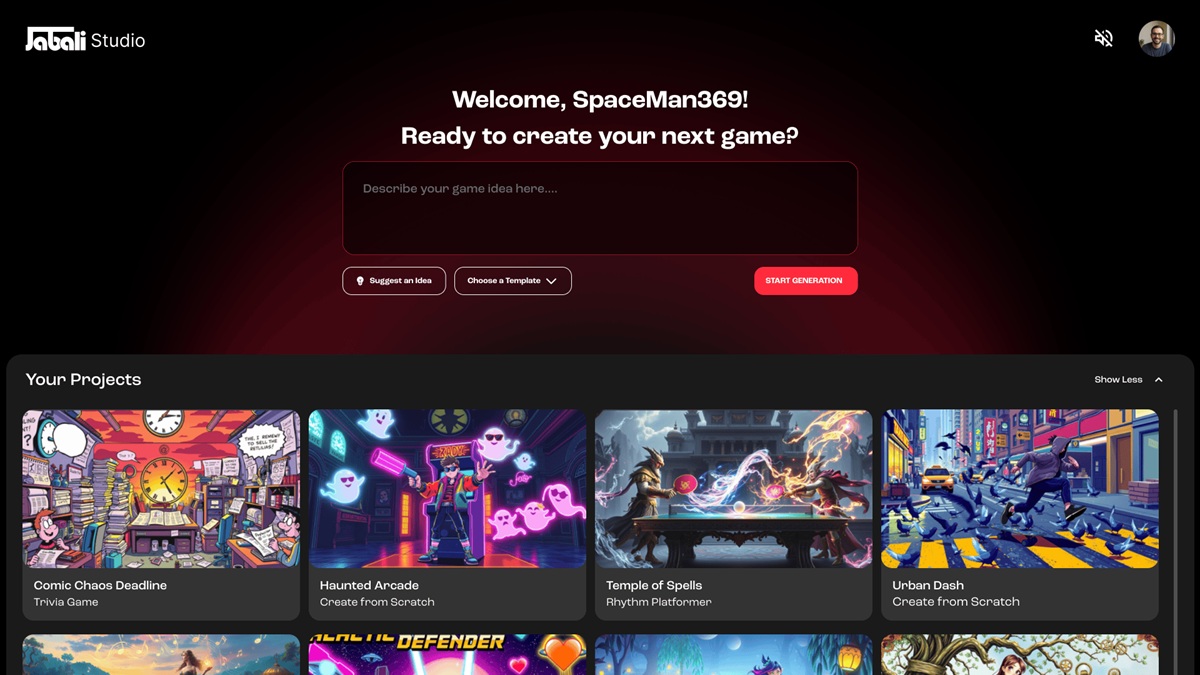
Jabali.ai, an AI-powered game technology company, has launched early access for Jabali Studio, which aims to democratize game creation.
The company calls Jabali Studio a next-generation platform that allows anyone to design, build, and publish 2D and 3D games with complete creative freedom. The product aims to empower creators, designers, and gamers to build and share games without the need for complex programming skills, accelerating innovation across the gaming industry, said Vatsal Bhardwaj, CEO of Jabali.ai, in an exclusive interview with GamesBeat.
“We are making a platform to democratize game creation and game publishing,” Bhardwaj said. “I believe video games are the most powerful way to tell a story, to express yourself.”
Origins

And so the problem of making game creation as easy as sending a text message or taking a photo or creating a TikTok reel is something he’s thought about for a long time. When he saw ChatGPT 2, he realized it could be done. That’s when he left his previous job.
Before starting Jabali.ai in 2022, Bhardwaj had a long career in games. In his previous gaming role, he was chief product officer at Skillz. Before that, he led the game tech team at Amazon Web Services. One of his teams delivered Gamelift, and another worked on Lumberyard, a game engine that was eventually open sourced with the Linux Foundation. At Amazon, he was servicing large enterprise customers. He also worked at Facebook on the team that launched Oculus. He also worked at Storm8 and Zynga.
“I love video games, and I love them both as a player as well as a creator of tools that enable other people to make video games,” Bhardwaj said.
It took a while to figure out how to make the dream into a reality. His first instinct was to go after big companies like Electronic Arts. But he realized large studios moved slowly and they were conservative when it came to adopting something as disruptive as generative AI. On top of that, the rate of progress was so fast that building an enterprise company that served slow-moving game companies didn’t make sense.
“We focused onconsumers and individual game designers and that’s when we started. The company raised money at the end of 2023, taking in a $5 million seed round from investors like Sony Innovation Fund. The team started with about five people in the San Francisco area and it expanded in North Carolina, as Bhardwaj went to Duke University and still knew people who could help recruit people there. The team grew to eight.
There are contracts who help, but a very small team was able to create a light version of the product early this summer.
“We had an organic, phenomenal receptions with thousands of users, thousands of games built by creators, from those learnings we went on to build Jabali Studio,” Bhardwaj said.
How it works
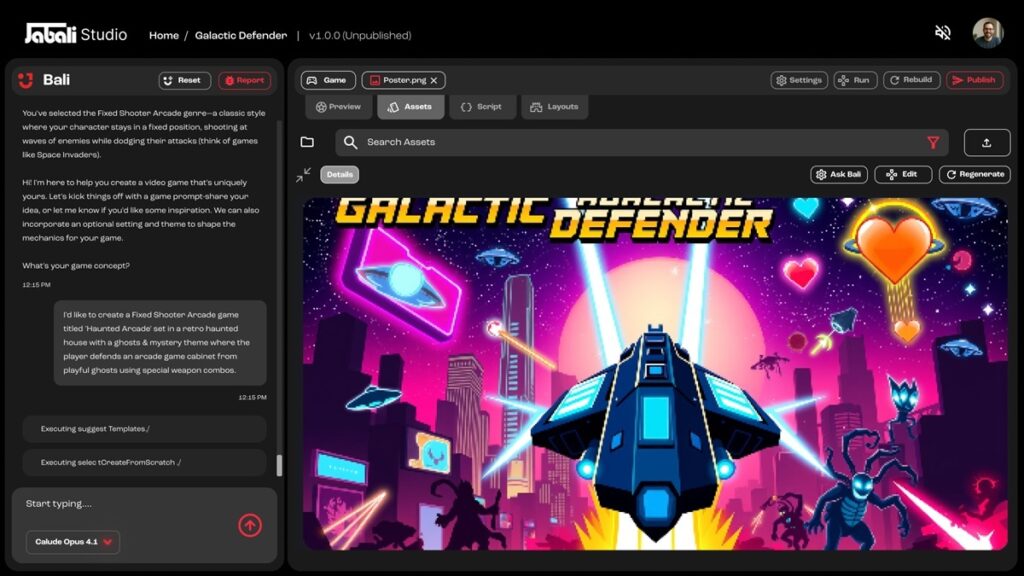
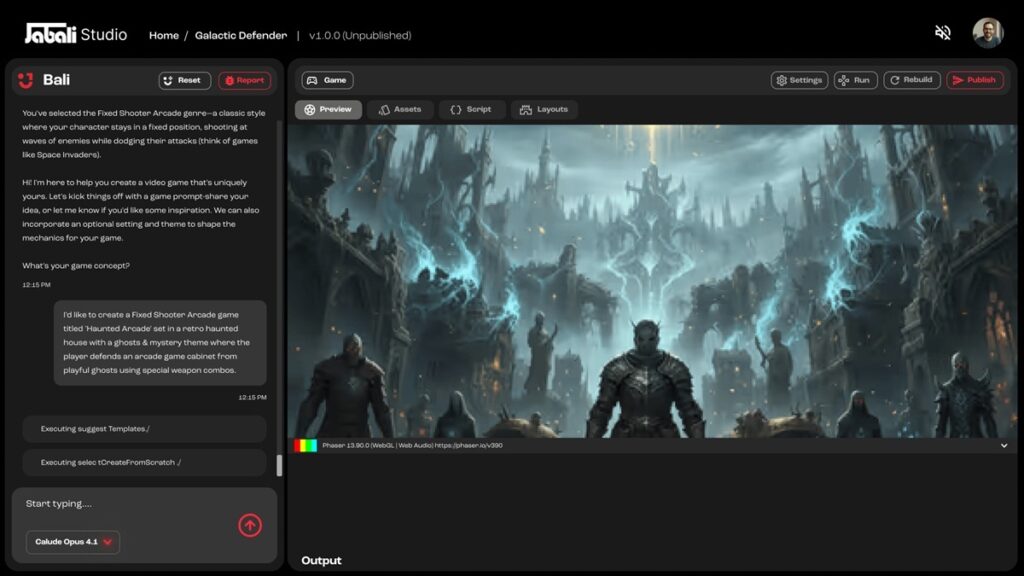
Conceptualized and developed by Jabali.ai, the platform represents the company’s mission to democratize game development and make interactive storytelling accessible to everyone.
Jabali Studio empowers users of all skill levels from seasoned developers to creative first-timers to bring their game ideas to life without the need for deep technical expertise, the company said.
Built on the principle that “everyone can be a game maker,” Jabali Studio enables creators to choose their preferred creative path through two distinct modes Vibe Code, for those who think in mechanics and logic, and Design Mode, for users driven by visuals and storytelling.
The platform seamlessly integrates with leading AI systems such as Gemini, Claude, OpenAI, Grok, and others, allowing creators to work with the AI tools they already know and trust.
“Game creation has long been limited by the complexity of tools and the need for large technical teams,” Bhardwaj said. “Jabali Studio changes that by combining AI, creativity, and accessibility in one environment. Whether it’s a simple casual game or a deep 3D world, creators can now focus on their ideas while AI takes care of the heavy lifting. This is a step towards a future where game development is open, intuitive, and limitless.”
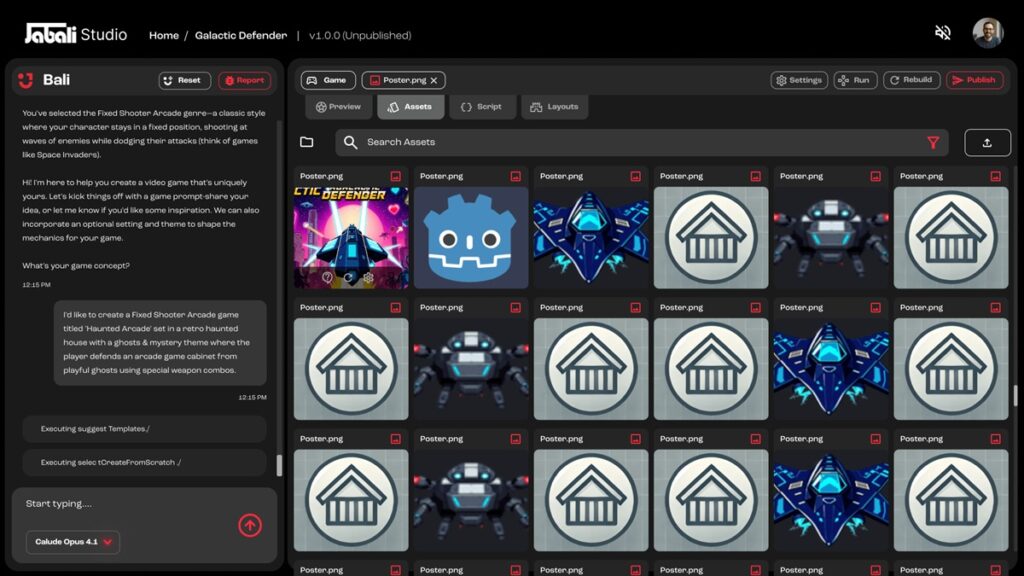
Jabali Studio is designed to adapt to diverse workflows, supporting a range of engines and frameworks. Creators can build directly within the platform using Jabali’s native templates or integrate with engines like Godot and Phaser, with support for Unity and Unreal Engine coming soon.
Every project in Jabali Studio comes with complete source code access, giving creators full ownership and the flexibility to learn, modify, and innovate freely, the company said.
Each creation environment includes advanced AI features such as self-healing projects that automatically correct broken builds, AI-powered debugging, and intelligent publishing to Jabali.ai. Users can also direct their AI co-pilot with varying modes Autonomous, Collaborative, Cautious, or Creative tailoring assistance based on their workflow and vision.
This launch comes as Jabali.ai continues to expand its vision of making generative AI tools more human-centered and accessible.
Last spring, the company raised $5 million in seed funding led by Bitkraft Ventures with participation from Sapphire Ventures and Sony Innovation Fund, is now positioning itself as a leader in the global AI-driven game creation ecosystem.
“Game creation is undergoing a fundamental shift,” said Austin Noronha, managing director, Sony Ventures — U.S, in a statement. “Jabali’s AI-powered, creator-first platform is enabling entirely new communities to participate in game development. We’re excited to support their vision of democratizing interactive entertainment development.”
Jabali Studio reflects Jabali.ai’s broader mission to transform how games are built and who gets to build them. By blending creativity, accessibility, and the power of AI, the platform paves the way for a new generation of creators to shape the future of interactive entertainment.
Jabali.ai provides a platform that empowers anyone to create games—no coding required. With a simple prompt in the AI-powered chat box, users can describe the game they envision, and Jabali.ai brings it to life in under 10 minutes. The platform is redefining game development by making it accessible, fast, and limitless in creativity.
A lot of competition?
I asked how the company will compete with others among the AI and game companies who are also combining user-generated content and AI. Those companies include huge firms like Roblox as well as many well-funded AI game startups.
Bhardwaj said, “I’ll just start with our team. We have a great team in place. I’ve been building games and tools for 15 or 20 years. The rest of the people come from AWS, where they built large-scale infrastructure and GPU infrastructures that were essential for AI. They played critical roles on Google Gemini.”
He added, “We do have competition, many that started years before us. I think the approach we took of building core game AI technology, which is both LLM agnostic, engine agnostic and multi agent tech, has actually helped us move fast. It took us a year of R&D to have something working, but it has actually helped us move very, very quickly.”
He noted that the company launched in the summer with just two styles of games that gamers could build. Now, after four months of work, the company now offers 20 styles of games to make without needing to know how to code. You can pick among engines like Godot or others.
“The team and the technology we have built is allowing us to move faster,” he said. “And we are think of how to go to market.”
He said he would talk more about that later.
The product is ready for early access now as Jabali Studio, a web-based experience.
Where AI game tools are going at a rapid clip
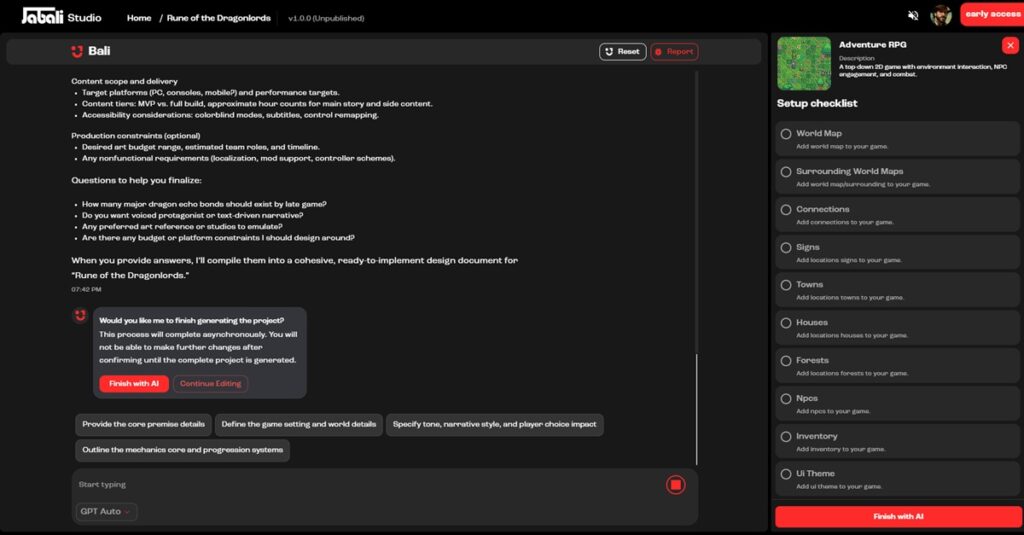
As for the pace of AI, and using it to generate video games, there are two broad approaches. One apporach that Jabali.ai took was using a variety of LLMs based on a task at hand.
“If you want to generate stories, we’ll use a model for music, coding for games, NPCs — whatever is the best model of what’s out there, and if there isn’t anything which exists, we’ll fill the gap by writing our own. And that’s the approach we took,” Bhardwaj said. “We take advantage of all the innovation, with a focus on the gaming domain expertise.”
Then the company puts energy into integrating these tools as needed. Games are fairly unique in that they are multimodal by nature. Both and consistency and coherency are super important.
“Otherwise you break immersion,” he said.
The company started working on multi-agentic architecture two years ago.
“We got that right. What we also got right was this thesis that it’s not a monolithic model. It’s actually combination of models and finding the right model for the right job, and then plugging into our core technology context manager so that you can get good output. You need consistent, coherent games at the end,” he said.
The team continues to evaluate and test advances in the frontier models and then tweak them so they can be used in Jabali.ai’s product.
A second approach is the approach of building world models. But he noted that takes a long time and takes away a lot of the fine-grained control that creators want. It goes from writing a text prompt to creating a playable world.
“There are a bunch of companies doing that. And that is another approach. My view is that approach world models are where image models were five years ago. So it’s still very early. It’s very promising and exciting, because, in three to five years, it can give you interactive play,” Bhardwaj said. “But right now, I think it’s still in R&D phase.”
There are many other technologies that could be used to implement AI in games, like visual or audio technologies. But Bhardwaj said the company is focusing on the problems around user intent. What exactly are they trying to do? Some solutions are expensive and complicated, but he believes the costs will come down over time.