

Grand Theft Auto VI is littered with intentional elements that transform the game’s virtual world into a well-oiled machine.
The release of Grand Theft Auto VI is shaping up to be the gaming industry’s biggest launch ever, with the game achieving roughly $1.5 billion in pre-order revenue ahead of its release tomorrow, November 19. Ahead of the big day, Rockstar Games has shared a set of detailed development notes with members of the press to provide more insights into the creative vision and design process behind tomorrow’s release. The notes spanned across almost every element of GTA VI, from world and mission design to writing and music, showcasing the intentionally cohesive nature of the production.
“The most exciting part of building out the world of Grand Theft Auto to me was exploring the connections between all the various strands of development we had going on at any one time, and looking for ways to make a minor tweak in one part that could have an influence in another and so on,” wrote Rockstar vice president of design Stephen Donkin in the notes.
GTA VI’s fictional setting Vice City is a deeply interconnected virtual world. Players’ decisions and interactions with other characters and elements of the environment are persistent, and a choice that the user makes in one area can have drastic and unexpected consequences elsewhere in the game. This connected world was held together by the game’s writing, with Rockstar game writer Alexa D’Agostino sharing in the development notes that all of GTA VI’s secondary characters had to have “real depth” with dialogue aligned with their individual personalities and quirks.
“Secondary characters are competing for attention in a world that’s constantly coming at you, and a storyline that feels urgent,” D’Agostino wrote. “They need to take up space, feel different and rich, and make players curious enough to get involved.”
The diversity in GTA VI’s non-player characters was visual, in addition to narrative. The development notes noted the developers’ intentional choice to give NPCs a diversity of sizes and body types, with Rockstar vice president of animation Mark Tennant explaining how his team had developed new animation techniques to allow for these different character models to share key animations in the development notes. Enabling diversity of appearance was a focus for the game’s player characters as well, according to Rockstar lead artist for wardrobe and inventory David Vallance in the notes.
“This is the first time in a game that we feel we have visually leveled the entirety of the character castings consistently, including all the world NPCs,” wrote Rockstar senior technical art director for dynamic art Valmor Garcia in the development notes. “We’ve taken the opportunity in this game to create new technology and tools from the ground up that were optimal for the engine while also supporting the creative direction, and raised internal expectations we had for the NPCs.”
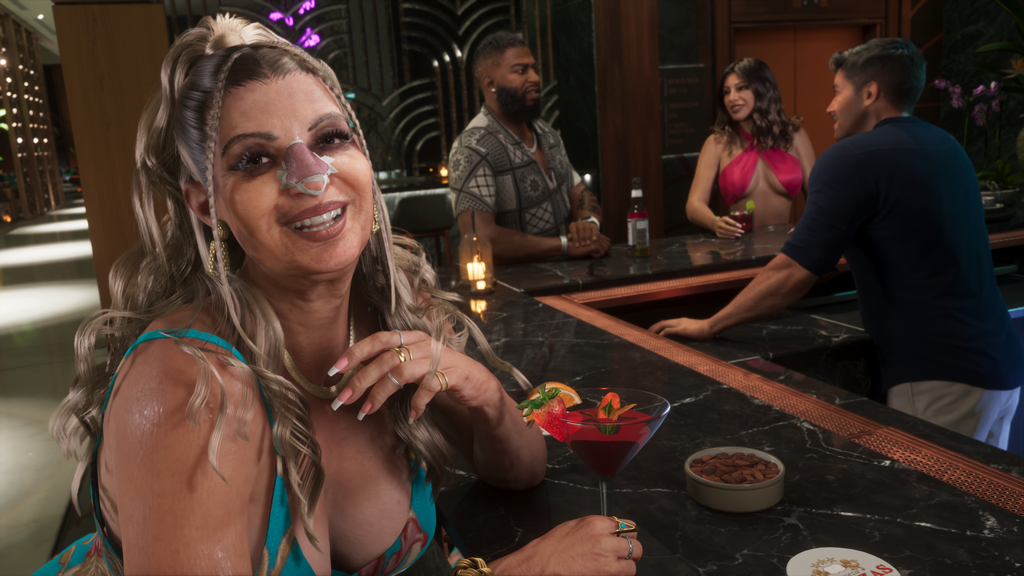
The fine-tuned nature of GTA VI’s virtual world is also evident in the game’s music and sound design. Music is a constant presence in GTA VI, blaring out from a multitude of in-universe objects such as car subwoofers and wireless speakers, and Rockstar vice president of audio Alastair MacGregor said the game’s soundscape is inherently connected to its visual aesthetics. For example, run-down convenience store appliances are loud and sound badly maintained compared to newer refrigerators and freezers in up-market stores, per MacGregor.
“The sounds of human life created by the diverse population of Leonida, often experienced as snippets of conversation on a busy street — projected fragments carrying farther depending on the wind — directly reflect the environment,” MacGregor wrote in the development notes. “How they speak, what they talk about, what they wear is all carefully crafted to tell the story of the different hang-out spots, neighborhoods, and regions.”
The purpose of the well-oiled machine that is GTA VI’s virtual world is to immerse players to a point where they stop thinking in terms of tasks and completion percentages and simply allow the game to unfold in front of them, according to Donkin in the development notes. Rockstar’s goal, per Donkin, was to create a game that feels nearly infinite at a macro level, but with a hand-crafted and human feeling behind each individual encounter.
“The interconnected nature of all the systems running in the game meant that it was never a case of just making a single change to fix or improve something we had picked up on; there was always some unintended consequence that occurred elsewhere in the game because everything speaks to everything else,” Donkin wrote in the notes. “At a certain point, when we had all that in place, the tuning and balancing of the world became something more like collaborating with the game itself rather than working on it.”