
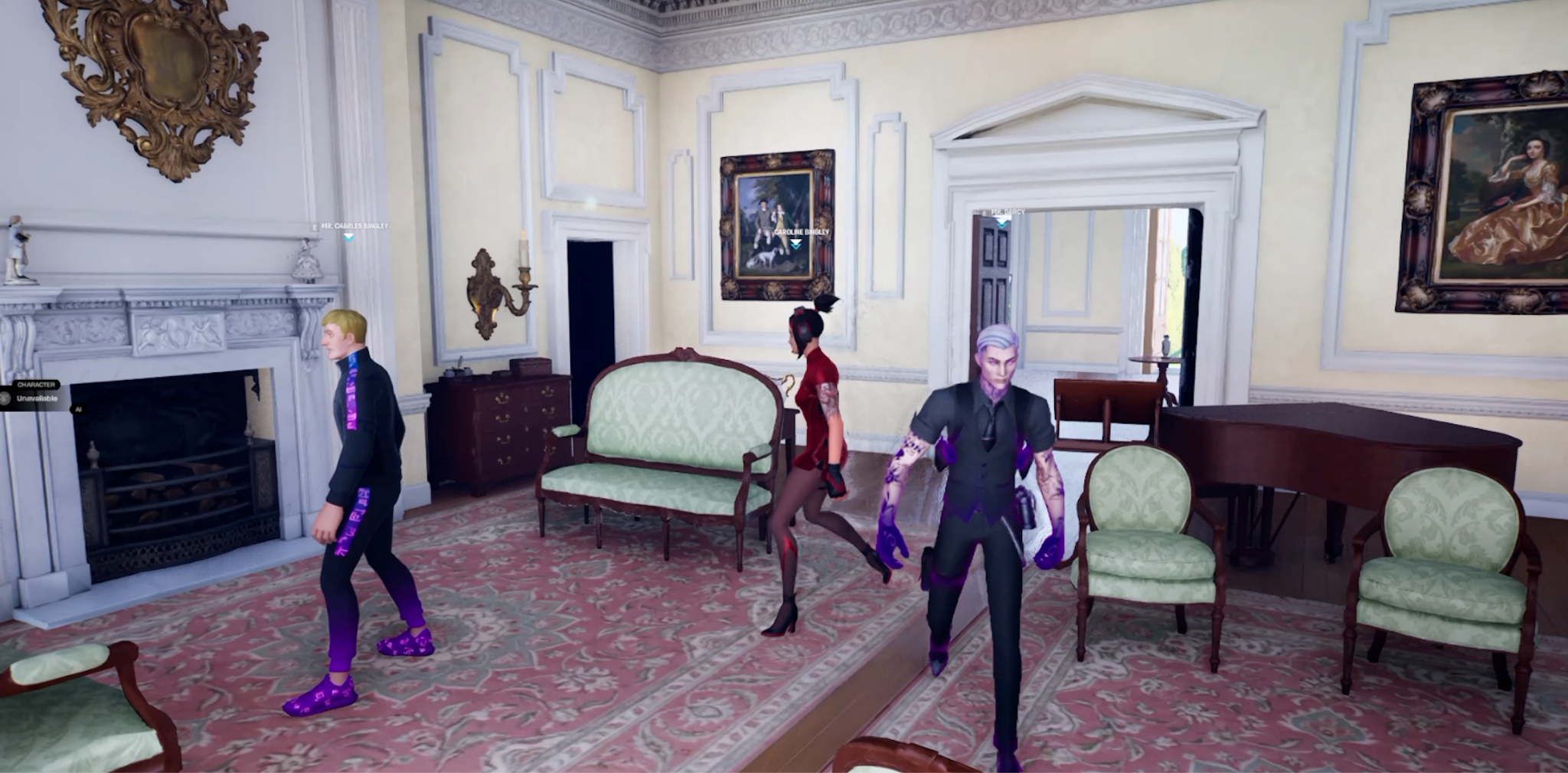
A three-person studio is rebuilding Netherfield Park from Jane Austen’s Pride and Prejudice inside Fortnite, one historically accurate chair at a time.
The studio, Whenere, (a blend of “when” and “where”) was founded by science fiction novelist Neal Stephenson and veteran game artist Karen Laur. The team is using Fortnite and AI startup Dreamlands to turn Austen’s Pride and Prejudice into a stage for interactive fan-fiction. The project started by building out a digital replica of Mr. Bingley’s Netherfield Park, the estate at the center of the novel’s early chapters, with a team of three developers.
In Whenere’s vision for this next chapter in the world of fan fiction, creators are able to write a scene in a web-based editor, then watch characters perform it live in Fortnite. The studio leaned on Dreamlands, an AI startup built on Google’s Gemini models and largely hosted on Google Cloud, to generate much of the furniture and décor and maintain historical accuracy.
Laur described her and Stephenson’s vision behind the studio’s mission. “We started Whenere because we wanted to shorten the distance between imagining a story and seeing it come to life in a 3D world,” she said. In the game, creators will get to set the scene, place the characters and write the dialogue themselves, then publish their custom-built Pride and Prejudice fan fiction.
Viewers can watch the performance live in Fortnite, or the creator can record it as a video to share. The format is deliberately linear. Laur said Whenere is writer-driven rather than a choose-your-own-adventure, and she credited someone at Google with a better description: “build your own adventure.” The studio builds on Unreal Editor for Fortnite and existing character skins. The game will feature no combat, with the studio’s blog post joking that “the only cutting comes from Lizzie Bennet’s remarks.” As of now, Whenere is preparing its first closed playtest, Laur said, and has no public launch date.
The partnership between Laur and Stephenson predates the project by 16 years. Laur started as a texture artist on Half-Life and rose to art director and creative director, and she now runs Whenere as chief executive officer. Stephenson, known for his legacy in science fiction and historical novels and for coining the term “metaverse”, detailed how he has been programming since about age 14, and that building worlds has been a through line for him as a writer, a reader, and a coder.
“It feels like we’ve been evolving toward this moment for a long time,” Laur explained. “Now, our research and vision can become a reality so quickly. It’s unbelievable.” Getting there was harder than that sounds. Whenere needed a full Austen world to prove the concept, and it needed funding to build that world.
“To make the whole world to tell the story, we need a huge amount of funding, and so we’ve been kind of stuck in this catch-22,” Laur said, in a funding environment she called challenging for an idea this new. Netherfield alone meant hundreds, if not thousands, of assets, the kind of load that can put an idea out of an indie team’s reach before anyone has the ability to test it.
Realizing the challenge ahead of them, Whenere turned to Dreamlands, an AI startup that generates editable 3D assets from images and text.
Thomas Tobin, its CEO and co-founder, said the tool collapses tedious work that once took development teams weeks into a single click. “Karen can be like, ‘I want this chair and make it look like this wood,’ and she clicks, and it transforms it to the exact wood type,” he said. “That would have been months of work.”
For Whenere, the practical payoff was consistency. “Furniture generated one piece at a time risks coming out in slightly different colors or tones of wood”, Laur said. Matching them by hand is a “terrible manual process.” Dreamlands gave her the ability to tell the software that every piece of furniture in a room should be the same tone of wood.
“This was just a really huge feature for us,” she said. “That would have been really hard for us to duplicate.” The company says giving an asset new texture takes about 7 seconds and costs under 10 cents in model inference per operation.
Laur also touched on Whenere’s larger and longer-term plans beyond the single-book project. “We’re not just making a Pride and Prejudice simulator,” she said. “We’re making a platform for lots of world building, and to do that, we need to be able to make lots of worlds without AAA budgets and timelines.”
Austen made sense as a starting point for their project for reasons that are partly practical. Her work is in the public domain, and Laur said that spared the team the need to go “through a year’s negotiation and a million dollars to get the rights.” It is also among the most popular subjects in fan fiction. The novel suits a test of emotional engagement, she said, because it is “really people standing around talking to each other, and yet is still incredibly emotionally engaging.” That lets the studio see whether its characters hold an audience without paying for battles or effects. She has bigger ambitions, including H.P. Lovecraft eventually, though she conceded that “tentacles is just a lot.”
Stephenson added that the novel’s historical settings carry another advantage in the development process. Photographs of real houses and museum collections give artists plenty of reference material, while invented worlds raise questions of ownership.
“Most of my own books are tied up in Hollywood rights,” Stephenson explained, so they weren’t an option for this project. He also noted that the fans these worlds attract are a market in themselves: “our culture today is dominated by coherent story worlds, and that is where fans like to spend time, and they have an insatiable appetite for new material in those worlds,” he said.
The team started with Longbourn, the Bennet family home, and built two versions, one by hand and one from Fortnite assets, which Laur called not entirely satisfying. Netherfield is next in the novel’s timeline, and it is where her devotion to period detail shows.
“A Regency house needs a Regency chair,” she said, “not a Victorian one.” Before games, Laur was a high-end wallpaper designer, according to a blog post. “I knew the house I wanted as Netherfield Park, right down to the wallpaper,” she said. “I got to stay with that picture, the research, the floor plans, which materials belonged together. Then I could stand in the room in the game and judge whether it was right.” Her references included real photographs of an English country estate used for Netherfield in the 1995 adaptation.
Every company working on the project framed the innovative approach in the same way: AI takes on the repetitive work so artists can focus on the craft. Jack Buser, who leads the games business at Google Cloud, said tools like Dreamlands matter because they cut the grind.
“It’s that toil, that repetitive grind, that have just sunk so many ideas over the years,” Buser said, “retaining creative control is the point.” He argued that small teams can now “punch way above their weight.” Buser also pointed to pressure behind the push: record industry revenue, tighter margins, development costs up about 90 percent since 2017, and playtime concentrated in a few long-running games. “Whether AI means shorter development cycles or more games from the same teams,” he said, “is not yet known.”
Stephenson tied the argument to iteration. When fixing something is expensive, teams settle. “The agility of being able to say, ‘let’s spend another 10 cents making this a little better,’ is transformative,” he said. In a blog post, he cast the goal more broadly. “This can be a place where AI is augmenting and enhancing creativity, not replacing it,” he said.
As of now, Whenere still has plenty to build. To capture Austen’s world, the team needs to recreate a bustling market town and historical London, alongside a cast of more than 50 characters, and it plans to add other public-domain properties. Stephenson said he hopes the new tools open “a new pathway” for fans and creators alike “to route around the cumbersome and expensive apparatus of Hollywood and start doing things for themselves. We want to give people the power to enter their favorite world and tell their own stories.”
With the news of the upcoming closed playtest, the public can look forward to future updates from Whenere by checking their blog for any upcoming announcements. Dreamlands, meanwhile, is opening to the public later today, on the Google Cloud Marketplace as part of Google Cloud’s Gemini at Work event.