
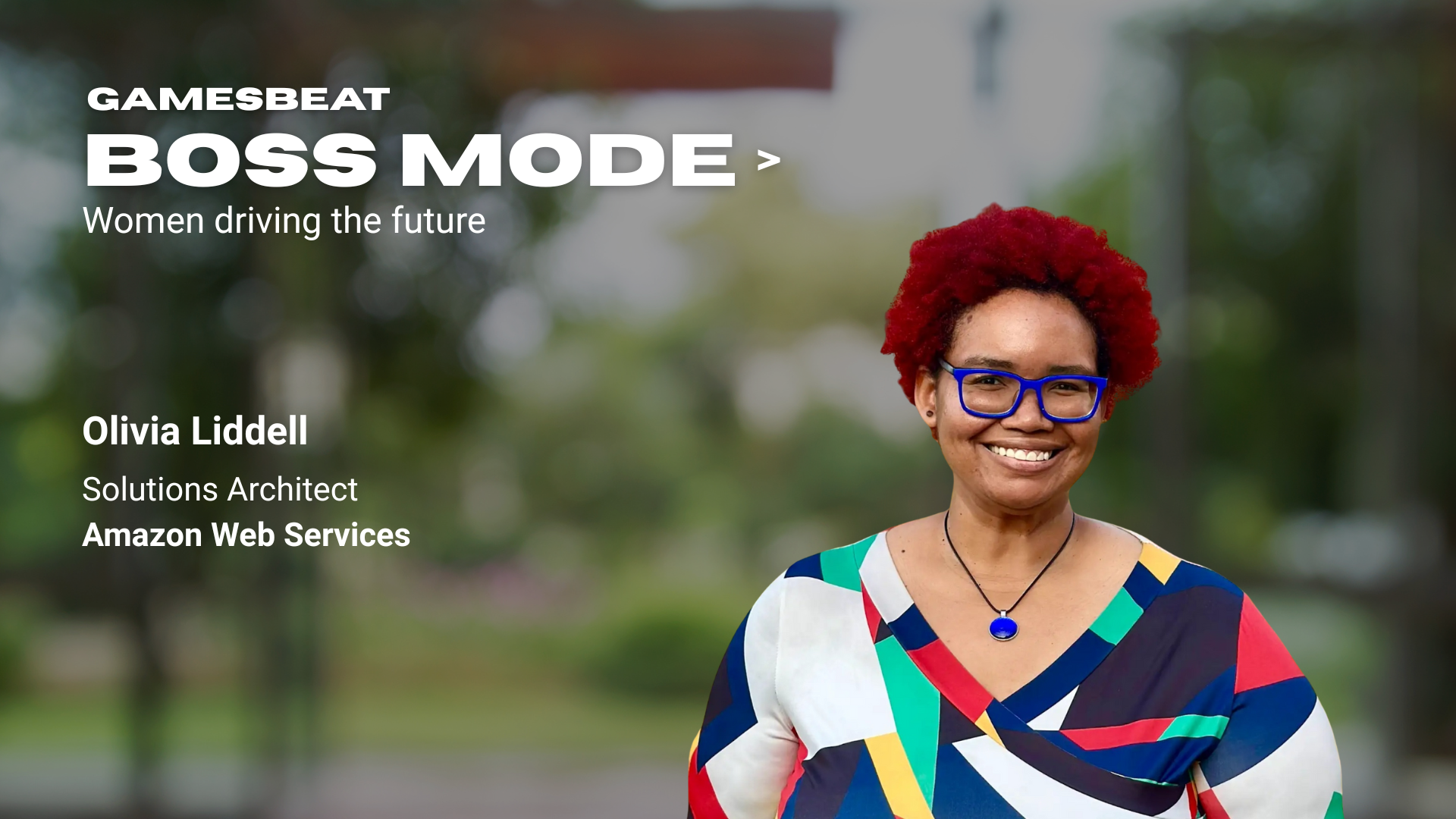
What does it mean to be a “leader?” How do you lead as a skill, no matter who you are and where you work? It’s a question that I’ve been contemplating myself over the last few months, and I got the chance to speak with the inimitable Olivia Liddell this week on exactly that subject. Liddell is a solutions architect at Amazon Web Services, presently, with a long history behind her of leadership solutions and mentoring. I couldn’t think of a better person to ask this question.
I had the pleasure of moderating the Women in Gaming & Tech Executive Breakfast at this year’s GamesBeat Next, where Liddell spoke alongside Raashi Sikka of Ubisoft and Sharon Lee of Moonlake AI. On their panel, Liddell, Sikka and Lee spoke on leading and responsibility, and how to be a leader no matter your job position or where you are in your career.
It’s a conversation that is also part of the thesis behind BOSS Mode, which we at GamesBeat created to spotlight women in the industry who lead without necessarily having the very specific job titles associated with leadership. And I’ve never had this conversation before — honestly, it’s overdue.
I got the chance to speak with Liddell one-on-one after GamesBeat Next, to get more details from her about her career and her thoughts on leadership (I’m hoping to interview Sikka and Lee separately for future BOSS Modes). Below is an edited transcript of our interview.
GamesBeat: Could you maybe set the scene for me? Give me a bit of background — I would love to know more about you?
Liddell: Sure! When I meet people for the first time, I tell them when they take a look at my LinkedIn, it’s going to look like a zigzag — but in a good way! I wouldn’t be who and where I am if I hadn’t taken all of those paths.
Being an educator is something that was ingrained in me from childhood. I come from a family of educators, and my mom was a teacher in D.C. public schools for 30-something years. I always had that part of education in my mind but never did anything with it until 2011 when I applied for a teacher residency program in Chicago. Then I became a teacher in Chicago public schools teaching Middle School Arabic.
GamesBeat: Wow!
Liddell: Yeah, that’s where the zigzags come in! That’s where the technology came in, because I’ve always loved the idea of using technology in meaningful, hands-on ways.
I noticed that my kids were struggling with recognizing numbers in Arabic. So one weekend, I downloaded Game Maker and made a very barebones game. I showed it to my kids the following Monday, and they loved it.
After that, I decided to move into educational technology for a bit, but then got bored. Then I started at AWS — fast-forwarding a bit — six years ago as a technical curriculum developer. I was the lead developer on the AWS cloud practioner essentials course. I remember hearing at an all-hands meeting that something like tens of thousands of people around the world have taken the course I developed.
But I was missing having some hands-on interaction and the chance to stretch as a leader. I became a solutions architect in February 2022, and it’s been wonderful because this position allows me to combine all of these different aspects of myself. This role has a lot more flexibility to choose your own adventure, to take on projects and advocate.
So that was a journey, but hopefully that helps you connect the dots of the Story of Olivia!
GamesBeat: Do you have any background in gaming as a hobby?
Liddell: I have a brother who’s two years older than me, and we bonded by playing games and spending time together. We had Gameboys and a Super Nintendo. Do you remember Blockbuster Video?
GamesBeat: Oh yeah!
Liddell: Back in those days, our local Blockbuster had a video game tournament every summer. I remember one summer it was the Judge Dredd game.
GamesBeat: Oh god, that’s throwing it back.
Liddell: I was always the only girl. Some of the guys there would say to me how cute it was that I was there to support my brother. No — I was there to win. I never came in first place, but I got pretty far. I am very competitive. The first time I played Mario Kart with my husband, he was not ready for that. In a game, I will take somebody down. So it started as a lifelong hobby.
Something I tell people all the time, especially in women my age or older, is “I play games, but I’m not a gamer.” You can identify any way you want, but if you feel like you’re not good enough — no, you play games. That’s something that I’ve been trying to navigate and help empower women to not hide the fact that they play games.
GamesBeat: We were talking during the Breakfast about different definitions of leadership. It seems like you apply that to your customers as well as the people who work under you.
Liddell: Yeah, the way we do it at AWS is that a solutions architect is paired with an account manager, and the two of us are the first point of contact for customers at AWS. I didn’t feel the full weight of that when I first started at the role, but as the years have gone on, I’ve started to see the potential for my customer-facing role as one of leadership — one where I’m able to guide my customers and lead them through the way they engage with our services, with the confidence and trust that they have in me.
It can be a heavy role at times, when I think about how the companies are coming to me. In addition to game development, my area of specialty is security, threat detection and incident response. When someone comes to me and says, “We know we aren’t doing well in security, and we know you’re good at this stuff. Help us.”
That is where I say, “Okay, they’re trusting me to help make their platform more secure.” It can be scary at times, but then when I also see that they did the thing I suggested that they do, and it helped, it feels amazing.
GamesBeat: It seems like an essential part of leadership is competence and confidence.
Liddell: I have a few mentees that I work with, associate solutions architects who’re on their very first jobs. This is one of the things I explain when I mentor them: Believing in their own level of competence at something. It can be really scary, even for me. But the way I approach it with my mentees, is to tell them to take actual notes on what they’ve learned.
That can give you evidence to help squash imposter syndrome, that you do know the information about this. The next piece is to carry that confidence into the conversations that you have with customers.
I often invite my mentees to shadow my customer calls, not so they have to do things exactly like me, but to see what’s going on and what parts of how I present myself most resonate with them. They might say, “I see how Olivia frames questions with the customer. I never thought of doing it that way, so let me add that to my toolkit.”
One of the most important lessons I’ve learned is that everyone makes mistakes at some point. What you do when that happens is acknowledge the mistake, explain why it happened and what you’ll do to fix it, and explain what you’re going to do to prevent it happening moving forward.
GamesBeat: What lessons do you think non-gaming companies can learn from the games industry?
Liddell: One of the things I’ve seen that non-gaming companies can learn from gaming companies is being more confident about taking risks in some areas. Gaming companies are always willing to jump in and try new things. They might say, “We’ve been using XYZ for our database, and it’s working but we know it’s not the best fit for us, and we’d like to give this other thing a try.” Then that other thing might work and they switch to it, or find a part of it that works for them.
What I’ve often seen non-gaming companies do is say, “Well, we know that our database, for example, doesn’t really suit us, but we’ve invested this much time and money into it, so we’re just going to stay put even though we know it’s not the right thing.” Having more of an open mind about taking risks and trying new things is such a vital piece that gaming studios are exceling at.
GamesBeat: How would you describe your impact and legacy within the industry?
Liddell: I’m someone who comes from a very non-traditional background: Someone who started as a teacher and is now an AWS solutions architect specializing in security and helping to make game studios more secure. Part of my legacy in this gaming space is to set an example of how the future of gaming can only be better if we open up more doors to people of diverse backgrounds and skills be part of this as well.
We can help those people them see how the experiences and skills that they’ve had in other industries can be applicable to what gaming needs. If we only amplify the voices of those who come from a more traditional gaming background — as in, they’ve always worked in games — then it becomes and echo chamber.
Also, for me, being a Black woman and wanting to show other women of color that I’m someone they can aspire to. It’s possible for them to take this path as well.
GamesBeat: If you could share one insight with decision-makers in the gaming and tech industries, what would it be?
Liddell: I’ll start with security! The concept of security in games is something that a lot of gaming studios put on the backburner. They look at security as like sriracha — you sprinkle it on at the end for better taste. But I look at it as something that should be infused throughout the entire process.
The importance of security is that, if your game and your infrastructure is more secure, that leads to a better experience for your players, and that leads to better player retention.
Be very honest with yourself about what extent you’re prioritizing security. If you’re not, that’s okay, for now. But you need to start getting help.
GamesBeat: What do you consider to be your “Boss Move,” the decision that defined your career and your approach to leadership?
Liddell: Can I have two moments?
GamesBeat: Yeah, of course!
Liddell: Back in 2016, I was working in educational technology, and I was a learning technologist. There was another position that I was interested in that would have been more like an administrator — a stretch for me, but a good next step for growth, and it very rarely opened up. I’d been working really closely with that team, and taking on my projects. I went through the interview process … and heard nothing.
Until one day, the hiring manager broke the news to me, saying, “We don’t think you’re the best fit for this.” One of the positions went to a previous intern, and another went to someone related to someone in HR. I thought, “Okay, that would have been the next logical step for my career trajectory.” And that’s when I started looking outside of the company to make a move. Had that door not closed to me, I would not have made the next step, which was to work as a technical trainer at a Google partner.
While I was in that role, I was trying to pursue more technical projects, and I had people straight-up tell me, “Olivia, stop trying to be so technical.” They saw, in me, that I should go on a path towards strategy and business leadership, but I didn’t like the idea of someone telling me that. It may or may not have been a coincidence that, when I left that job, I put a little bit of emphasis on telling people, “I’m going to be a technical curriculum developer.”
You tell me I can’t do something, I’m going to prove it to you and do it that much more. Those two steps really lit the fire under me.
GamesBeat: What would your boss music be?
Liddell: If I were to choose my music, I would have to say… I’m a huge Beyonce fan. I would say “Formation.”