
AI demand has driven memory chip prices to unprecedented levels in 2026. For instance, costs for AI server dynamic random-access memory (DRAM) roughly doubled during the first quarter of 2026, according to a new report by Deloitte.
For 2026, prices are expected to increase fourfold increase for the full year. Although memory chip makers are increasing their capital expenditure to add capacity, that new supply isn’t expected to come online until 2029 or 2030. As a result, enterprises that need memory chips may need to pay more and wait longer to get these scarce but vital products.
This kind of shortage and price hike trend is going to wreak havoc among all sorts of companies, from game console makers to consumer electronics makers and PC makers.
There are steps executives in the semiconductor and data center industry can take now to help navigate this challenging and fast-changing environment.
Prices are up, margins are being squeezed, and unit sales are falling
Memory chip industry insiders and market analysts are calling this scarcity-driven surge in chip prices “RAMageddon.” RAMageddon looks likely to last and could even get worse before it gets better.
Those most likely to be affected are hyperscalers, integrated server and storage original equipment manufacturers (OEMs), neoclouds, and both AI and non-AI data center operators. Consumers and enterprises also are likely to feel the effects of higher prices for devices and electronics ranging from personal computers (PCs) and smartphones to telecommunications gear.
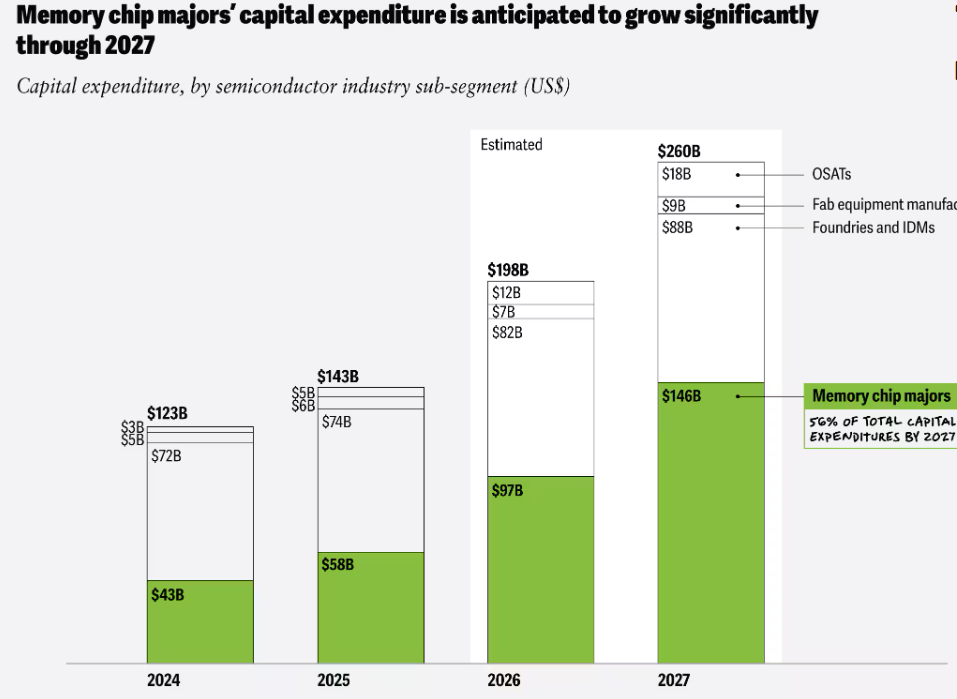
Deloitte anticipates the three largest memory players may increase their combined capex nearly 340% between 2024 and 2027 (figure 1) to keep pace with the growing demand for memory chips. And memory capex could constitute roughly half of the total chip industry capex in 2026. But that higher spending isn’t expected to increase supply or reduce prices by much in the next year or two, since it often takes three to five years to build memory fabrication facilities and scale up production.
AI hyperscalers’ massive investments are driving a surge in memory sales and capex
In response to massive demand for AI tokens for both training and inference, Deloitte expects hyperscalers’ capex spending to exceed $1 trillion in 2026, more than double of what they planned in January 2026. Among the types of chips needed for AI data centers are memory chips, including high-bandwidth memory (HBM), high-capacity DRAM, and enterprise solid-state drives (SSDs).
Hyperscalers are projected to spend roughly 30% of their 2026 data center investments on memory, and that share will likely reach 36% in 2027. In addition, memory constitutes roughly one-fourth of total AI server racks’ bill of materials, according to Deloitte’s analysis of this category for select high-end AI server rack systems. So, it may be no surprise that memory sales are forecast to exceed $1 trillion in 2027, up from $230 billion in 2025.
Memory product prices and expectations for the first and second quarters of 2026 suggest that the robust memory sales growth forecast mainly reflects higher average selling prices as volume increases in bit shipments have been low. Moreover, memory vendors are increasingly reallocating their standard DRAM and NAND memory capacity to AI data center memory such as HBM and enterprise SSDs.
Beyond memory, AI is driving demand for various types of chips and related solutions: leading-edge logic; CoWoS packaging; substrates; extreme ultraviolet (EUV) tools; and advanced etch, deposition, metrology, and high-end test equipment. In response to the demand for AI chips, semiconductor companies across the value chain are likely to increase their capex spending in 2026 and 2027.
One important question: Is this a longer-term memory supercycle in which demand and prices stay high for many years, or a shorter-term boom-then-bust cycle? Servers are the single largest cost item in an AI data center, representing about 60% of the estimated $38 billion required to build a typical one-gigawatt facility. As server prices rise due to the sharp increase in memory costs, the cost per megawatt to build an AI data center may face meaningful upward pressure.
Considerations for executives in the broader AI semiconductor and data center industry
Given this context, how should semiconductor and data center leaders move forward in the next three to six months? Here are three near-term strategic steps executives can consider in order to help navigate this complex landscape and bolster their long-term competitive position.
Take a deliberate approach to placing orders. Memory costs have historically been highly cyclical, with new demand driving prices much higher for 12 to 18 months. But the current cycle differs because building new, advanced memory capacity takes longer and costs more. Therefore, the market is likely to be in flux for the next two to four years.
Companies should work to ensure that return on investment remains sustainable at these highly inflated chip prices, especially for memory. To do so, companies should consider being deliberate when placing orders, entering long-term forward contracts for memory solutions to secure both capacity and pricing, and identify potential alternative sourcing partners.
Be selective in identifying and investing in memory technologies.
Memory capex is going to technology migrations such as EUV lithography and DRAM tools, HBM standards such as HBM4 and HBM4E, hybrid bonding, and advanced packaging, apart from overall capacity increases.19 These investments are targeted at highly specialized, complex areas that support the broader AI infrastructure-driven shift.
Memory chip producers should consider a balanced approach, selectively identifying and investing in new or distinct types of memory technologies such as language processing units, on-chip static random-access memory, and near-memory computing architecture, based on what they believe is strategic from a long-term perspective.
Perform proactive and predictive demand-supply scenario planning and impact analysis. The current memory supply tightness and elevated prices may persist until 2029 or even 2030, assuming continued demand among hyperscalers for memory chips. Other customers that need memory for devices such as PCs, smartphones, and other consumer electronics, as well as for non-AI data centers, will likely also need to contend with high memory prices.
Therefore, it will be important to perform dynamic and ongoing demand sensing, supply planning, and demand forecasting across several tiers of downstream customers.