
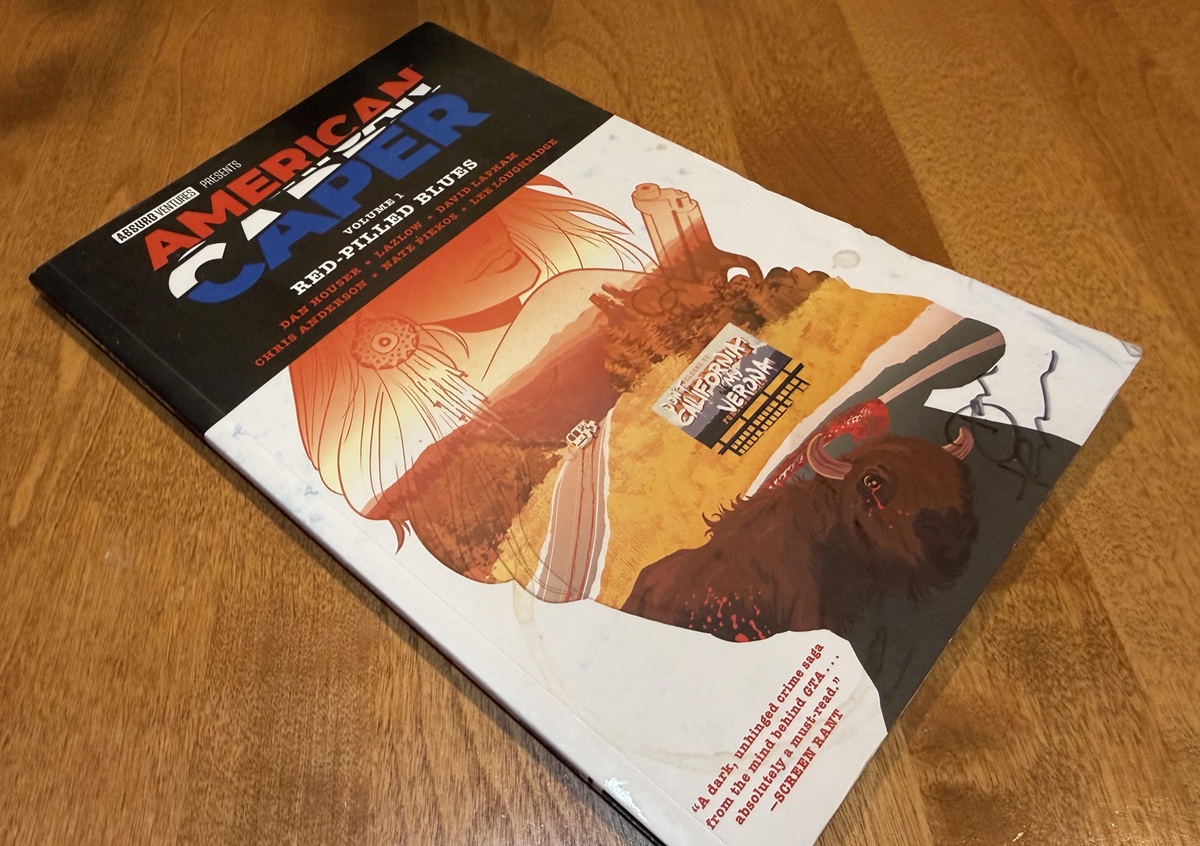
The writing of American Caper should be familiar to video game fans. That’s because it’s the work of Dan Houser, the creative mind behind some of the biggest video games of all time — the Grand Theft Auto and Red Dead Redemption franchises.
After a long run at Rockstar Games, Dan Houser struck out on his own in March 2020, at the beginning of the pandemic. His brother Sam Houser stayed at Rockstar to bring Grand Theft Auto VI — which launches on November 19 — to the market. But Dan Houser wasn’t quite done with creative work. He started Absurd Ventures in 2021 to work on a wider array of media than just games.
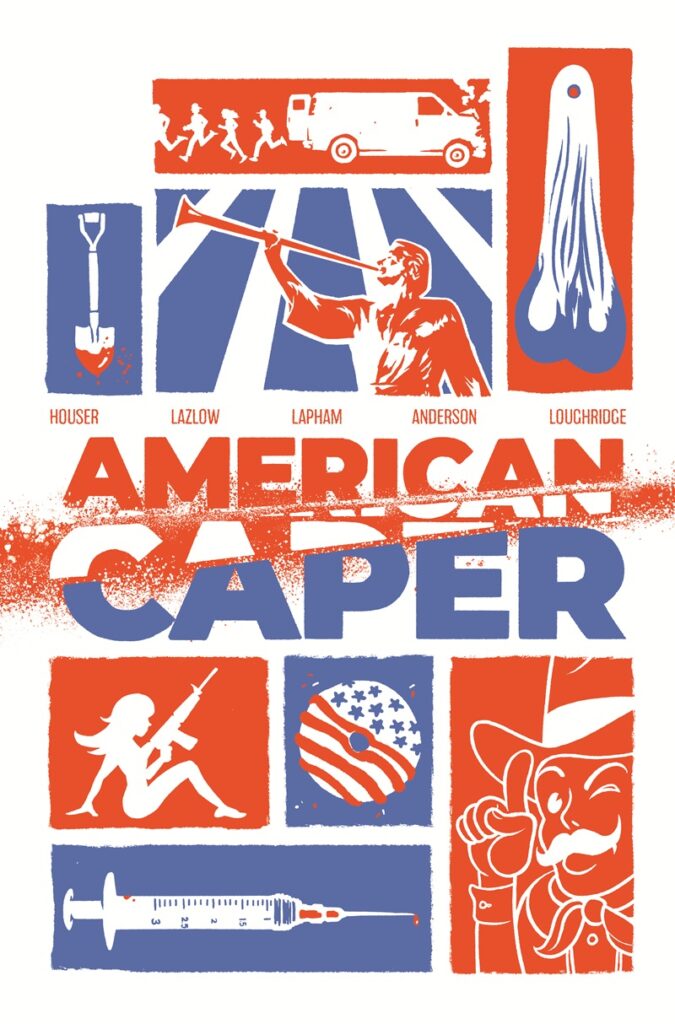
Now Absurd Ventures, with the backing of Smilegate, has created American Caper, a comic book series that, like Dan Houser’s previous games, looks at the underbelly of society. It was published by Dark Horse Comics. American Caper is an ongoing series. The first season of American Caper will span a dozen issues, with the last two coming out this year. There will be a second season kicking off next year.
So far, Dan Houser isn’t saying anything about Grand Theft Auto VI, nor is the company saying much about its ambitions beyond comic books. I read the first issue of American Caper and enjoyed it, though I did feel kind of sticky, like how you feel after reading about unsavory characters.
The story is satirical, set in the rural utopia of Wyoming. But if you lift the covers, you’ll see crime, political extremism, addiction and the greed of a predatory billionaire and all those in his orbit. Pretty soon, the frames of the comic book turn bloody and violent. Capitalism comes to idyllic Wyoming, and two families fall victim to greed.
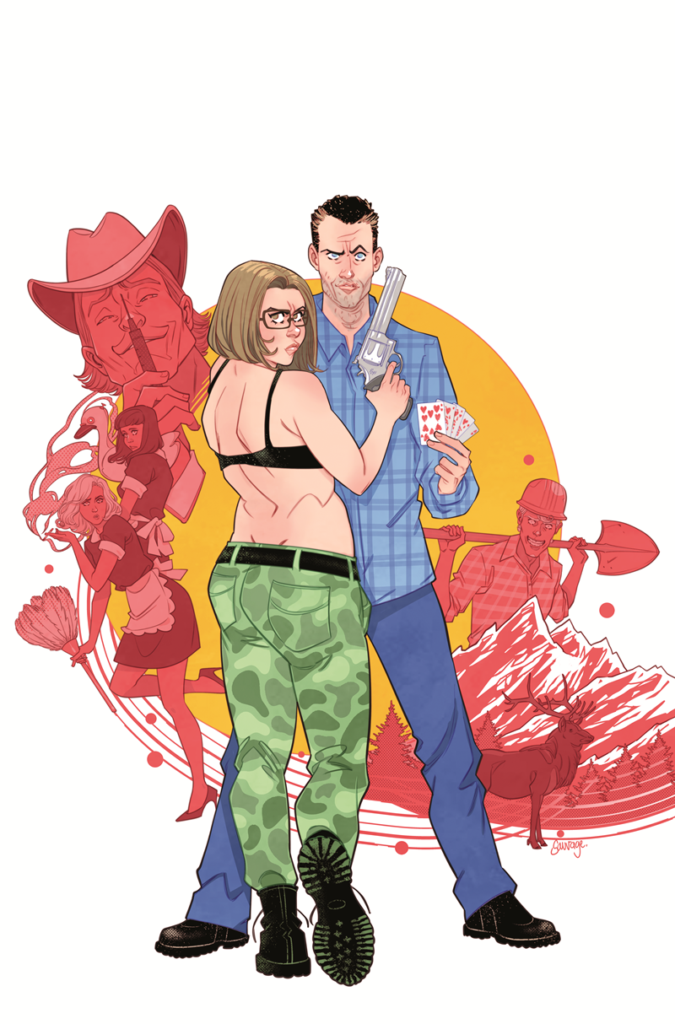
A failed-lawyer-turned gambling addict leads one fractured family and a Mormon hitman, who seems to be so innocent, leads the neighbors next door. A lust to recover broken dreams takes the families into deals with the devil. Add to that a real-estate developer and a Mexican beauty queen on the run from her past, and you get an interesting menagerie of characters. It’s enough to turn Verona, Wyoming, into a Shakespearean stage.
You can tell the crime-fiction was written by Dan Houser. But he’s also assembled an interesting team. I interviewed Houser’s fellow writer Lazlow and Shelly Bond, lead comics editor. While they’re very focused on the comic book at the moment, you can expect that they’re art will spill over into other media.
Here’s an edited transcript of my interview with Lazlow and Bond.
GamesBeat: I’ve only gotten through volume one. I liked it. I happened to read it at the same time I was watching the GTA VI Netflix show. It felt similar in terms of–there’s the ideal picture of American life, and then there’s the underside.
Lazlow: If you look at those characters that Dan came up with, going back to GTA III, all the way through GTA V and Red Dead Redemption 2–the characters for this series came out of his head. The locations as well. He came to me and said, when we started Absurd Ventures, “I have two game universes that I’ve been thinking about, but I also want to do a comic book.” For no other reason than just to do a comic book.
We love storytelling in all different kinds of media. We’ve collaborated for 25 years doing world-building and storytelling in radio and in-game TV and all the advertising that you see throughout the worlds. He said, “I have this idea to tell a story in a small town in Wyoming.” We’ve done world-building in very large locations, stories set in large locations. He and I have talked a lot about Wyoming and Montana. The interesting scenes there, the friction, how people go there to escape and try to live this fictional version of themselves.
As you can see reading it, there’s a character who’s obsessed with cowboy cosplay. Going to these re-creations where they all dress up and shoot each other. It’s got some elements of that ridiculousness and satire from GTA, as well as cowboy overtones. A lot of conflicted characters that have been turned into something that they never imagined. Throughout the series we explore a lot of different characters, where they started and where they ended up.
I think it also speaks to the modern-day–we were talking about constant distraction and continuous partial attention. Phones, the internet, gambling, religion, all these things and how they affect and change people. But it’s also about the comedy and tragedy of America at this moment.

Shelly Bond: I think it asks the question, how can you be a hero in a world that has done this to you, in a world that’s gone loco? Is it even possible? I think William Hamilton, who’s one of our main characters–he starts out the series, page one, asking that question, because that’s what he wants to be.
Lazlow: He’s got a son who’s disappeared into video games and is lost, like many teen boys. His daughter is a bit lost. She’s gone super lefty. We enjoy these over-the-top characters. Dan’s such a master at coming up with these characters that are over-the-top, but you feel bad for them, and then you hate them, and then you feel compassion for them. A lot of conflicting emotions.
Shelly came on to this project. She’s a superstar in the comics world. Every creative project needs an editor that’s willing to tell you when you’re wrong, when it needs to be tighter. She brought some of my favorite comics throughout my life–she brought those to life. The editors in comics don’t really get–when you go to the conventions, it’s just, “This is the artist.” When she was at Vertigo, that label had so many gritty, amazing adult comics with incredible storytelling. Those were books where she saw the pitches and said, “We’re going to do this.” Books like Fables and many others.
Dan and I would submit scripts to her and she would give us very candid feedback on storytelling. “I know you guys have done a lot and had a lot of success, and I’m going to help you not fall on your face with comics.” She really helped push us creatively.
GamesBeat: Do you see this as an end in itself, the comic book series, or does it also feel like a testbed for ideas that you could use in a video game? We’ve seen companies like Skybound use comics as a relatively inexpensive test for the market acceptance of an idea.
Lazlow: We started American Caper just because we wanted to make a comic. We frankly started making issues with this superstar team that Shelly put together before we even had a publisher. We spoke with all the publishers, but it was always about–this is an interesting medium that would be fun for a different kind of storytelling and world-building.
We’ve had people say, “This feels like an FX TV show,” or it could be an amazing film or a game, but that’s never been our intention. We have two very large games currently in production. Maybe someday it could be. Some interesting ideas have been pitched to us. I feel like too many projects in comics are basically, “We’re storyboarding for a TV pitch.” We never had that conversation. It was all about, “Let’s tell a story with a lot of different characters that are all very separate and come together in this small town. Mayhem and comic violence ensues.”
Bond: On the page, if I may just jump in–first of all, I’m flattered by all the praise. But I would not have taken on this project if I thought they wanted to use this incredible story as a stepping stone to something else. Because I’m a comics purist. Three decades wielding the red pen. I feel like I can pick and choose, in some cases, my freelance jobs. I run a small press with my husband, so I don’t have a lot of time to take on other gigs. This story had tremendous legs.
I knew from reading the pitch, right from the jump, that Lazlow and Dan were great writers, but they really hadn’t written comic book scripts. I was intrigued to hear more about it. I was in pretty quickly when they looked me in the eye and said, “We want to make a comic book. We want to build a world on paper.” I couldn’t resist. I was not only in immediately, but they kept asking me to stay. I didn’t hesitate, because they were delivering the goods.
I’m pretty tough. Comic book editors have a reputation of people thinking that we just make deadlines, enforce schedules, get people paid. That’s such a small portion of what we do. In fact, editing script is about 30% of what we edit. The legit comic book editor gets her hands on everything, from hiring the right team to making sure the page turns work to knowing what’s a good cliffhanger or what’s a great cliffhanger. This one, I think, has it all. I’m thrilled that you enjoyed it.
Lazlow: We do get the question about how this is different or similar to making games. The process is similar for all the projects I’ve worked on with Dan since Grand Theft Auto III in 2001. He has the characters. He has the overall story arc and beats. I hate the phrase, but building the plane as you go–there were decisions we made halfway through and toward the end where a character’s trajectory changed based on once you see those scenes. The same thing happens when you’re viewing early cinematics and cutscenes for a game. You think, “This character is really popping. I think we can explore this more.”
The other thing we did was what Dan and I started doing together on day one, which was making fake ads. To us, advertising is a core element of setting the tone of a world and world-building. That’s why there are fake ads throughout the issues, and even bonus fake ads at the end of the trade paperback. Just stuff that we thought was funny, like a fake video game ad for a game we came up with called 55th State. You see the kid in the comic playing it. But that was a key component. It’s a bunch of extra work, but we love it. It makes us laugh.
People would say that when they read the book, they’d start to flip past the ads. A lot of comics run real ads or promos for other books. Then they’d think, “Wait a second. This ties into what’s going on in the world.” We tried to stuff as many billboards and advertisements into each panel and issue as we could.
Bond: It demands multiple reads. That’s what I love about comics. You’ll be inspired to go back and reread to find more clues and Easter eggs. Again, not unlike in games. It’s thrilling to me to have that in common with Dan and Lazlow. Those ads were an important part of most of the work I’ve done over the past 10 years.
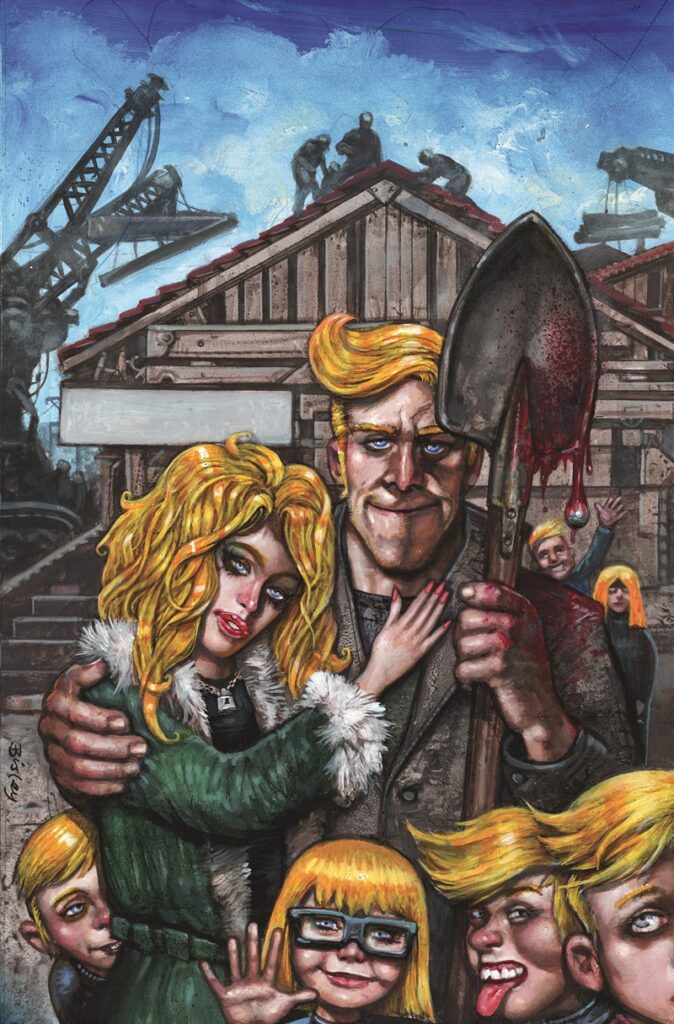
I will say that the strong women characters in American Caper are another reason why I stuck around with this crew. As someone, a woman, in a male-dominated field, it’s more often than not that men are writing the material I edit. There’s rarely the authenticity that I feel we need as readers of modern. Both Dan and Lazlow just stepped it up and really brought home a promise that they made to me in the beginning, which was, you will see a character, a heroine in this book, kick ass and take names. They were true to their word. That’s something that’s important for you to know, that it’s rare that people really deliver on their promises to me in comics.
Lazlow: She’s talking about Eva, who you’re introduced to in the first trade, the first four issues, and then you find out a whole lot more about her in the following issues. There’s 12 issues total. There will be three trades. I think the second trade comes out in October. So many comics have scantily-clad women with guns and swords or whatever. Eva, you see her mostly either in the van being smuggled from Mexico and then in a maid’s outfit cleaning toilets. She has a very interesting story that comes to an interesting conclusion at the end of the series.
GamesBeat: I did wonder about the time-shifting approach, where you flash back in time and flash forward. What’s the intention behind telling the story that way?
Lazlow: One, I think it allows more character development. Specifically, Marnie and William–when you meet them, she’s on the computer inhaling conspiracy theories and craziness and getting angry at the world, stockpiling AR-15s and food rations. Mainlining caffeine and donuts. So out of her head that she’s feeding her dog donuts. Her husband, who thought he was going to be a successful lawyer–he was somewhat successful, but he’s addicted to online gambling, casino gambling, and chicken wings. I love chicken wings, so I can relate. But they’re both a bit lost and loathsome.
I came up with the idea of a flashback to when they were recently married in Chicago, before they moved to Wyoming. She was healthy. More middle-of-the-road or progressive politically. The fridge was full of healthy food. It gives you more background to the characters, and more compassion. We do that with several characters. A flashback to what turned them this way, why they’re on this journey. At first you think, “Wow, this is a crazy, disturbed person.” The escaped convicts that carjacked the van that was smuggling immigrants that crashed in between the two houses, these neighbors that we follow in Wyoming. But we explore as many characters as we can with that. At first you think, “Oh, they’re over the top and ridiculous and broken.” And then you find out why they’re that way. I think that’s fun.
That’s also what I really enjoyed with comics. It’s similar to making animation. Dan and I did a lot of animated shows that we put inside the games, both GTA and Red Dead. You’re not limited by art resources. You can do these flashbacks, and I don’t have to have a 3D team create that whole environment for a short scene. It’s artists collaborating on a page. You have a lot of freedom in your storytelling there.
GamesBeat: On the politics side, a lot of media shies away from politics now. With this, it seems like you skewer every extreme.
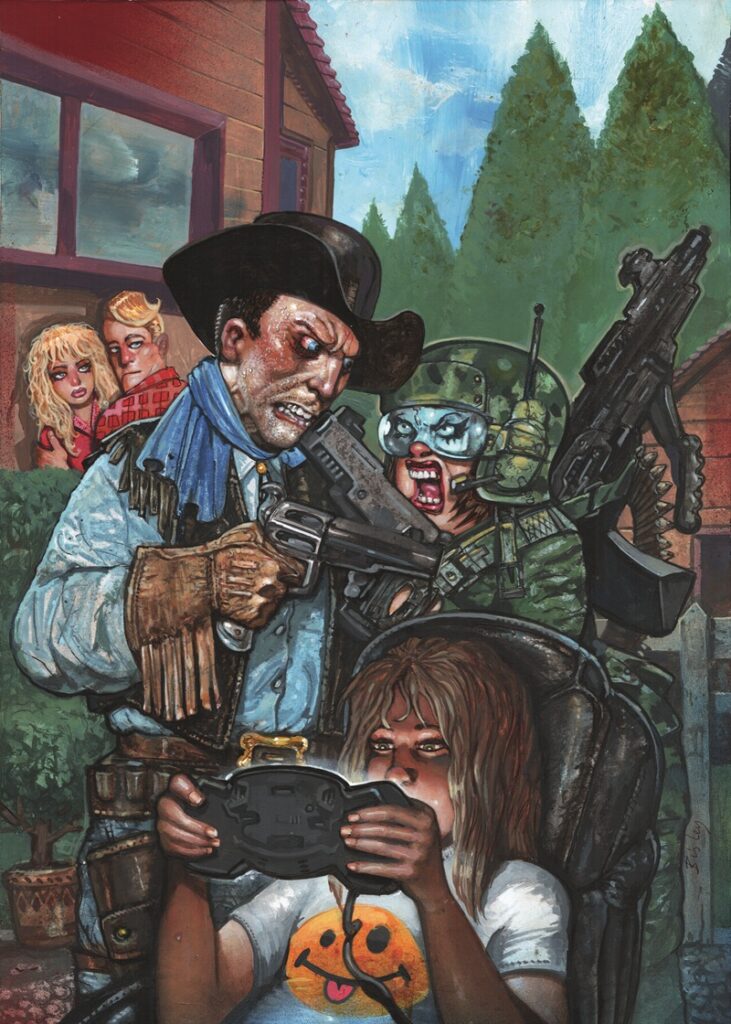
Lazlow: We don’t mention any political parties, actually. We just show characters that have gone so far left or so far right that they’re bananas. It’s those extremes that we enjoy, the satire of that. There are a couple of characters – Marnie and Arabella – who have gotten into extreme politics, but a lot of other characters are consumed with other things. We haven’t mentioned the perfect Mormon family that lives next door to Marnie and William. He got sort of hoodwinked by this religious elder who happens to be a massive real estate developer. He makes the mistake that you learn about in this first trade, when he’s down in Mexico and breaks his religious vows. Then his boss uses that to blackmail him and turn him into what he never could have imagined, a Mormon hitman.
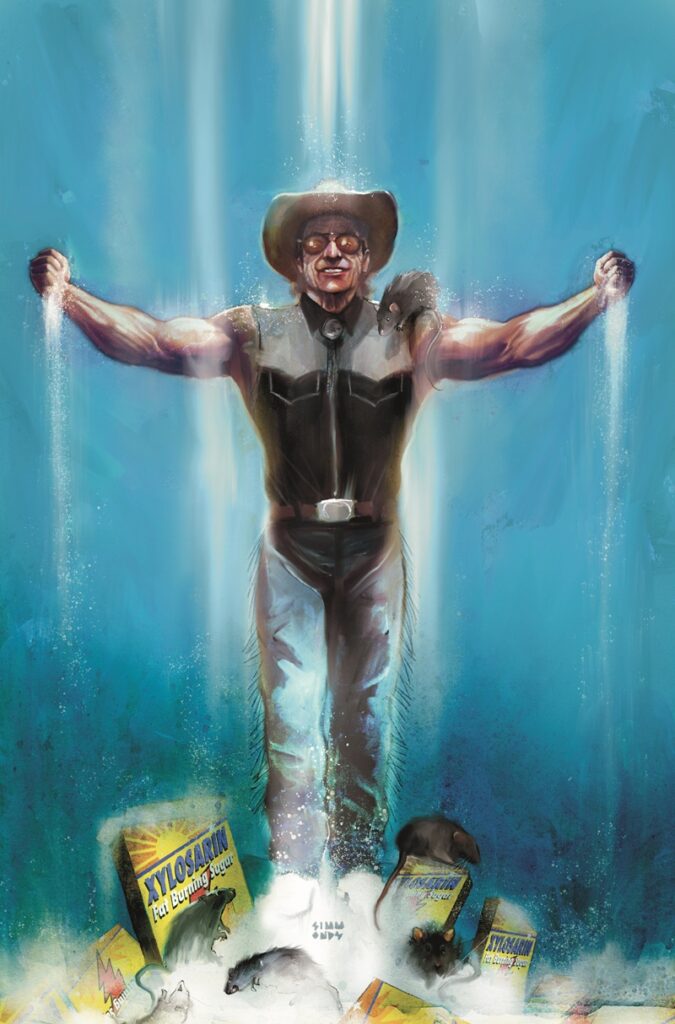
I also like how Dan weaves these stories together. People are looking at other people and thinking, “My God, they must be so happy. They’ve got it all.” And then when you dig into all those characters–Marty, a billionaire Wall Street guy who moves to Wyoming to play cowboy. Like so many men in their 50s that are successful, he’s freaking out about youth and longevity. He’s shooting HGH and doing cryotherapy. Running around doing extreme sports and all these crazy things to try to regain that youth. But he’s clearly miserable inside, despite having it all.
GamesBeat: I don’t know if it’s too reductive a word, but is there a cynical view of everyone? If you’re going to introduce a character, they have to have some kind of hypocrisy or hidden side? Some kind of underbelly to them.
Lazlow: Yeah, they’ve got some kind of secret, some sort of conflict. But they’re also ridiculous. That’s one of the things Dan did so well across all of the games that we worked on together. The characters felt over the top. The world continues to get more beautiful and photorealistic, but his characters are very over the top and satirical and ridiculous.
One of my favorite reviews on this series was from a person who said, “I don’t know where this is going, but I love it.” That made me so happy, because it makes you want to pick up the next issue. We have an issue that opens up in Fallujah, talking about flashbacks, later on in the series. There’s a lot of media that I enjoy, but you have those moments of, “Oh, I know where this is going.” With Dan’s storytelling and Shelly’s assistance in American Caper, there’s a lot of moments where things suddenly go sideways. That’s fun. We can all identify with that.
Bond: I think that was critical in this series. In 2026 we’ve kinda seen it all, whether it’s in comics or games or TV. That was critical for a book that was going to take shots at the American dream. The thing that–to play off what Lazlow just said, even for those of us who don’t want to admit it, there’s something really intriguing about following characters in decay. When you asked that question about why we flash back, why we show the other side of a character or situation, I think it’s for context. It’s because comic book readers are very sharp. They do want to understand the inner machinations. Why is someone behaving like this? Why are people so vile in this book? Maybe 90% of the time they have a very good reason. I like to think that we all know people like this sprawling cast of characters, who are diabolical and devious, and we can’t help but watch and see what happens to them.
In some cases they die. We have a lot of scenes where there’s blood, because it is satire, and that’s the best way, in my opinion, to look at the way we live now and maybe even consider what we can do to not have our kids make the same mistakes that our generation did.
Lazlow: I hope your kids don’t make some of these mistakes. One of the through lines is that this real estate developer is so hell-bent on making a luxury golf resort and mowing down pristine wilderness in Wyoming that he’s willing to send a highly religious gentleman out with a shovel to bash people over the head when they stand in the way of his real estate deal. Making fun of America’s obsession with real estate–Dan said, when he was thinking about this series, that America was founded for lawyers by lawyers. You see that when you drive down the street in any major city in America and half the ads are lawyers encouraging you to sue someone.
GamesBeat: Can people look forward to seeing a hero in this story? Or is there a different approach? Is this something like Game of Thrones, where anyone you think is a hero is going to die?
Lazlow: I’ll let Shelly answer this as well in a second. But there are several people who, in the conclusion–we just wrapped issue 12. That goes to the press any moment now. There are several people who turn out to be heroes. And other people you hoped would turn out better–Shelly?
Bond: What really tied things up nicely for me with issue 12 is that–this was a year-long story, a big story. It needed to be the ending that the characters deserved and the readers deserved. It’s a double-sized issue. It’s nuts. If you think what you’ve read so far is a rollicking joyride, just wait for the grand finale.
Dan started out issue 1 with the quote from Shakespeare. “Blood will have blood.” And blood will out. There’s no other way to answer the question than to say it’s going to be a shocking conclusion. You’ll just want more. You’ll want to see some of these characters again, and you will. It’s an incredible journey. We’re coming back.
Lazlow: It’s being released in a lot of different languages. The Italian editor did a synopsis of the series: “They open each issue with a Shakespeare quote, and it definitely ties in to this story and this caricature of America that we’re telling that’s both comedy and tragedy, just like Shakespeare.” And a lot of ridiculousness and blood.