
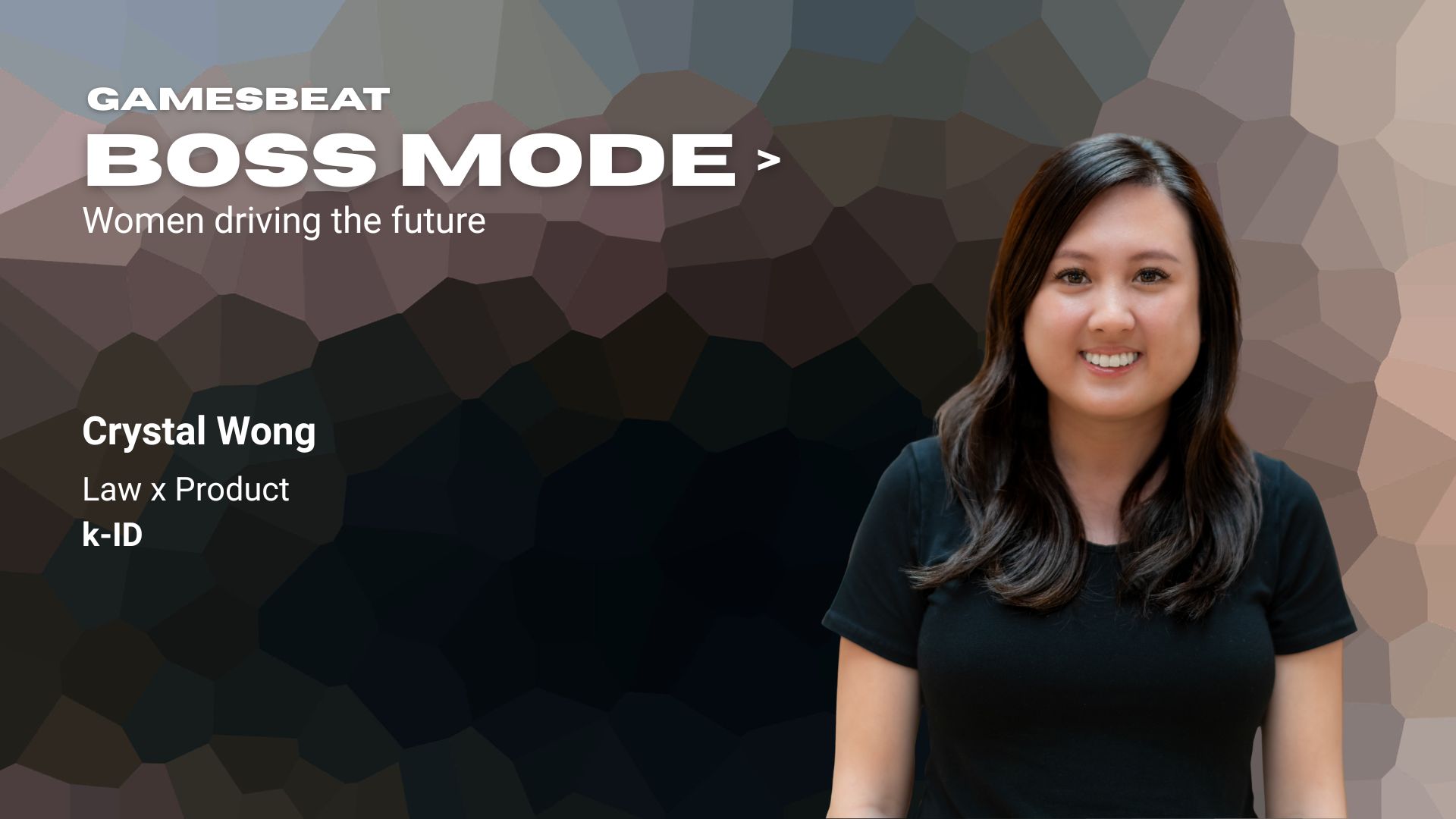
BOSS Mode: Women Driving the Future is a series spotlighting women shaping the future of games, entertainment, and tech. This entry is a sponsored interview produced via GamesBeat Studio. The GamesBeat editorial team was not involved in the production of this content.
Creating products for younger audiences requires more than compliance. It demands a thoughtful approach to safety, privacy, and trust at every stage of development.
In this BOSS Mode conversation, Crystal Wong of k-ID shares how her leadership approach has evolved while helping build infrastructure focused on age-appropriate design and online safety. At k-ID, Wong works at the intersection of technology, policy, and game development, supporting studios as they navigate a rapidly shifting regulatory landscape while still delivering seamless player experiences.
With a background spanning partnerships, strategy, and emerging technologies, Wong brings a cross-functional perspective to one of the industry’s most complex challenges. She discusses how leaders can balance innovation with responsibility, why proactive design matters more than reactive compliance, and how the industry can better support younger players as digital worlds continue to expand.
Can you walk us through your career as an impact driver across multiple organizations? What eventually led you to k-ID?
I think impact looks different depending on where you are in your career, and I’ve tried to be intentional about what I can uniquely contribute at each stage. Looking back, the thread that connects everything is probably a consistent desire to work at the frontier of hard, unsolved problems.
Early on, I had the privilege of cutting my teeth in the technology and data privacy practices of major local and international law firms at a time when data privacy law was still taking shape. That meant advising significant tech clients on entering new markets, working on large-scale data privacy projects, and supporting organisations in building out their compliance frameworks from the ground up. It was rigorous, formative work, and it gave me a fluency in regulatory complexity that I don’t think you can develop any other way.
But it also gave me a clear view of something that wasn’t being addressed. Lawyers would advise on what was permissible and then hand it back, while product teams would build what was possible. There was a persistent, rarely-addressed gap between a legal requirement on paper and something that a product team could actually implement. Compliance stayed theoretical when it needed to be operational.
When k-ID’s founders laid out their plans for a platform purpose-built to close that exact gap for companies building digital products for children, it felt less like a career pivot and more like an inevitability. How do you take compliance from theoretical to operational, for one of the most important and underserved user groups on the internet: children? The chance to bring a legal lens to a product role, in service of a mission that genuinely mattered, felt like the right next expression of impact for me.
You joined k-ID at an early stage. How did you approach shaping a child safety platform that didn’t exist before, and what guided your decisions in those formative moments?
In those early days, there was no playbook. The hardest part was probably figuring out what to build first when the problem space was so vast. Child safety online is one of those problems where you could start from a hundred different directions and still be working on something worthwhile.
What grounded us was an early decision by the founding team that I think was quietly radical: before we built anything, we listened. Long before a single parent was on the k-ID platform (we now have over 1 million parents on Family Connect), I was speaking with child psychologists, academics, researchers, social impact agencies, and child development experts, and channeling those conversations from insights into actionable strategy. It was a deliberate effort to understand the problem from the inside out and shape our thinking before a single line of code had been written. Ultimately, k-ID exists to solve a compliance problem, but what always felt special about it was that we cared just as much about the families at the other end of it. That mission-driven instinct shaped how we approached the product from the very beginning.
These conversations taught me what the law simply can’t capture: the anxiety of a parent whose child is entering an online gaming world for the first time, the nuance of age-appropriate experience that no legal framework fully defines, and what children at different developmental stages actually understand about their own data and digital footprint.
Looking back, what guided me most was staying connected to why it mattered. The regulatory frameworks gave us structure, but the conversations with parents and experts kept us honest about what we were really building for. That combination of legal rigour with genuine human context is what I think makes k-ID more than just a compliance tool.
BOSS Mode celebrates leaders who take ownership and drive outcomes independently. Can you share a moment where you made a tough product decision that had a lasting impact on k-ID’s direction?
One decision that stands out was to reimagine one of our earliest products, our core regulatory knowledge base, into something fundamentally more powerful. That product became neimo. At its core, it’s a story about recognising when something you’ve built has greater potential than the context it was originally built for.
Early on we had built and taken to market a comprehensive database of every regulation, standard and legal framework relevant to building digital products for kids and teens including COPPA, GDPR-K, Age Appropriate Design Code, and much more beyond. It was one of the first products I built at k-ID and it already had a clear, proven purpose: to power k-ID’s Compliance Developer Kit (CDK), enabling developers to easily build compliant, age-appropriate kids’ products. That’s a real, working use case. But the question I kept coming back to was ‘is this the only use case?’
What we had built wasn’t just a database, it was a fundamentally distinct approach to compliance. One that takes the dense, fragmented world of global child privacy and safety regulation and makes it operational. Not just “here are the rules”, but “here’s what they mean, here’s how the market is responding, and here’s what this actually means for you.” That approach had a depth and specificity that I don’t think exists anywhere else in the market.
The tough decision was whether this should solely remain the engine of a single product or if we should invest in expanding the utility of the knowledge base, when we already have something that works. As a lean and focused growth company, we have to ensure we are both efficient but also seize every opportunity. The opportunity is that, whilst the CDK is one expression of what that knowledge can do, there are also business leads making GTM strategic decisions, lawyers advising clients on product launches, compliance teams stress-testing their obligations, policy leads tracking regulatory change across markets. These are all distinct audiences with real needs that the same underlying approach could serve.
That multi-audience utility is what neimo. is built for. An AI-forward platform that takes our compliance approach of operationalizable, insight-rich, globally comprehensive data, and makes it applicable beyond the developer context. The AI layer is what allows that knowledge to flex across use cases: surfacing the right regulatory guidance for the right context, at the right moment, for whoever is asking.
That decision reframed how we think about the full breadth of what k-ID has built, revealing that our compliance intelligence, and the approach we’ve developed to make it operational is an asset with reach and value well beyond any single product with neimo. an expression of that.
Building tools for child safety is both technical and ethical. How do you balance product innovation with the responsibility of protecting children online?
It’s a tension that comes up a lot in this space, and I think it’s worth unpacking. When you treat child safety as a constraint on innovation, you’re always looking for ways to minimize it. But when you treat safety as the definition of good product design in this space, the calculus changes entirely. Innovation and responsibility don’t have to pull against each other, and at k-ID we’ve found that the most meaningful product decisions have come from holding both at once.
In practice, that means being deliberate about who is in the room and what questions are being asked. I’ve always believed that product decisions at k-ID need to be informed by people who understand the lived reality of children and families, not just engineers and business stakeholders. The question isn’t just “does this work?” but “who does this work for?”
My legal training instilled a habit of thinking about edge cases and worst-case scenarios. In child safety product work, that instinct often isn’t overcaution, it’s part of the craft. More often than not, it leads to building something more robust, more trustworthy, and ultimately more valuable for everyone in the system.
What do you think the broader gaming and digital entertainment industry can learn from k-ID’s approach to privacy, safety, and age-appropriate experiences? What can the broader industry learn from your own professional and personal experiences?
The industry has spent years treating age verification and parental controls as friction to be minimised. The prevailing question has been “How do we do the minimum to comply and make it fast enough that users quickly onboard?” That’s the wrong starting point. The right question is: “How do we make this meaningful and useful enough that parents actually trust us?”
What k-ID demonstrates is that there’s a real market for trustworthiness. More than a compliance solution, they need a credibility signal. Parents are increasingly discerning, regulators are increasingly active, and children deserve experiences that were designed for them, not just age-restricted versions of products built for adults.
One thing my own journey has taught me is that diverse backgrounds at the table make for better decisions. I came in as a lawyer, not a product person and that felt like a limitation at first. But it turned out to be the most useful thing I brought. The companies that are getting this right aren’t necessarily the ones with the most resources or the most sophisticated technology; they’re the ones asking better questions, listening to families, and being willing to slow down when it matters. That requires people who think differently about risk, about user trust, about what responsible design actually looks like in practice. That doesn’t require a legal background specifically, it just requires a willingness to look at the problem from a different angle.
Looking back on your early career, what lessons from building something entirely new at k-ID would you share with other leaders trying to create impact in uncharted territory?
Bring your whole background, even if it seems out of place. Being a lawyer in a product role felt unconventional at first. But it meant that I could read a regulation, identify risk, and translate legal complexity into product requirements. Your atypical path can be your actual edge.
Anchor to the “why” when everything else is uncertain. When there’s no playbook, the mission has to be the compass. On the days when priorities were unclear or tradeoffs were hard, coming back to the question of what truly serves children and families gave us a decision-making framework that no roadmap could have provided.
Be deliberate about the culture you build before the pressure arrives. The decisions made before scale, before revenue targets, competing priorities, and external scrutiny, become the organisation’s DNA. The culture we built in those early months at k-ID is why, when truly difficult decisions arise today, we still tend to make the right ones.