

Brilliant Labs wants to bring smart glasses to a wider audience — and the company believes gamification will help it accomplish this goal.
Founded in 2019, Brilliant Labs has raised approximately $6 million to develop and manufacture open-source, AI-powered smart glasses, including the Frame line of smart glasses released in 2024 and a clip-on Monocle device sold by the company in 2023. Now, Brilliant Labs is rolling out its latest product, the Halo smart glasses, and the company sent GamesBeat a review copy to try out the Halo ahead of its official launch.
Trying out the Halo glasses
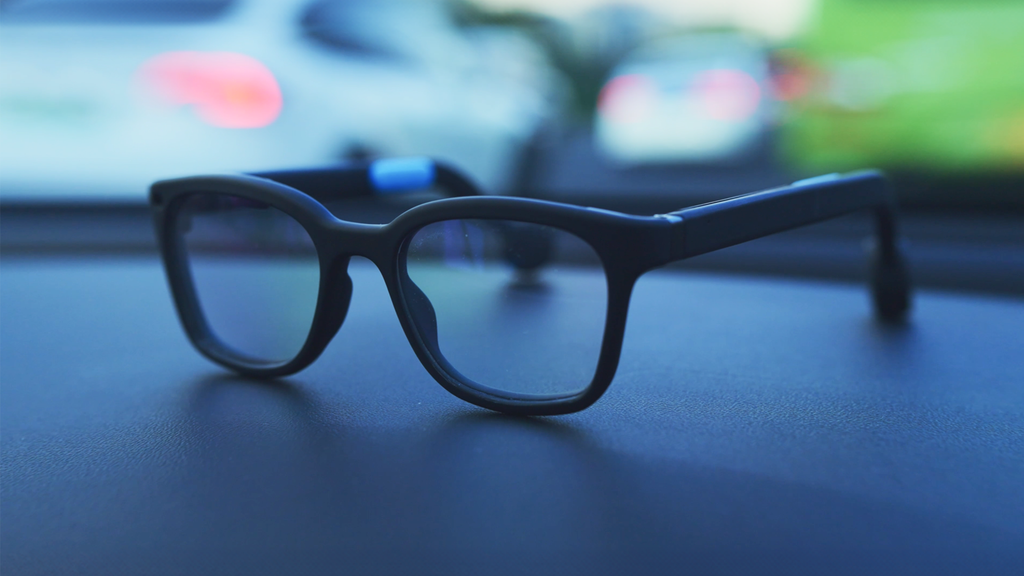
Brilliant Labs’ Halo glasses feature fully on-device processing, bone-conduction speakers, a 0.2-inch full-color display projecting a glanceable image into users’ peripheral vision, and all of the standard camera and microphone features one might expect with a pair of smart glasses. In other words, it’s a full-fledged smart device that rests on the bridge of its user’s nose, with a battery that lasts for up to 14 hours of normal use and a weight of just over 40 grams. At the moment, the Halo glasses sell for a base price of $299.
“We’re differentiated because we’re open source, and that’s not something that every company can or is willing to do,” said Brilliant Labs co-founder and chief executive officer Bobak Tavangar in an interview with GamesBeat.
When I received my Halo device in the mail, I was surprised to find that its display lens — the lens that projects an image into users’ right eyes — had fallen off of the device inside its box. Brilliant Lab’s user manual notes that this can naturally happen while adjusting the focus of the display, but seeing the small lens rattling around in the box made me realize how easy one could lose or damage this miniscule part. Brilliant Labs is working with its part manufacturer to offer replacement display lenses for sale, per Tavangar.
Using the Halo glasses is as simple as charging the device, turning it on with a button press, and connecting it to Brilliant Labs’ Noa app, a smartphone app allowing the user to control both an AI assistant and a host of homegrown apps. The AI assistant — dubbed Noa AI — is able to react to all images and audio recorded by the device without sending data into the cloud. Tavangar said this feature was intended to assuage users’ data privacy concerns, noting the ongoing perception that some smart glasses wearers are using their devices to record others against their consent.
“There are some companies that make money by harvesting the data of your life, and that’s not how we make money, but we do think it’s important for people to be conscious of that, and to understand the bargain that you’re engaged with when you’re using glasses from those companies,” Tavangar said. “We take a really different stance on privacy. All of the models that do the inference over the rich media — the images, the audio — we run that all locally on your phone.”
A built-in AI companion
Wearers of Halo glasses can converse with their Noa AI in real time or ask it to listen in on their conversations and take notes. They can also use a host of user-built apps to do everything from tuning guitars (with Noa listening to audio input) to editing photos taken by the device’s camera, turning Halo glasses into a one-stop mobile platform for the typical LLM user experience. Due to Halo’s open-source nature, users are already hacking it to push its capabilities further, with some members of the Brilliant Labs Discord community reporting that they’ve used its camera to generate video with frame rates of up to 15 frames per second.
The Noa app and Halo user experience are deeply inspired and influenced by video games. The app uses a pixel-art style and game-like sound effects; when first opened, it uses written prompts to help the user to create a custom, pixelated character. This character is placed onto an open-world environment layered over a real-world map populated by a range of non-player characters. Users can level up their own character by moving around the physical world and interacting with NPCs.
“We not only wanted people to feel like there was a fun and engaging experience as they have this agentic memory interaction, but we also wanted people to feel like this system sees them and hears them, and finds a lot of play and whimsy in the story of their life,” Tavangar said.
The Halo glasses’ gamified overworld and pixelated characters were fun to interact with at first, but after the novelty wore off, I felt there wasn’t much of an incentive to continue engaging with this part of the device. Tavangar assured me that more gameplay elements are in the Halo’s roadmap, including social elements like multiplayer or player-versus-player modes.
“We wanted to wait for a minimum threshold of people on the platform to understand how they use it, but also to understand how people connect with each other,” he said.

The past, present, and future of Halo glasses
The Halo glasses have undergone a series of production and development delays since Brilliant Labs announced the product — and its intended shipping date before the 2025 winter holidays — in July 2025. After missing several shipping targets over the course of 2026, the company is officially shipping out batches of Halo glasses this month. Tavangar attributed the delays to disruptions in Brilliant Labs’ supply chain, noting that the company has shared weekly production updates throughout the process.
“Ultimately, you’ve just got to ship. You’ve just got to get stuff in people’s hands, and that does allay the concerns,” he said. “But yeah, it’s been a period for us, that’s for sure.”
What I found most striking and exciting about the Halo glasses was the practical implications of a smart device that latently records one’s video and audio and records them using a responsive, AI-powered memory interface. While trying out the glasses, I spent time with a loved one who is suffering from the early stages of dementia. This person was extremely taken by the Halo glasses, immediately realizing they could be used to essentially replace their degrading recall by storing memories and lived experiences inside an easily accessible digital repository.
Although medical science has not yet found a cure for dementia, AI technology and smart glasses could represent a pathway forward — a use case that Tavangar said his team had kept in mind while designing the Halo glasses, although he made it clear that the glasses aren’t an established medical intervention or validated cognitive aid and that his company is not marketing them as such.
“We’ve seen that people in the broader community have been talking about this, and even if someone doesn’t have an illness which impairs memory, many of us, myself included, struggle to remember a name, remember a detail,” Tavangar said. “That was one of the impetuses, when we were going to the drawing board of ‘what are glasses for?’”
In 2026, augmented-reality smart glasses are gaining some traction, but remain a relatively niche market compared to other smart devices. Currently, only 6.4 percent of U.S. online adults say they own a pair of smart glasses, according to a Q3 2026 report by S&P Global Market Intelligence. Brilliant Labs is betting that this proportion will increase going into 2027 — whether through the fun of gamification or the benefits memory support — and the company is positioning its Halo glasses as the premier option for users looking to try out smart glasses in an open-source and data-private way.
“We think that in the years to come, when there are more and more of these glasses on people’s faces in public or private spaces, it’s going to matter that people trust who makes the glasses, and how that data is handled,” Tavangar said.