
Among the bigger country booths at GDC Festival of Gaming was the Brazilian Games booth run by Abragames, the Brazilian Games Association.
It was one of a number of game events where Brazilian game developers will show off their games at overseas events like GDC in San Francisco. It’s part of a strategy of enabling Brazil’s 1,000 game studios to export their work and make money for the country.
Speaking of the delegation of companies that showed up at GDC, Patricia Sato, program executive manager of Brazil Games, said in an interview with GamesBeat that these are exactly the kind of studios that the group wanted to attract. The companies were studios that often started with work-for-hire and moved up the food chain to create their own original ideas — including games that reflected Brazilian culture, Sato said.
“The work with the mentees in the studios in the accelerator classes is awesome,” Sato said. “We’re seeing a lot of traction building. We’ve been picking up activity from the studios, exactly the studios we want to attract inside the program.”
The accelerator has been operating for a short time, with the first stage now in progress. Training programs are taking shape.
I had a look at the Brazilian Games booth at GDC, and I’ve been going to Gamescom Latam in Sao Paulo for a few years and will return for this year’s show from April 29 to May 4. And I have to say that the games are steadily getting better.
“A lot of our games showcase different facets of Brazilian essence and Brazilian culture, which is something we identified inside the association,” Sato said. “So for the 40 studios that are being accelerated right now, many of them, like Talaka and Hermit Crab, they showcase a little bit of the culture in a subtle ways, but also very sensitive ways.”
The idea of exporting Brazilian culture to the world is similar to how the Japanese turned anime into a global phenomenon or how South Korea exported K-pop culture.
“We saw that the export of culture in a proper manner. We can assist a whole country to really create better a better state of life for the whole community, and especially for games. We are seeing this because games create immersion,” Sato said. “With games, culture easily slips in and gets into a more sensitive way of discussion. We have been leaning in very powerfully into the soft power of exportation of culture.”
Abragames sent 20 companies to the Tokyo Game Show last fall. It turned out the Brazilian companies loved the show, Sato said, as “Brazilians love Japan. I don’t know why I was so surprised but it was a really good arket for us.”
That’s why Brazil increased its presence at the GDC Festival of Gaming, even though the show shrank from around “near 30,000” attendees last year to about 20,000 this year.
“We need to be more here and show more of our games,” Sato said. “We are improving our showcase. We are improving our training as well with our accelerator. We want to foster this knowledge of Brazil. We are stronger when we grow together.”
In 2024, Brazil recategorized the legal framework for games, allowing it to gain access to cultural funding programs. Brazil has started giving grants to game studios for cultural benefits as well as innovation. And it is admitting more companies into accelerators.
“We are building a strong ecosystem for training companies,” said Sato. “We can foster new talent as well as grow senior talent.”
Ubisoft teams with Hermit Crab on Sportia — a multi-sport arcade game for the PC and consoles
Among the games on display was Sportia, a dynamic sports and exploration game aimed at the PC and consoles.
Sportia is an arcade sports game, much like Mario and Sonic at the Olympic Games, where you can play different sports minigames. But the game has its own Brazilian twists.
Sportia is an utopian land, lost somewhere in space and time, where beings from all worlds, universes, and legends come together to celebrate sport. Mythical creatures, aliens, weekend athletes, robots, and kids from the neighborhood all gather to play, compete, and have fun.
There’s a soccer version available as part of the demo, and the team is working on other single-player sports as well as basketball and rugby.
Hermit Crab Game Studio, a Brazilian independent game studio, announced the game back in October and it’s working in partnership with Ubisoft.
Sportia offers players a wide variety of characters with different skill levels and shapes, allowing them to play in a wide range of sports like street soccer. The goal here is to build your team based on the sport and compete against others in arcade-like games.
It’s the work of Matheus Vivian, Hermit Crab’s CEO, and Vitor Leães, head of product and creative director of Sportia. Leães walked me through a demo of the game at GDC. The game takes you to a city park that serves as a hub for the different sports. You can play soccer in the park and run around. You can grab on to a balloon and float around in the air, and do other whimsical tasks like that.
The goal is to develop a community and get fans coming back to play different sports minigames, which will be added over time. You can customize your athletes and teams and play diverse game modes. It’s local multiplayer and co-op, with versus game modes. It also has a single-player mode.
Hermit Crab is a Brazilian game studio with a team of 80 people. It’s already creating games for mobile and sports game experiences on Fortnite, Roblox and The Sandbox.
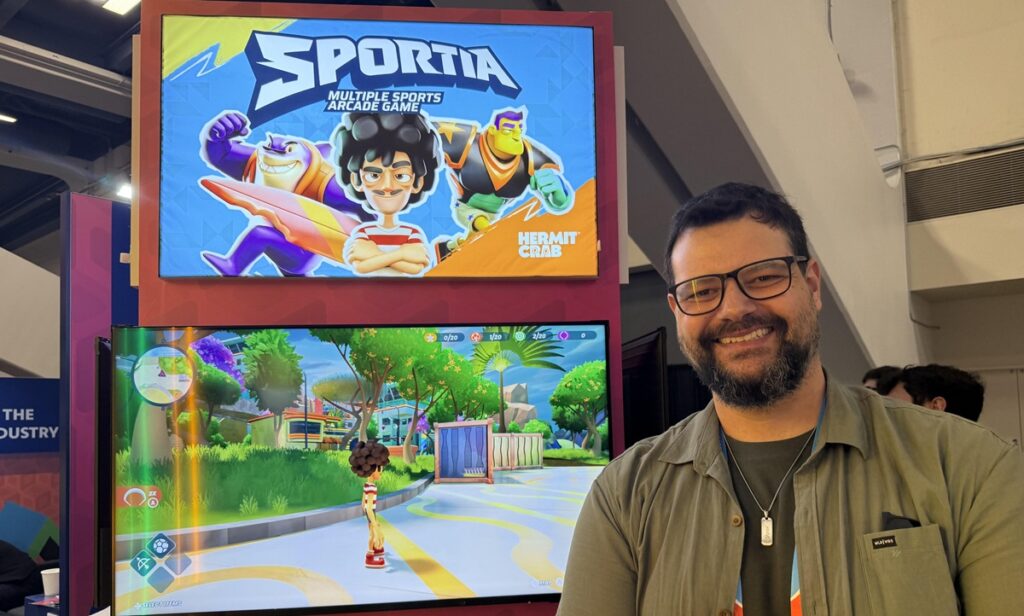
“The gameplay is very easy and arcade style,” said Leães. “We started developing on Unity, and last year we decided to change to Unreal. So right now we have this build with football community and another build with the RPG single player campaign of the game on Unreal.”
The team is adding an RPG layer with a story mode to connect the arcade games via a single hub and story mode.
“When you unlock athletes, you build your team, make quests, or do challenges with NPCs,” Leães said. “When they challenge you, or when you enter in a tournament inside the story, you play this arcade-style gameplay.”
The PC game is expected to release by the end of the year on Steam and consoles in 2027.
You can move around the hub, which is like a park, and play with your soccer ball, which is almost like a fashion statement. The aim is to release the game with 12 to 15 playable characters, each with a background and special abilities. In some games, you’ll “invade” another player’s turf and try to score a goal on their territory.
“As Brazilian kids, we play a lot in the streets, kicking the ball at targets,” Leães said.
The game will have licenses as Leães said that the company has already made partnerships with a lot of soccer clubs in Europe and elsewhere.
“We know that it’s impossible to compete with Nintendo in terms of party games and sports games like the Olympic games, but with this layer of RPG, we are bringing the charisma of the characters and the story and the game vibe. We want to offer for the audience another point of view of art style and mood and games,” Leães said.
The internal team has 12 developers, but there are other freelancers and outsourcing partners working with the studio, Leães said. Leães said he loves the game’s music from a famous Brazilian music teacher, as it reminds him of Carmen Miranda, a classic Brazilian star.
“We can showcase Brazilian essence and culture in this way that is relatable,” he said.
Ubisoft made a seed investment in the Hermit Crab Studio. It’s a relatively rare event for a Brazilian company to interact in such a way with a triple-A game publisher. Ubisoft isn’t the publisher, but it made the investment through its Strategic Innovation Lab at Ubisoft. Hermit Crab is still looking for a publisher.
Venn Studios shows off dark fantasy deckbuilder Rogue Reigns
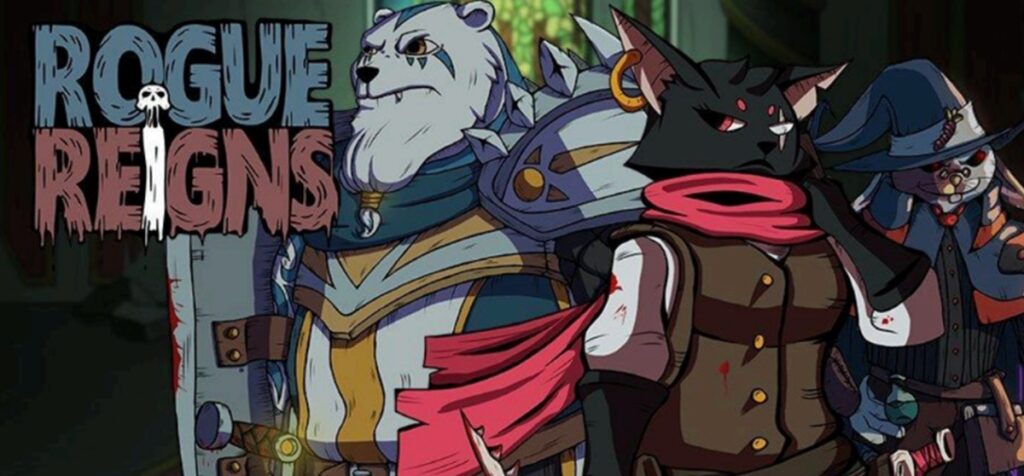
Continuing a string of showcases at game events around the world, Venn Studios, a Brazilian indie game studio from São Paulo, showed Rogue Reigns at GDC as well.
This dark fantasy roguelike deckbuilder runs directly in web browsers and has been tested extensively at major international gaming events throughout 2025. Hugo Neri, CEO of Venn Studios, said the company is making the web game with its own game engine.
Venn Studios, initially focused on financial markets, the team was making financial simulations. Then, after hearing feedback from others, the team figured its work was so cool that it transitioned to gaming, leveraging its engine for browser compatibility.
Once it made the decision, the team figured out what kind of game it could make.They got started on one title and decided to shelve it. Then the team focused on creating a new intellectual property from scratch. They decided to create a roguelite deck builder.
Built entirely from scratch using Three.js without any commercial game engine, Rogue Reigns delivers tactical deckbuilding combat in a corrupted world where immortality has
become a curse. Players assemble parties from six distinct classes to face corrupted rulers
across five fallen kingdoms, collecting artifacts that gradually reveal the world’s lore through multiple runs. The art is hand drawn.
When the game was announced, Neri said, “Rogue Reigns represents everything we’ve learned from our community over the years. We wanted to create something that captures the tactical depth of Slay the Spire while embracing the dark atmosphere and environmental storytelling we love in games like Elden Ring. Building it from scratch for browsers allows us to bring that experience directly to players wherever they are.”
The game features a three-point action system where every decision matters, with advantage/disadvantage mechanics that create dynamic combat scenarios. Six character
classes—Warrior, Barbarian, Wizard, Paladin, Rogue, and Ranger—offer distinct playstyles
and can be upgraded through encounters with corrupted NPCs who retain fragments of
their former selves.
Convention testing shapes development
As Sato said, testing the game at conventions helped with feedback. Throughout 2025, Rogue Reigns appeared at Tokyo Game Show, BCN Game Fest, and Milan Games Week, where direct player feedback has continuously refined the game’s interface and mechanics.
This convention-driven development approach has proven invaluable for creating intuitive systems that communicate clearly even in time-constrained demo environments. Part of the reason is that the Brazilians are aiming to make globally appealing games. They’re familiar with the huge success of Black Myth: Wukong and how that has vaulted Chinese gaming to the top of the charts.
Community-driven development
With over 100,000 subscribers on YouTube, Venn Studios has built Rogue Reigns alongside
an engaged community. The studio’s iterative approach emphasizes authentic
communication and evidence-based design decisions, incorporating player feedback at
every stage of development.
The browser-based architecture makes Rogue Reigns uniquely accessible while maintaining the depth and replayability expected from the roguelike genre. The technical approach allows for offline play at events and seamless access for players testing the game online.
Global expansion and transmedia vision
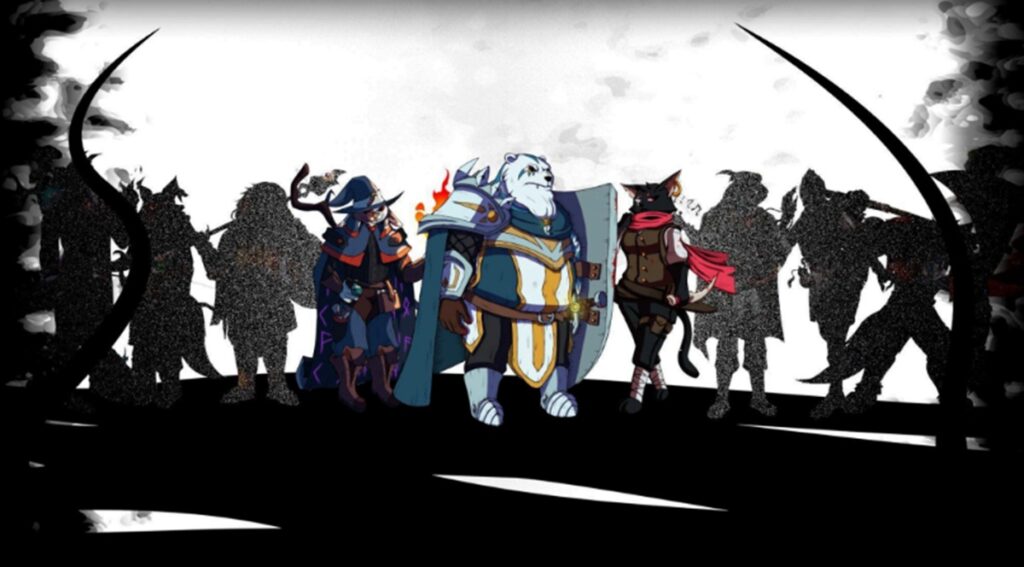
Rogue Reigns is part of Venn Studios’ broader vision of “building transmedia franchises, one game at a time.” The studio views each game as an opportunity to develop proprietary technology alongside engaging player experiences, with Paradoxical also in active development.
Following GDC 2026, Venn Studios plans to continue expanding its international presence
with appearances at Gamescom Latam, Tokyo Game Show 2026, and Gamescom in Germany. The studio is also actively exploring opportunities in Asian markets, with particular interest in South Korea’s vibrant gaming community and potential future
expansion into China.
Rogue Reigns is available to wishlist now on Steam. Venn Studios has 13 people in São Paulo and a community over over 100,000 YouTube subscribers.
Talaka is a fast-pace roguelite that brings Afro-Brazilian mythology to life
Talaka is a fast-paced, combat-driven roguelite that brings Afro-Brazilian mythology to life in a vivid, hand-painted world. Acclaim, the reborn American game publisher, is publishing the original title from developer Potato Kid.
You play as a young warrior who once believed in the old legends—the stories of Orisha gods, mystical creatures, and ancient realms. But as time passed, the myths faded. Forgotten by the world, the legends have begun to unravel—twisting into chaos, breaking the harmony between worlds, said Paulo Santos, game designer at Potato Kid, in an interview with GamesBeat.
Now, you must journey across dreamlike landscapes, reconnect with divine forces, and uncover why the myths have gone rogue. With the Orisha by your side, you’ll fight to restore balance before the stories vanish forever.
Featuring lightning-fast action, dynamic roguelite runs, and a stunning watercolor-inspired art style, Talaka turns your controller into a paintbrush and every battle into a living canvas. Will you rewrite the myth—or let it fade into oblivion?
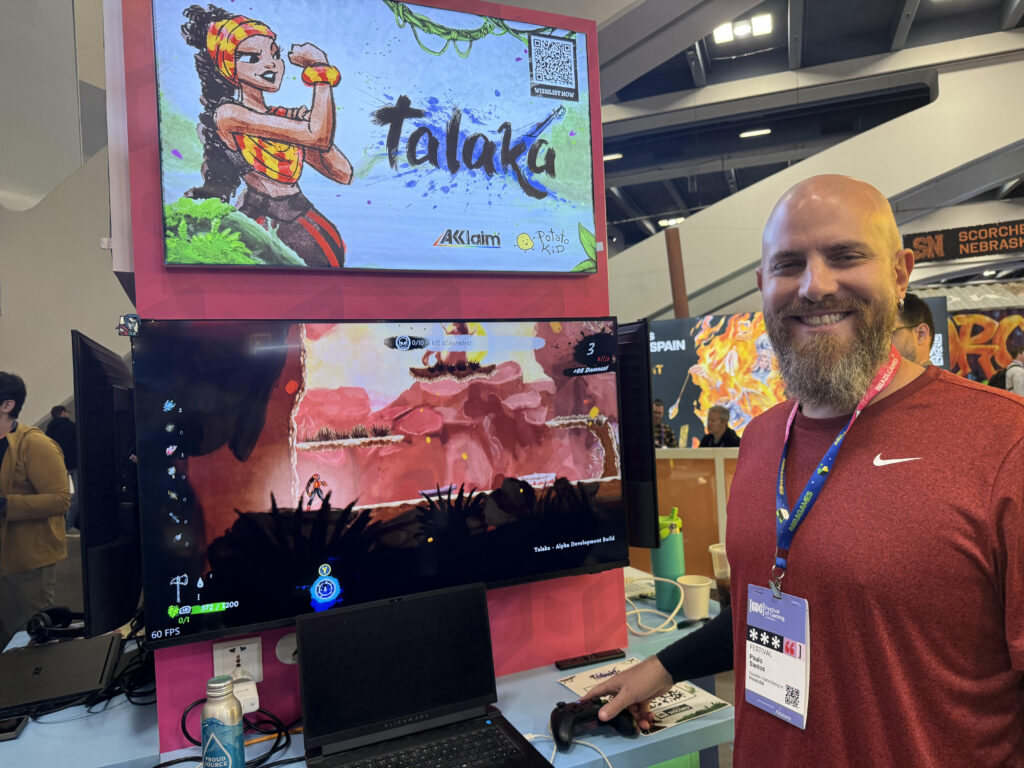
The enemies include Brazilian demi-gods known as Orishas. You also fight twisted legends who once protected the land. The boss fights require skill, timing, and deep knowledge of mythic patterns.
In the game, yuou can explore lush, watercolor-painted biomes inspired by Afro-Brazilian heritage, Candomblé rituals, and jungle folklore. Every area is alive with ancestral magic and hidden stories.
It features dynamic, roguelite combat. Every run offers new challenges, powers, and god-blessed weapons. Dodge, parry, and paint your way through corrupted spirits and celestial beasts in fast-paced, reactive combat.
You can choose your path. Players can shape Talaka’s fate through branching narratives, blessings from gods, and critical moral choices. Will you bring peace—or become the next legend?
The sound track lets you experience drums, chants, and melodies crafted in collaboration with Afro-Brazilian musicians, evoking the divine rhythm of a world on the edge of rebirth. The game has a “mythvania” familiarity with fast, fluid, high-stakes combat with panic-rolls, parries, and god-tier weapons. It has dynamic runs with ever-changing relics, mutations, and divine boons. There are no checkpoints. You can learn enemy patterns, grow stronger and try again. You can unlock new paths and powers after each attempt—open shortcuts, discover forbidden shrines, and bargain with ancient spirits.
And you can tap immersive Afro-Brazilian mythology brought to life through hand-painted art, mythic enemies, and original soundscapes rooted in ritual.
Santos said Talaka has been in the works for a couple of years. It’s a 2D action world, where everything you encounter on the screen is inspired by Brazilian culture, he said.
He pointed to one of the characters, an Orisha of the crossroads and pathways. He’s a non-player character (NPC) that guides you on a journey.
You can play the game shifting between different weapons, the boomerang or the hammer. Santos showed me the hammer, which is a heavy hitting weapon with a slow wind up. All told, there are 25 weapons.
The game has a Hades-like loop, where you choose the reward in the next room. You can choose a reward like survival If you clear the enemies in the next room, you can claim your reward. Each room is handcrafted.
“You clear a loop of the game and grab some shiny resources. And every time you do a room, you meet one of the Orishas that will bring you something to help you in a journey,” Santos said. “Everything in the game is hand like hand animated frame by frame. We got this watercolor art style, something that makes it unique. I want people to come for the art and stay for the gameplay. That’s kind of what we’re trying to accomplish here.”
There are traditional Brazilian features like a native rattlesnake. The combat resembles that of Dead Cells on a 2D screen with a lot of movement. And it’s like Hades in terms of the structure of how things work. Overall, the game will have about 60 levels.
The team has been together for a while, starting at a different company in 2018. They did work-for-hire jobs and moved up the food chain in 2024 to restart the work on the original game. They dusted it off and started working on it again. The team is just three people, with a gamer designer, an artist and a programmer. An outside company, Moon Sailor, is doing the music, and there are some external helpers. They have all worked together in the past.
“We have good rapport and good chemistry working together,” he said. “It’s a small team and that’s on purpose.”
Eden’s Frontier revives the energy of retro 90s games with a fresh vision
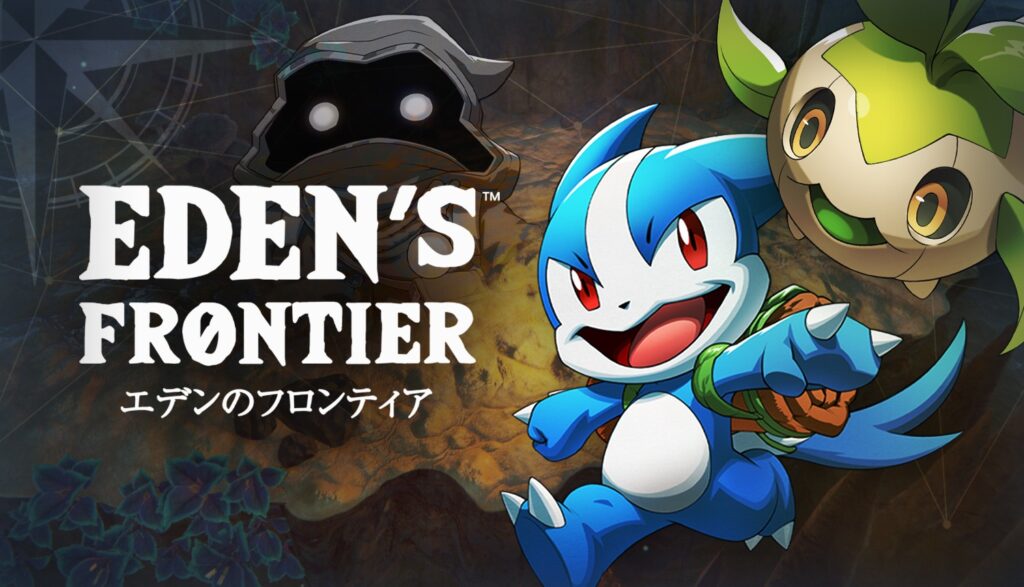
Eden’s Frontier was created to bring back the days of the 1990s and 2000s games, when titles were defined by unforgettable worlds. Frontiers Group Entertainment aims to reignite the essence of classics that shaped an entire generation and captivated players worldwide, while delivering a brand-new experience reimagined for today.
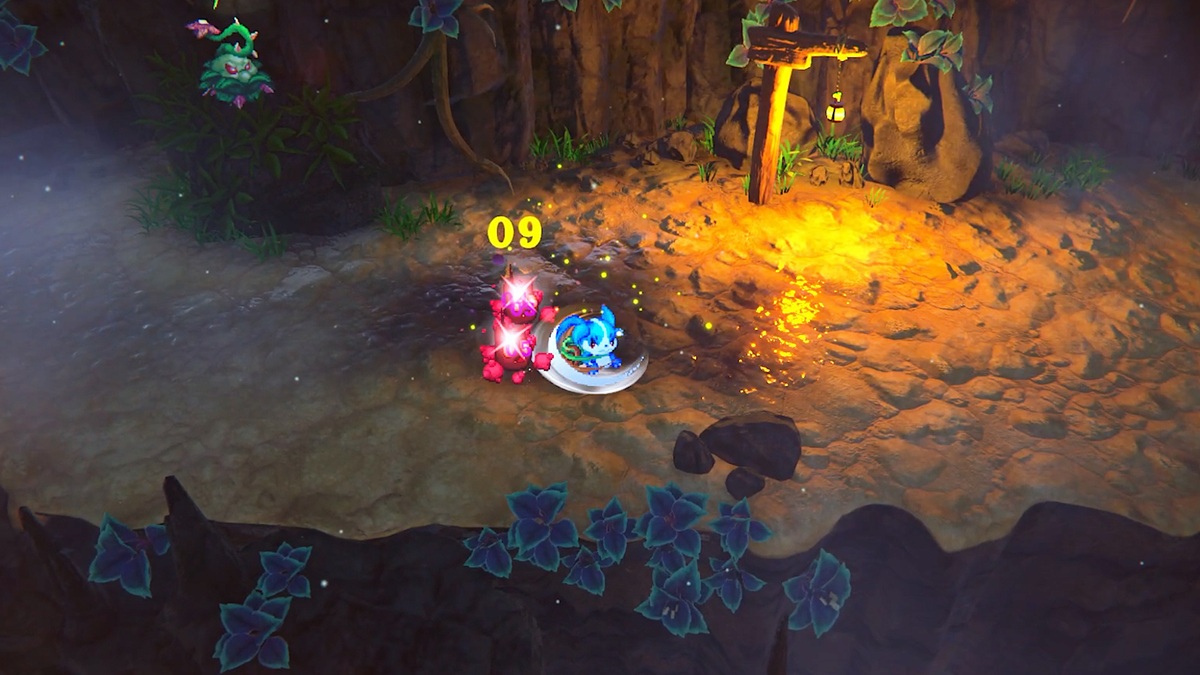
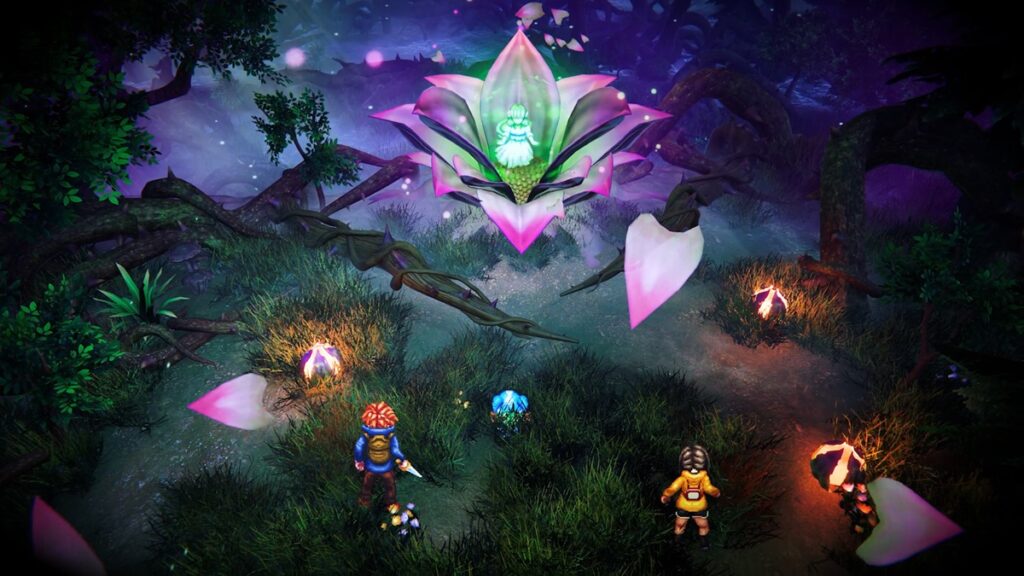
In a real-time action RPG focused on direct, fluid combat, the retro game blends HD anime-inspired pixel art with 3D environments. You begin your journey with Blu, one of the three protagonists, exploring the unknown on the path toward a mysterious new land.
Explore, fight, collect, and rebuild Spiral City
Players are invited to explore a world filled with races, kingdoms, and hidden threats that emerge mainly at night. The day and night cycle is one of the core elements of the adventure, with specific events occurring depending on the in-game time. These changes affect encounters, unlock new explorable areas, and introduce fresh challenges.
The game’s narrative is intertwined with an original and free comic set in the same universe. In it, you are introduced to Seth, Maria, and Blu, the protagonists of the game’s story, and learn more about the civilizations and locations they inhabit.
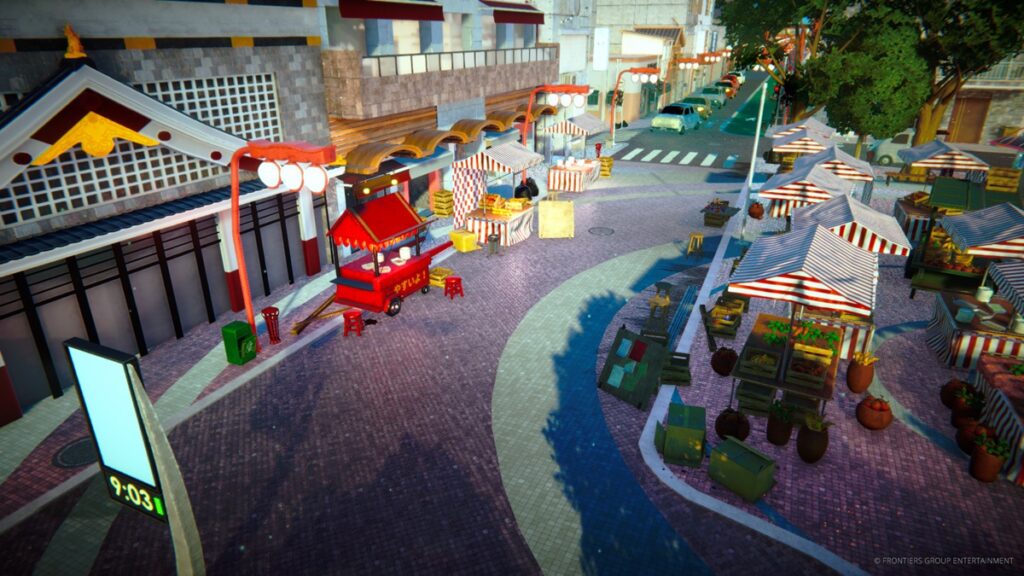
The concept goes beyond fantasy by also featuring explorable urban environments from the real world, such as an explorable replica of the Liberdade district in São Paulo, Brazil. The area is known for its strong Asian cultural influence and for being located in a region with the largest Japanese and Japanese-descendant population outside Japan.
The game also features progression systems involving recruitment for Spiral City, as well as a collectible, playable card system. These cards can be upgraded and equipped to assist the player during real-time action combat.
A childhood dream becoming reality
Jean Felipe, creator and director of Eden’s Frontier, alongside the team at Frontiers Group Entertainment, a studio based in Sorocaba, São Paulo, Brazil, is bringing a childhood dream to life:
Jean Felipe, CEO of Frontiers Group Entertainment, was showing off Eden’s Frontier for the first time. The game is based on an original manga-style comic book.
Eden’s Frontier has some inspiration from Souls-like games, with also beat-em-up and hack-and-slash RPGs. There are multiple playable characters with different comic-book looks. It’s got beautiful 3D environments merged with cute pixel-art characters.
There is one scene that is based on a real Brazilian neighborhood called Liberdare. (There happen to be a lot of Japanese ancestry people living there. You can explore the place and it has a look of realism to it.
The game was heavily inspired by Brazilian culture and Japanese culture.
“But also I got a lot of inspiration from Ragnarok Online, the classic game with pixel art style and environments,” Felipe said. “There’s another type of Brazilian essence, which is very much tied to the immigration process that we’ve had. For us, we are in countryside of San Paolo as a huge colony of Japanese people. So this is a chance for narrative here.”
Felipe said you can explore the areas and collect items. But the mechanics go far beyond battling and collecting. You have to solve puzzles or move around like Sonic the Hedgehog, viewed from a third-person view. It has inspirations from Dragon Quest and Final Fantasy IX as well.
“We will be running through a tunnel and getting some items and evading some crystals and rocks, almost like the old Tempest game.
“We have been putting a lot of love in this game because a lot of PlayStation, Sega and Super Nintendo games are the inspiration for us to make this game,” Felipe said. “This is Zelda-style world building.”
The game has linear parts, where you follow a path, and it hhas an open world section with day and night cycles. At night, the environment gets more dangerous with more monsters.
“Things will be very tough at night, and it will be harder for players to explore,” he said.
The team has five people and it has been working on it for 15 months or so, he said. Felipe said he invested a lot of his own money and is doing work for hire as well. The goal is to give players 15 hours of gameplay and finish the game in a year or two.
With careful attention to detail, from a soundtrack to a visual identity that resonates across generations, Eden’s Frontier aims to deliver an experience accessible both to fans of classic games and to new players.
The project is already available in a multimedia format through a free, fully colored online comic presented in webtoon format. Localized in English, Japanese, and Brazilian Portuguese, readers can already access 43 pages available on the project’s official website.
“The comic is a key piece of this project,” Felipe said. “The idea is to have multiple multimedia fronts that connect within a single story in an accessible way for everyone. Hiro is the protagonist introduced in the comic and, despite his importance to the game’s plot, he is not one of the game’s protagonists. We want players to feel immersed in this universe, knowing that everything they follow is canonical and important to the story.”
A new universe inspired by a love for PlayStation 1 and Sega games
The game’s Steam demo is currently in development, based on the version showcased at events such as Brasil Game Show, which partnered in the project’s initial promotion. The game is also confirmed for GDC 2026. The feedback at shows was positive.
“I grew up playing on the PlayStation 1 and Sega consoles, and it is impressive how people at the event recognize those influences,” Felipe said. “Many visitors came to the booth mentioning Final Fantasy, Sonic, Ragnarök Online, and even Klonoa. I really did not expect people to remember Klonoa, but I am glad they did. That game was an important part of my childhood.”
More information, images from the universe, and a future demo can be found on the game’s official Steam page. Eden’s Frontier is Frontier Group Entertainment’s first game, currently in development and based in Sorocaba, São Paulo, Brazil.
Paradoxical is coming from Venn and Gubebra
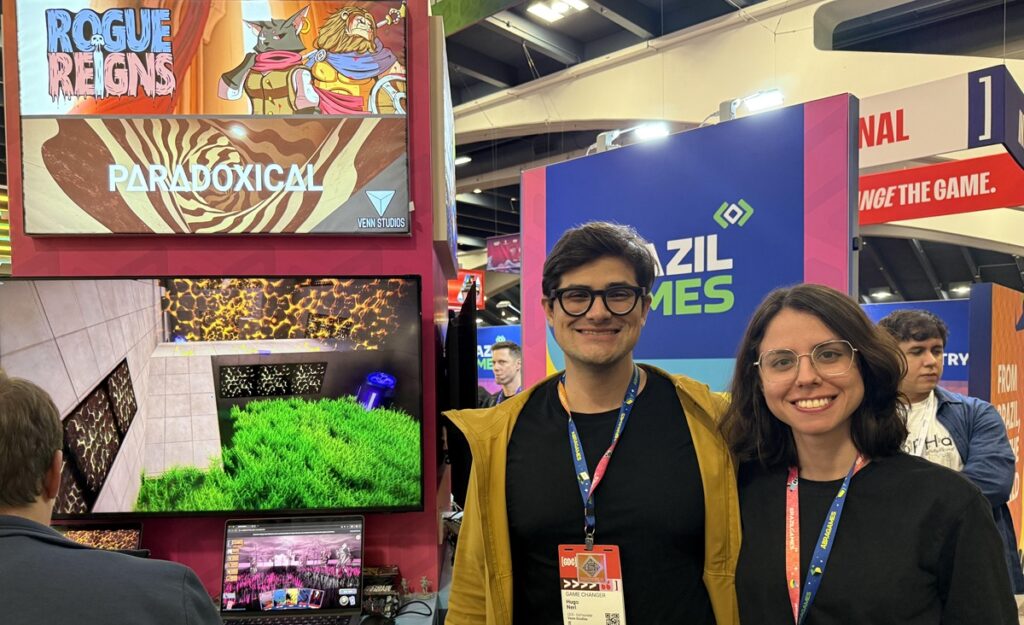
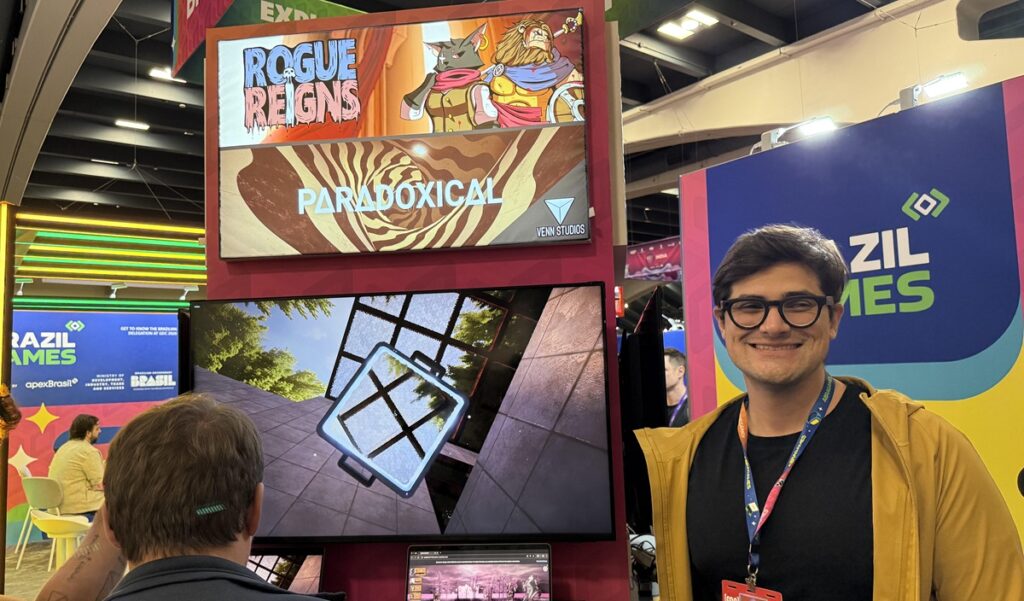
I also got a chance to see Paradoxical, from developer Gubebra and publisher Venn Studios. Hugo Neri, CEO of Venn Studios, the game was inspired by Valve’s classic game Portal, where you move from one part of a map by going through portals in another dimension.
Gubebra is making the game with the Unity game engine. Paradoxical is a first-person puzzle game with surreal and minimalist art. Like in Portal, you can create a portal in one part of a scene and create another portal in another place. When you enter one side, you’ll come out the other, possibly moving between walls or putting objects through the portal.
Paradoxical features dynamic gameplay, multiple character classes, and a visually rich environment. The team, consisting of 14 members, has been developing the game for about a year and a month, with ongoing iterations and playtesting.
The game uses procedural algorithms to generate the landscape like trees. It’s not AI-based vibe coding. It’s more like what you see in games like No Man’s Sky, where the algorithms draw the objects. It’s mathematically generated rather than hand painted. That helps compensate for having a small team.
The game has garnered significant interest, averaging 100,000 views per day on YouTube. The team is self-funded, and it has an investment from one of its partners and indirect support from the Brazil Games.
Funding is self-managed, with some investment from a partner, and indirect support from government incentives. The team is using YouTube to communicate with the community and get feedback on the game.
“Each character is simple, visually. The environment is is rich because we developed our own engine so we make sure that everything will be connected. If a wizard casts a fire spell, the grass should catch fire as well,” he said.
“Our goal right now is just reset the playtesting and regularly do rounds of playtesting just to keep refining it,” said Neri.
Disclosure: The Brazilians are paying my way to Gamescom Latam in Brazil, where I will moderate a session at the B2B event.