
The Ethical Games group has unveiled its latest draft of its code of ethics for the game industry.
Led by user experience designer and researcher Celia Hodent, the group believes that games should be made in an ethical manner focused on benefiting both players and game industry workers. Hodent now wants to get game leaders to endorse the code or help with revisions of it as a living document.
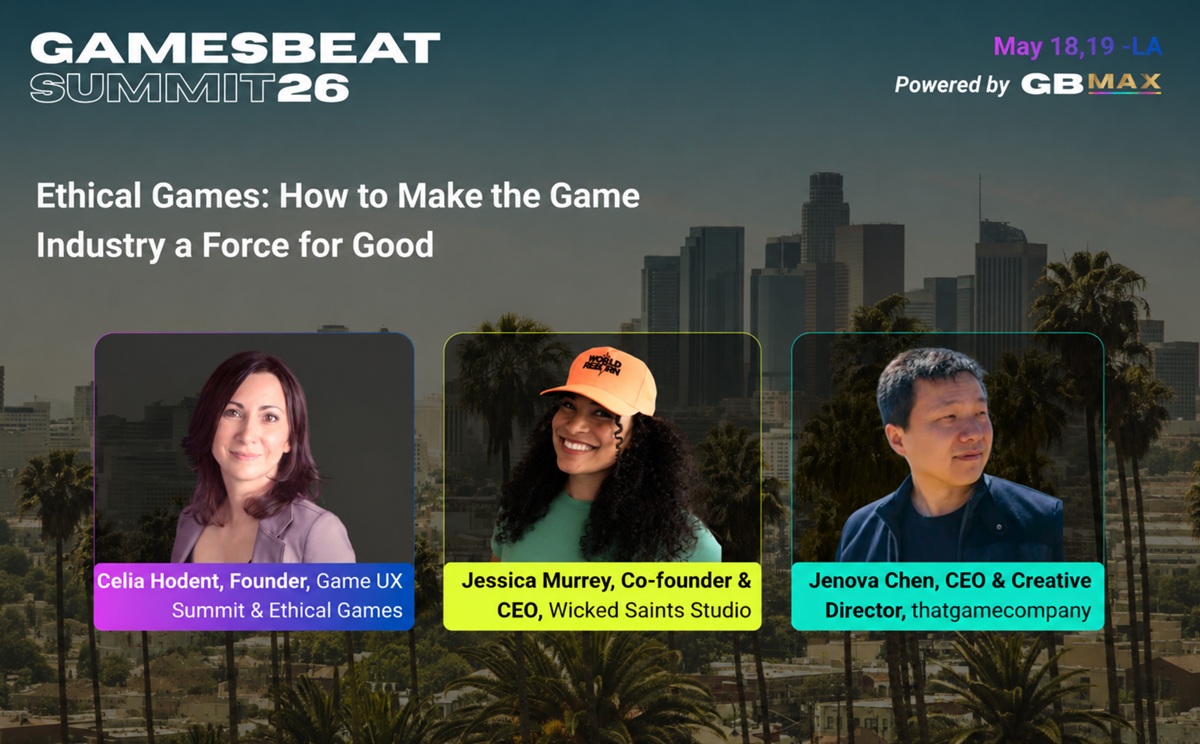
I will be moderating a session on the topic at GamesBeat Summit 2026 today at 3:30 pm. to 4:30 pm Pacific time at our event at the Marina del Rey Marriot. The session is entitled Ethical Games: How to actively make the game industry a force for good. Our speakers include Hodent, an independent consultant who has a doctorate in psychology and is author of the book The Gamer’s Brain: How Neuroscience and UX Can Impact Video Game Design; Jenova Chen, CEO of Thatgamecompany and maker of games like Sky: Children of Light and Journey; and Jessica Murrey, CEO of Wicked Saints Studios.
Hodent said the next step is to get game industry leaders to give feedback on the latest version of the code.
“What is acceptable as is and what needs tweaking or is not clear. There’s a survey on the website (ethicalgames.org) that they can fill in,” she said.
She noted that in June, the group will have another round of workshop with TIGG and DigiSoc (the academic group) to iterate on it another time. The hope is to finalize the code this year and have studios ready to sign it and back it up. Then, next year, the group can start working on practical guidelines.
Video games have significant reach in society: supporting employment in the creative industries, engaging audiences of all ages and backgrounds across the globe, and serving as pieces of interactive art.
As video games continue to attract audiences and become part of the fabric of society, it is important to acknowledge the positive and negative impacts that these games have on these audiences. Moreover, games provide a cultural space where a relationship is formed between the game creators and the players, and between players. These relationships call for an agreed set of values amongst all involved.
Hodent said that she believes it’s important to make CEOs in the game industry understand that it’s in their interests to abide by a code of ethics. After all, consumers favor companies that do business in an ethical way. As with any other business decision, there are cost-benefit trade-offs. It’s up to the CEO to decide what is non-negotiable.
Among the trade-offs? Back in the day when everyone worried about video game violence, it was important for the industry to step up and regulate itself with the Entertainment Software Ratings Board (ESRB), which set age ratings for games.
Now, there are a lot of lawsuits related to children’s participation in online games. Once again, the industry is attempting to regulate itself with technologies like AI content moderation, age estimation, and proof of age documentation. Hodent believes that if regulation comes, it’s best if it is based on research, not moral panic.
Hodent has noted the entire game industry benefits from a shared set of values and understandings around the ethical acceptability of the different aspects of the game-making process, from conception to development, publishing, deployment, and ongoing monitoring and maintenance of games and game communities. Open discussions around these ethical issues promote accountability and transparency.
The present code of ethics – elaborated by worldwide scholars, game industry professionals, educators, regulators, and players – expresses the values and professional conduct of the game industry. (I participated in one session early on).
The code in is present form says, “We strongly value global perspectives, feedback, and collaboration. However, because this initiative has been primarily led by contributors based in Western regions, this code is currently intended for game industry professionals operating within Western contexts, in recognition of and respect for the autonomy of other regions to develop guidance that reflects their own cultural and professional frameworks.”
The code continues, “The Code is meant to voluntarily guide the ethical conduct of game industry professionals and aspiring professionals and include game-industry adjacent professionals, such as educators, students, influencers, video-game event organizers, or streamers. The Code includes principles formulated as statements of responsibility for those involved in the game development and publishing processes. Each principle is firmly grounded in academic research and is supplemented by guidelines, which provide explanations to assist game industry professionals in understanding and applying the principles.”
“Signatories of this code of ethics acknowledge that games should be made in an ethical manner focused on benefiting both players and game industry workers.”
Ethical principles for the protection of players
1.1. Protect players from social harm
Games and platforms should be designed with proactive consideration for how communication tools and interaction systems may increase or reduce exposure to harassment or disruptive conduct, and aim to create social spaces that are welcoming, respectful, and enjoyable for players.
Players should be able to enjoy a game without encountering social harm and disruptive conducts (e.g., harassment, discrimination, exposure to harmful ideologies, abuse) within the game and its ecosystem, whether online or during in-person events (e.g. conventions or esport competitions). These behaviors should be addressed in a timely manner by employees trained on this matter.
When the game studio, publisher, or platform is enabling a social space around a game, or organizing an in-person or remote event, a code of conduct should be established and enforced. It should be clearly communicated and offer an actionable ability to safely report any disruptive conduct. Players of multiplayer games should have to formally acknowledge the guidelines before participating.
If the game or platform allows for user generated content (UGC), creators should be made aware of the present code of ethics and formally acknowledge it. The platform owner is responsible for enforcing the code of ethics among creators.
Algorithmic systems should be monitored for unintended bias, exploitation, or harm.
1.2. Respect players’ time & money
Players should feel free to engage with games when and how they choose. Engagement systems, including notifications, time-limited events, and progression mechanics, should be designed to support enjoyment and avoid manipulative or coercive design practices. Players should not feel that their disengagement with a game or platform may be penalized.
Monetization systems should respect player autonomy and informed choice, and should not rely on deceiving or psychologically exploitative design practices (e.g., temporal, monetary, or social dark patterns). Psychological tricks (e.g., gambling-like mechanics or loss aversion) should not be used to encourage players to spend more time and money in a game they would have otherwise.
1.3. Respect players’ data privacy
The collection and use of player data should be transparent and initiated with explicit consent from players or their guardian when minors.
Brain imaging techniques and brain activity metrics (e.g. EEG, MRI) should not be used for marketing or business purposes (e.g., maximizing retention or conversion). Those techniques should be avoided for development purposes of commercial games (with the exception of therapeutic games).
Telemetry data collected should respect players’ privacy. Studios, publishers, and platforms should understand and uphold their responsibilities under international data protection frameworks (e.g., General Data Protection Regulation or GDPR), including obligations that apply outside their primary operating region.
1.4. Design inclusively
Games should be inclusive and accessible. They should be welcoming to players regardless of their ethnicity, sexuality, gender, faith, culture, and geography. They should avoid unnecessary barriers (i.e. those that are not central to the enjoyment of the gameplay) to be accessible to players with disabilities. When such barriers exist, players with disabilities should be clearly informed about them before they download or purchase the game.
Games are free to explore difficult, controversial, or emotionally challenging themes as part of artistic expression. When doing so, studios and publishers should approach these topics with care and responsibility, reflecting on how design choices may impact different players and communities. Rather than prescribing moral outcomes, designers should consider the potential consequences of player actions within the game world and the broader context in which those actions are experienced (i.e., considering players as moral agents within the game world).
If a game explores sensitive topics or portrays potentially harmful behaviors, studios and publishers should take care to educate themselves, seek informed perspectives, and consider how their work may impact marginalized communities. Game professionals should be mindful of who could be affected, how harm might arise, and whether challenging content serves a meaningful purpose beyond shock value.
When games include material that may affect players’ physical (e.g., flashing lights) or mental wellbeing (e.g., depictions of violence), clear and accessible content information should be available both before purchase and within the game.
If the game is published across multiple territories, the cultural adaptation of content (a.k.a. culturalization) should be considered to be respectful of local expectations, and in some cases, local regulatory necessity.
1.5. Operate transparently
The time and money that players have invested in the game overall should be clearly communicated to them (or to their guardians for minors) and this information should be easily accessible in-game.
Players should have a clear understanding regarding the data collected from them and how the marketing and game systems might adjust to their behavior (e.g. customized marketing offers or dynamic difficulty adjustment of the gameplay).
Games may include intentional mystery or misdirection when it is central to the player experience; however, players should not be misled about the fundamental nature of gameplay systems. For example, players should be clearly made aware when they are playing with or against AI-controlled participants.
1.6. Protect minors
Protection of children (i.e., under 18 years of age) should be an absolute priority. If minors are playing a game or participating in an event, all of the above considerations should be strictly enforced.
Industry professionals must acknowledge that children have a maturing brain and are protected by specific rights. Games explicitly developed for and/or marketed to children should be respectful of children’s right to play safely and without time or financial pressures.
Companies should not exploit minors’ vulnerability to psychological pressures (e.g., gambling-like mechanics or dark patterns) for any purpose.
Protection of minors in the game’s social spaces should also be a priority. Implementing proactive and reactive policy, tooling, and education (when applicable) around online social harms (e.g., harassment, abuse, pedocriminality, grooming, bullying) to prevent such harms from occurring and, when that is not possible, be addressed in a timely and transparent manner.
Games targeted to children should be designed with their physical, mental, affective, and social well-being in mind (e.g. using UNICEF’S RITEC framework & toolbox).
Ethical principles for the protection of game workers
2.1. Company values
The ethical principles that guide how game professionals treat players should also inform how companies treat employees and how they design in-game systems and virtual characters. Consistency in these values helps foster respectful workplaces, trustworthy player relationships, and responsible creative expression.
Precise company values should be defined at the company level and enforced (e.g. the IGDA Core Values & Code of Ethics should be respected).
Game companies and ecosystems should work towards creating and maintaining a community where open communication, respect, and knowledge sharing is a standard, with the purpose of raising the ethical bar in the game industry.
2.2. Workers protection
Harassment, abuse, hateful speech and behaviors between colleagues should not be tolerated. Reports of such behaviors should be taken seriously and lead to consequences when confirmed.
Exploitative work practices that compromise workers’ physical and mental wellness (including sustained overtime or “crunch”) should be actively prevented through responsible planning and production practices. Any exception should be rare, minimal and clearly bounded, transparent, and supported by appropriate compensation and recovery time with safeguards to prevent disproportionate impact on marginalised workers.
Company employees interacting with players on social media should be supported and protected against potential harmful behavior and speech from the public. A plan of action detailing how to react in case of public harassment of an employee should be elaborated before any incident happens, and the company should publicly state that such harassment against their employees is not tolerable.
Companies should strive to ensure the work environment, policies, and structures promote well-being and respect, transparency, and an open feedback culture.
All work or inspiration should be compensated, or at least credited. Use of copyrighted art should be disclosed, including when using generative AI tools.
2.3. Diversity & Inclusion
The company should be inclusive and accessible, which includes the consideration of implicit biases in company policies and practices.
Companies should invest in inclusive practices that broaden perspectives, reduce bias, and support equitable participation. Efforts should be intentional, resourced, and transparent, with a focus on meaningful outcomes.
Diversity and inclusion should be embedded throughout the organisation rather than treated as a function owned solely by human resources. Responsibility should be shared across roles, with executives, managers, and employees contributing in ways that reflect their scope of influence and decision-making authority, while ensuring that the work of inclusion does not fall disproportionately on individuals from marginalised backgrounds.
2.4. Environment
Company executives should reflect on the impact of game development and servers on the environment, and make it an urgent priority to reduce their carbon footprint (e.g. consider joining the UN Playing for the Planet initiative).
The group that created the document so far comes from the game industry, academia and gamers themselves. Many people have participated in the elaboration of this first draft, and many more have given precious feedback. The objective is to ultimately provide evidence-based guidelines whenever possible, which is why academic researchers are sought to lead this initiative.
A conversation on ethical games
Our session will focus on issues for discussion. In a prep call, our group had a very interesting preliminary discussion.
Before the pandemic, there was a lot of concern around gaming addiction. The World Health Organization began research into that topic. But then the pandemic came and platforms like Roblox were credited with saving a lot of kids, helping them socialize with each other at a time when they couldn’t go outside. Learning programs developed on top of Roblox, and games were credited with saving the mental health of so many people.
But the concern about addiction didn’t go away. Matthew Ball, CEO of Epyllion, said in his state of the game industry deck that addiction industries — such as Only Fans, AI companions, sports betting, online gambling, YouTube, TikTok and prediction markets — were growing so fast that they were taking attention away from games.
We can see the increased scrutiny for child safety in games as a result of new laws passed in Brazil, Turkey and elsewhere. It’s happening now because so many of our games are now multiplayer titles with chat enabled, rather being than single-player games.
Australia banned social media, Meta lost a big court case on the harms of social discourse, and public opinion has shifted on whether AI is welcome if it means a lot of job losses or data centers that could drain the power grid of electricity and drive up energy rates.
Murrey said that data showed that 97% of Wicked Saints Studios’ players say the game, World Reborn, makes them feel good an confident.
“There’s a perception that a game can’t be both fun and good, but if its doing good, then it is not fun, and this is so predominant in the games world,” Murrey said.
I asked if some would push back against the code of ethics because it could advocate censorship, as it would likely come down hard on developers who make a game such as Grand Theft Auto, where a lack of morality is central to the gameplay and narratives.
Hodent believes it’s fair game for video games to take on the subject of violence. It’s a valid subject, but she counsels companies to approach it with care, so as not to stigmatize populations that are already stigmatized in real life. Some times it is appropraite to show the world from its “darkest corners.” She also noted the code of ethics is a voluntary code, and so it’s not about censorship.
“We’re only saying, ‘Hey, if you talk about sensitive topics, just do it with care. That’s all we’re saying,” Hodent said. “We see that it’s difficult, and the point of ethical games is not only to define a code of ethics, but also to provide resources and to connect with researchers that can help. That’s going to be the second part. Once we can agree on a code of ethics, and also to then provide a bunch of resources, a playbook, and more.”
Murrey said that her work at Wicked Saints Studios shows that if you go the extra mile of enabling your player to good for the world, it has other amazing benefits.
“We designed our platform to activate players in real life to do good both on and offline, and while we’ve been really pushing on that, we’ve been trying for years all of these different ways and things of doing it. Now we’re finally getting to a place where we’re actually activating them to do good in the real world, and what we’re finding is that we also have these wildly crazy high conversion rates for brands while we’re doing this,” Murrey said.
She noted that the conversion rate for brands is about 31%. That’s magically high compared to 1% conversion rates in many other cases.