
How do Western game developers, primarily those based in English-speaking countries, approach a market like China? That’s the question at the heart of “By The Book? Western Developer Perceptions of China’s PC Games Market,” the latest report from gaming platform Rokky.
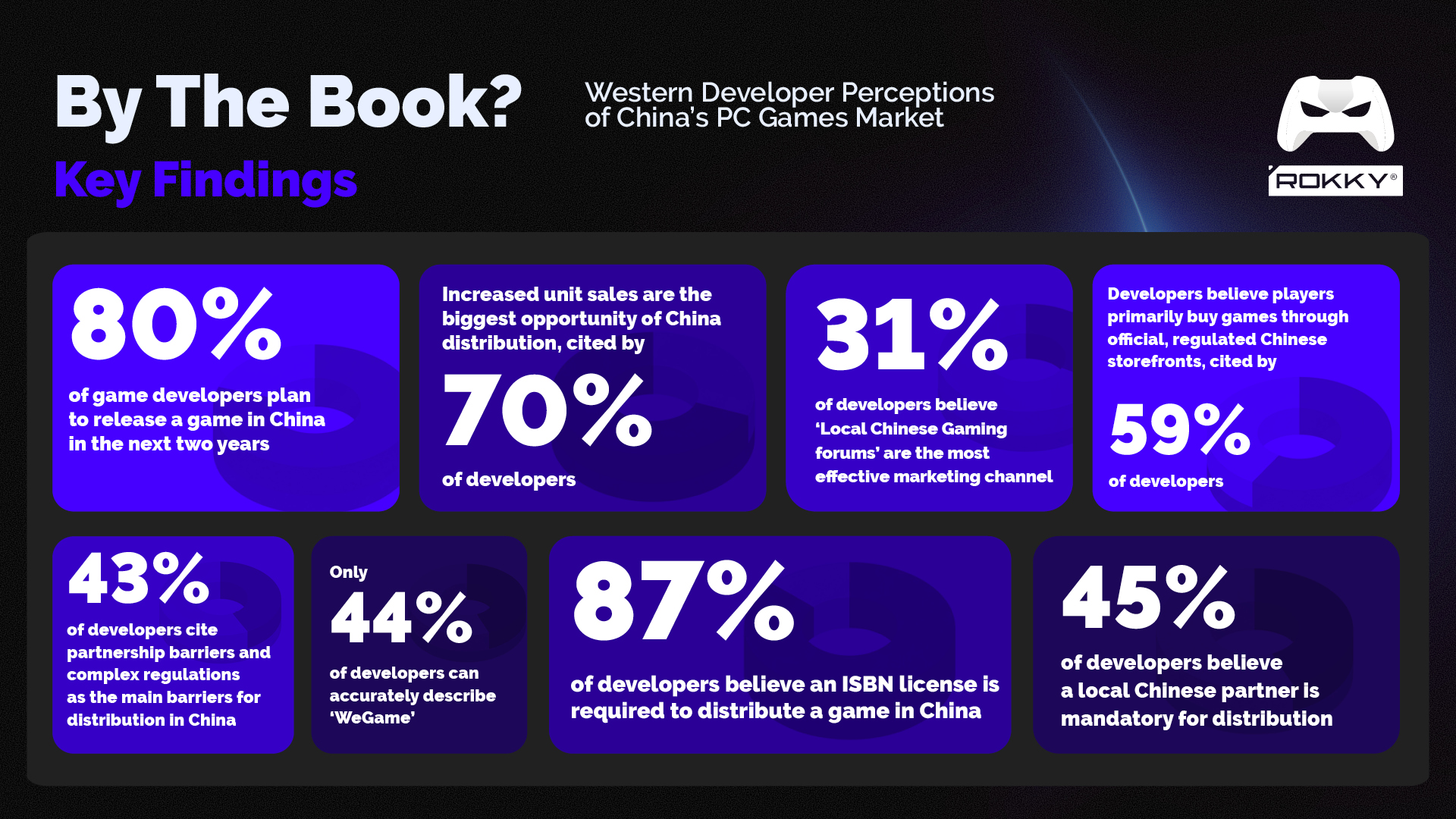
One of the main themes of the report is just how many misconceptions and roadblocks stand between Western developers and the Chinese market. As the report points out, only 44% of respondents accurately identified distribution platform WeGame (3% thought it was an MMO title); and 24% believed that they’d be able to use Google Ads to enter the market when Google itself is blocked in China.
The report follows on the findings in Rokky’s previous whitepaper, “The State of PC Game Distribution.” The conclusions come from survey data with 300 respondents, each a game developer with a title of manager or higher, with half being based in the U.S. and the other half in the U.K. Atomik Research conducted the survey on Rokky’s behalf earlier this year.
Rokky CEO and co-founder Vadim Andreev said in a statement, “I regularly speak with studio executives who look at China with a mix of desire and confusion. Navigating China requires an intricate understanding of local regulation, distribution routes (with and without ISBN approval), marketing channels and more. We commissioned this report to measure the sentiment, strategies, and friction points Western development teams have towards the region, and explore the best approaches to reach PC gaming’s biggest market.”
You want to release a game in China — now what?
Andreev spoke with GamesBeat about the findings, noting that one of the main friction points between Western developers and Chinese gamers is how games are advertised. “If a gamer in China sees an ad for a game, they will not buy the game. They prefer to listen to what their favorite influencer says.”
He also noted the perspective of just how few games from Western developers actually make it in China, at least according to research from Niko Partners. According to the latter’s report, the Chinese government issued ISBN licenses to 754 domestic games and 25 to imported games in the first half of 2026.
But, as Andreev pointed out to me, that’s not the only way to reach the Chinese audience. “99% of the games on Steam don’t have an ISBN license, and they’re accessible from a VPN.” In the report, 31% of developers surveyed believed that the VPN/Steam method was the primary way that Chinese gamers bought their games.
What are the sustainable solutions? When I asked Andreev that, he said that local partners are a viable solution for many developers. They know the market and speak the language. He also noted that developers who wish to target the Chinese market should begin to do so early in the process. “Develop for China alongside your other markets — not later, not one year after you launch elsewhere.”
When it comes to the main friction points preventing this from happening, the report notes that 43% of respondents think that the complicated regulatory process and the difficulties in finding competent partnership are their biggest barriers. That said, they clearly see the value in the market, with 70% saying they see an opportunity in China to expand their sales by including the world’s largest PC gaming audience.