
Despite a wealth of metrics and predictive data, an overwhelming majority of game makers believe it is nearly impossible to predict whether or not a game will succeed.
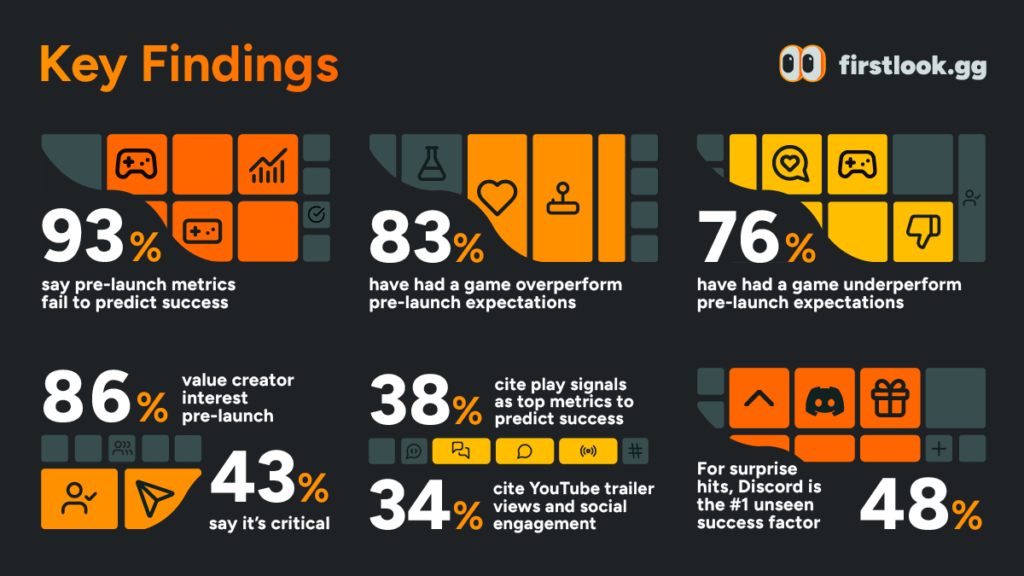
A whopping 93 percent of game studio leaders say they cannot reliably predict whether a game will be a commercial success or failure ahead of launch, according to a survey of over 250 senior industry executives at double-A and triple-A game studios in the United States, United Kingdom and Europe released by the player engagement platform FirstLook today, March 4.
Developers’ inability to predict performance is not always bad news for the game industry: 83 percent of the executives polled by FirstLook said that they had had a game release overperform compared to pre-launch expectations.
“Four out of five studios have genuinely worried about a game, pulled back, braced for disappointment — and then watched it massively outperform. That means studios are systematically underinvesting in their own breakout hits because they didn’t know how to read the signals,” said FirstLook CEO Eden Chen in an interview with GamesBeat. “That’s not just a data problem, that’s real money left on the table, real games that didn’t reach their potential.”
FirstLook’s report puts a spotlight on the growing gap between the metrics and data that studios track and the signals that they actually trust to provide a bellwether of a game’s performance. Instead of focusing on top-of-funnel awareness metrics — ”Highguard’s” flashy reveal at the Game Awards may have ultimately done more to damage the game’s chances than boost them — game makers are starting to realize the usefulness of metrics that measure active engagement.
Of the metrics that responding studios flagged as genuinely meaningful early indicators of a game’s performance, leaders included hours played, replay rate and day 1/day 7 retention, with 41 percent, 30 percent and 29 percent of studios respectively praising the predictive power of these active engagement metrics.
“The forecasting failure we’re documenting isn’t a scale problem, it’s a measurement philosophy problem,” Chen said. “Studios of every size have been taught to worship at the altar of awareness: wishlists, trailer views, press coverage. That orthodoxy runs deep across the whole industry. The difference is that a large studio can absorb a misjudged launch. A five-person team often can’t.”
Studios that responded to FirstLook’s survey identified Discord community growth as their top unseen success factor, with 48 percent of respondents saying that joining and actively participating in a Discord server was their strongest indicator of a player’s long-term interest in a game. However, only 40 percent of studios said that they currently track their Discord community in a structured way. In 2026, a more diligent and structured approach to Discord marketing could mark the difference between studios whose projects sink and studios whose projects swim.
“If your top-line awareness looks average but your Discord is growing and highly active, you could be sitting on your next breakout hit,” Chen said. “The competitive advantage in this market isn’t going to the studios with the biggest hype cycles. It’s going to the ones who know how to read the room.”