
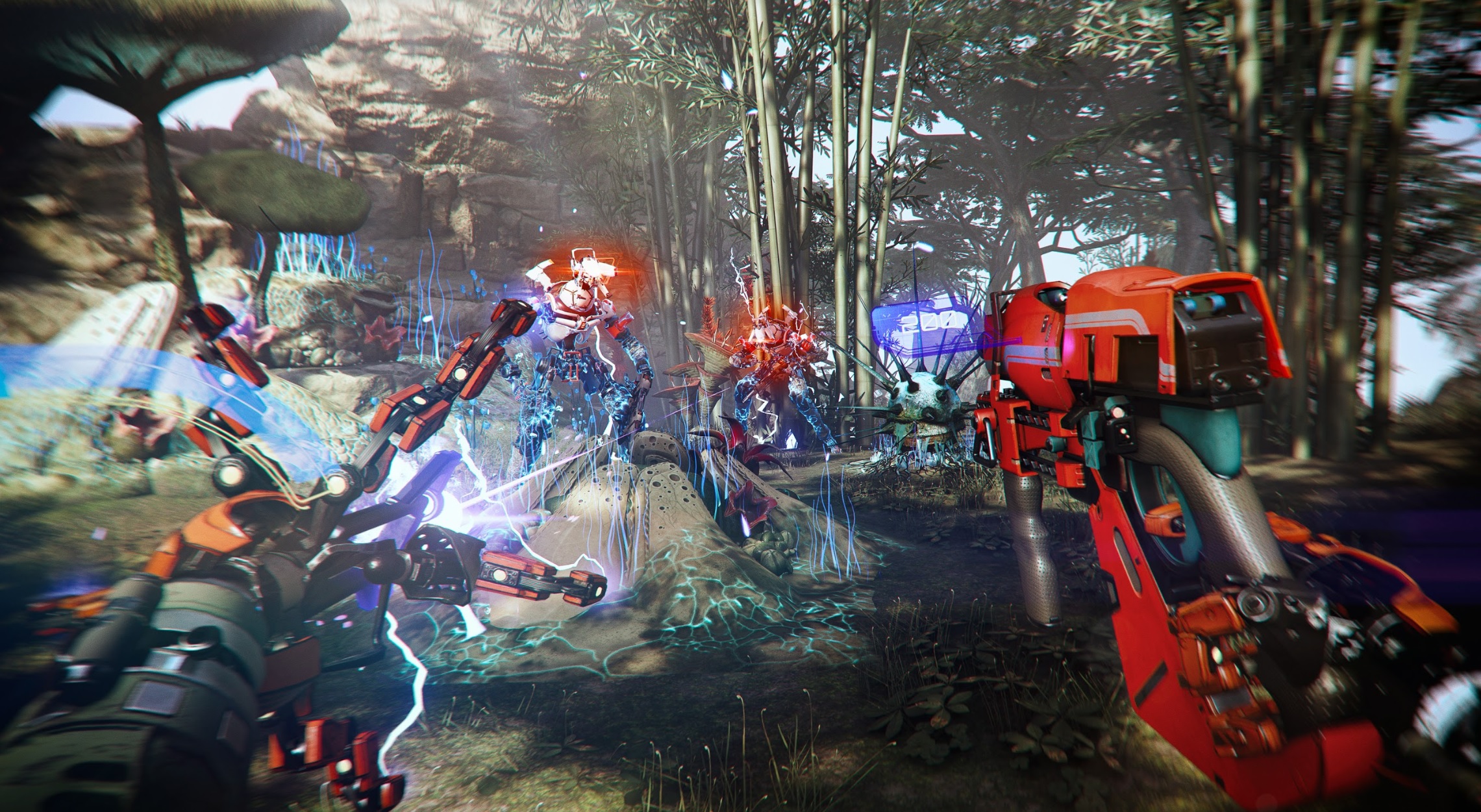
GamesBeat: The movement by climbing and grabbing things–it seems like what works in games like Echo Combat works here too. Is that about controlling some of the motion sickness that can crop up?
Daly: Obviously we want to mitigate motion sickness as much as possible. But I think climbing is something a little bit more primal than that, even. Grabbing on to a surface and having that one-to-one motion is just a naturally intuitive gesture. It works on a lot of levels. It’s intuitive. It affords a great deal of precision and control along every axis. It’s comfortable. Climbing was a win-win for us. We’re really glad we put it in.
That’s not to say that we didn’t discover all these little tiny details that worked or didn’t work in the process. For example, we found that having a buffer between you and the climbing surface is really useful. That distant view lets you take in your surroundings and navigate a lot easier.
Having your hand up against a surface, you just feel the awkwardness of there not being real-world collision there, not knowing exactly where to land. Tuning that buffer, finding the right ranges, figuring out how to communicate it visually so you have an idea of how you’re expected to orient your hands, where the attach point is that you’re supposed to grab on to — whether that’s in front of you or to the side — lots of little things went into making it look and feel good. We did a lot of experiments where we discovered, “Whoops, this is not good.”
GamesBeat: Can you describe the fiction around Stormland, the backstory?
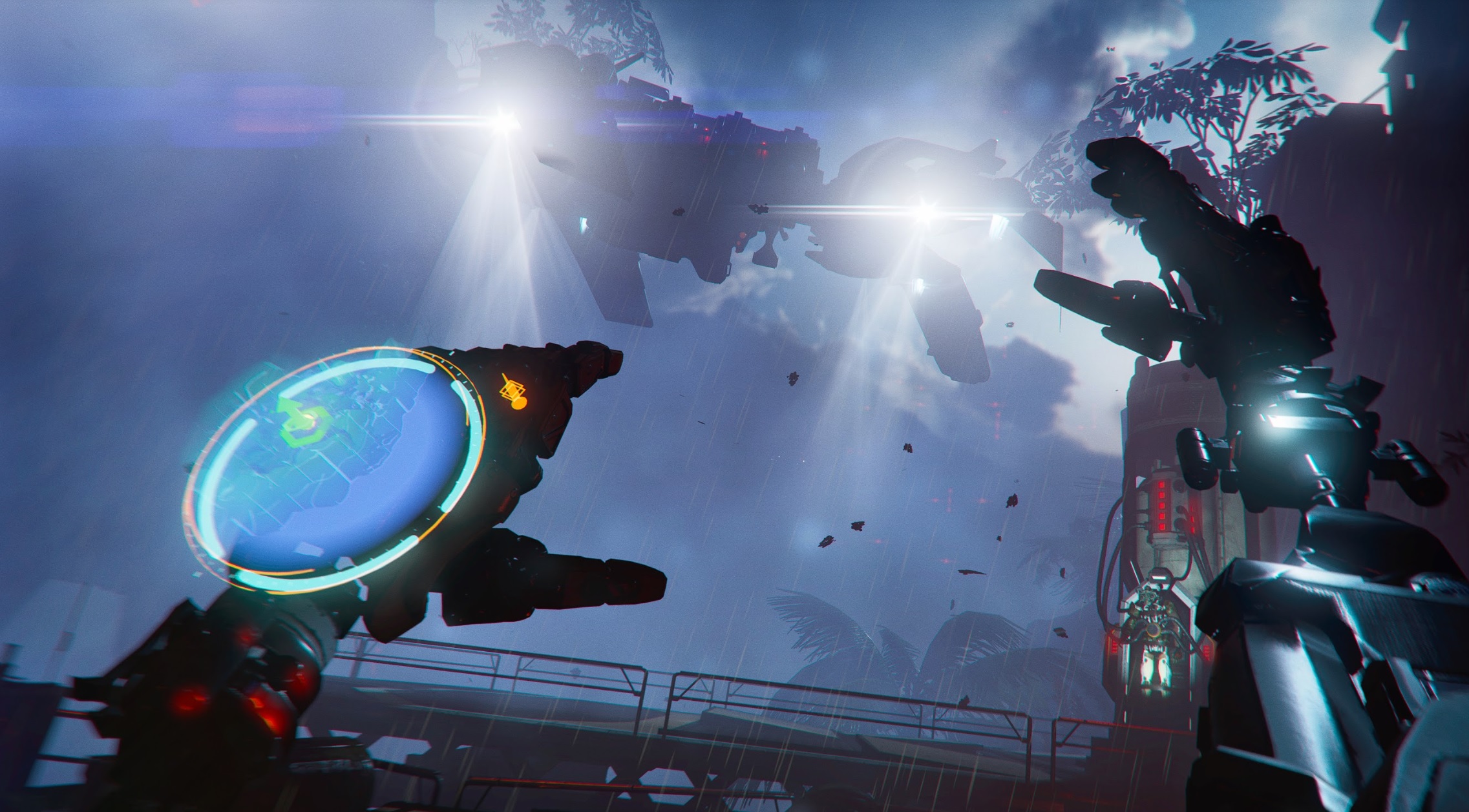
Daly: In Stormland, you’re an android gardener who traveled to an exotic alien planet to help settle it. But you were followed by a malevolent, militaristic organization called the Tempest. The Tempest decimated the settlers and broke your body, leaving you for dead. Decades later, you mysteriously rebooted. Now, in order to try to recover and rebuild, you have to travel up to the Stormland.
The Stormland is a massive, eternal storm, unique to this planet. It hosts the remnants of a skybound civilization. The Tempest are up there trying to exploit the mysteries of this civilization for their own gain. In this storm, there are endless resources. There are mysteries. There are alien technologies. There’s the harvesting infrastructure the Tempest has built, and older structures from the settlers before the Tempest arrived. It’s up to you to travel there, explore the place, rebuild your body, build in new enhancements that take it beyond its original design, rescue and repair the other androids that were originally settlers, and mount an effective resistance against the Tempest. That means delving into the secrets of the world and what makes it tick.
GamesBeat: Is it interesting to have a development like Spider-Man going on at the same time?
Daly: It’s been a lot of fun seeing Spider-Man develop alongside this game. They’re very different in a lot of obvious ways, but there are lots of similarities too, with regard to things like trying to nail the feeling of free movement and the agency of getting the way you want to in a way that’s fluid and exhilarating. Having a game that tells a story and has a deep progression system that keeps you engaged over a long period of time. It’s just fun to have Spider-Man playtests for us and see Spider-Man folks trying Stormland for the first time. It’s always a joy to get that reaction. And we all basically get to share in the good vibes of Spider-Man coming out and getting all these great reviews.
GamesBeat: After seeing how far VR has come, are there things you’re still looking forward to, things you want to see happen with the VR platform?
Daly: Yeah, definitely. There’s a lot of room for improvement in hardware and software. Just thinking about the software, the more we play with the Touch controllers, the more we realize that there is a slowly evolving standard of motions and gestures that we’re interested to see evolve further. I feel like somewhere out there, just a bit beyond what people have discovered so far, has got to be a really awesome set of conventions that let you interact with 3D objects in a quick, responsive, intuitive way.
I sort of equate this to when the mouse was invented for computers. Just the act of being able to move it slightly with your wrist, or macro with your arm, it has a very natural, intuitive feel to it. That enable software to do all sorts of stuff in turn. Now you had spatial arrangement of computer data, rather than linear text arrangement. You could move windows front and back, or minimize and maximize things. Those were the convenience discoveries that took your ability to interact with a computer way beyond what it was before.
There are things like that, things that are empowered by hand-tracking controllers, that are out there just waiting to be discovered. You’re not constrained to the resolution of a screen. It’s all around you. You have the ability to move things in and out of depth. There has to be some sort of gesture language that lets you manipulate that space in a way, once the conventions are discovered and more widely adopted, that software will start being able to work together. VR won’t feel like, “I’m launching this one app and doing it for a while” so much as, “I’m just going to work and I’ll do my thing in VR.”
I was sitting down in my hotel before I came to this event, and I brought a big stack of papers and a notebook that I had spread out on a table. I thought, “Wouldn’t it be awesome if I had something on Oculus Go that could do all of this?” Just have all my stuff there where I could rearrange it in space. That may be two or three years in the future, but I think it has a lot of potential. That could be really cool.
The haptics for your hands, I still think there’s a lot of opportunity there. I would love for those sensations to convey a bit more feeling. If you go to an arcade and play a game that has a gun with a solenoid, where it has that kick to it, it’s such an awesome feeling. At the moment, I’m sure it’s not practical to ship a half-pound slug in everyone’s controllers or whatever you’d have to do. But in the future, anything could happen.
GamesBeat: Do you feel like you have a set of VR veterans on the team now, people who want to keep on this track?
Daly: A lot of the folks that worked on Edge of Nowhere also worked on Unspoken and are also on the Stormland team. The maturity of how much thought we’ve put into what we can do with the headset, what we can do with controllers, the impact these decisions will have on players, it’s getting pretty mature, and that lets us come to the right conclusions more quickly, come up with better ideas around how to innovate and drive things forward. By the time it’s done and ready to come out, Stormland will reflect that. You’ll be able to play it and say, “These guys know what they’re doing.”