
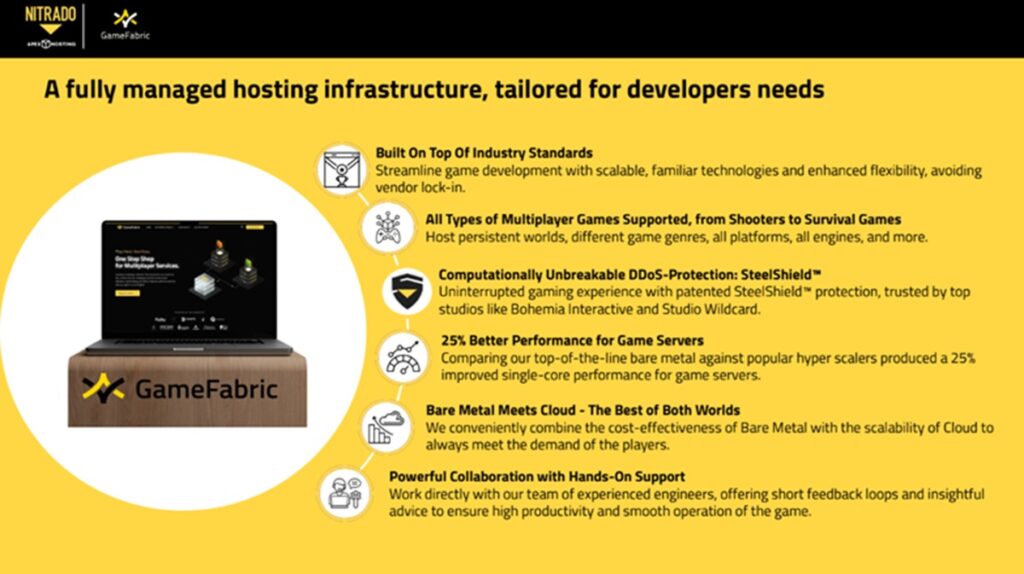
Nitrado’s GameFabric is a multiplayer server hosting and orchestration platform that is meant to offload infrastructure tasks from game developers.
Built on open standards and designed for modern game studios, it enables full infrastructure sovereignty by combining the performance of Nitrado-owned bare metal with the scalability of GameFabric Cloud, powered by Google Cloud or BYOC.
As part of Nitrado’s global infrastructure and with over two decades of industry experience, GameFabric is trusted by studios such as Bohemia Interactive, Fenris Creations, Eleventh Hour Games, and TinyBuild. Nitrado has grown to around 180 employees in 17 nations, said Raphael Stange, CEO of Nitrado, in an interview with GamesBeat. In the past five years, Nitrado has grown rapidly as it scales up to handle more game business.
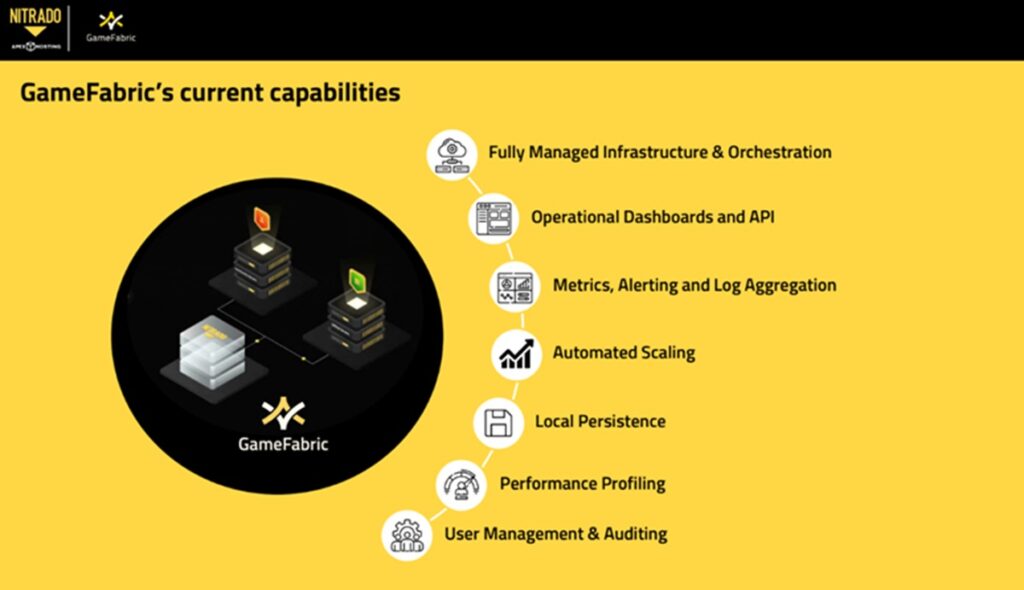
Engineered for automation, the platform provides API-first control with an official Terraform provider, ultra-low-latency scaling, and SteelShield – Nitrado’s patented DDoS protection system that authenticates UDP and TCP traffic at the network edge.
Nitrado, together with its subsidiary, Apex Hosting, is a global provider of private game server hosting, with over two decades of industry experience. The company operates more than 6,500 physical servers across 10 data centers worldwide, supporting over six million registered users. Both brands deliver high-quality, reliable server solutions across the industry’s most popular titles.
For game studios, Nitrado provides GameFabric, a developer-first multiplayer server hosting and orchestration platform built on open standards. It enables full infrastructure sovereignty by combining the performance of Nitrado-owned bare metal with the scalability of GameFabric Cloud – powered by Google Cloud or BYOC.
GameFabric is engineered for automation, offering API-first control with an official Terraform provider, ultra-low-latency scaling, and SteelShield, a patented DDoS protection system that authenticates UDP and TCP traffic at the network edge.
The games making the biggest infrastructure waves right now aren’t always the mega-franchises. They’re the indie titles nobody saw coming.
Windrose, a pirate survival game by small studio Kraken Express, sold 500,000 copies in 48 hours of early access and hit nearly 100,000 concurrent players at peak. Nitrado was its recommended dedicated server partner, embedded in the in-game UI from day one.
That’s not a one-off. It’s a pattern repeating across the genre: Palworld, Valheim, Peak, and now Windrose.
The case for unifying official server infrastructure and community private hosting — and why it’s an untapped lever for player retention Most studios treat their official server infrastructure and their player community’s private server ecosystem as two entirely separate problems – different vendors, different budgets, different conversations.
But there is a compelling argument that keeping them with the same partner creates something neither side delivers alone: cost efficiency at the studio level, and a privileged relationship with the most engaged, highest-retention segment of the player base, Stange said.
Origins
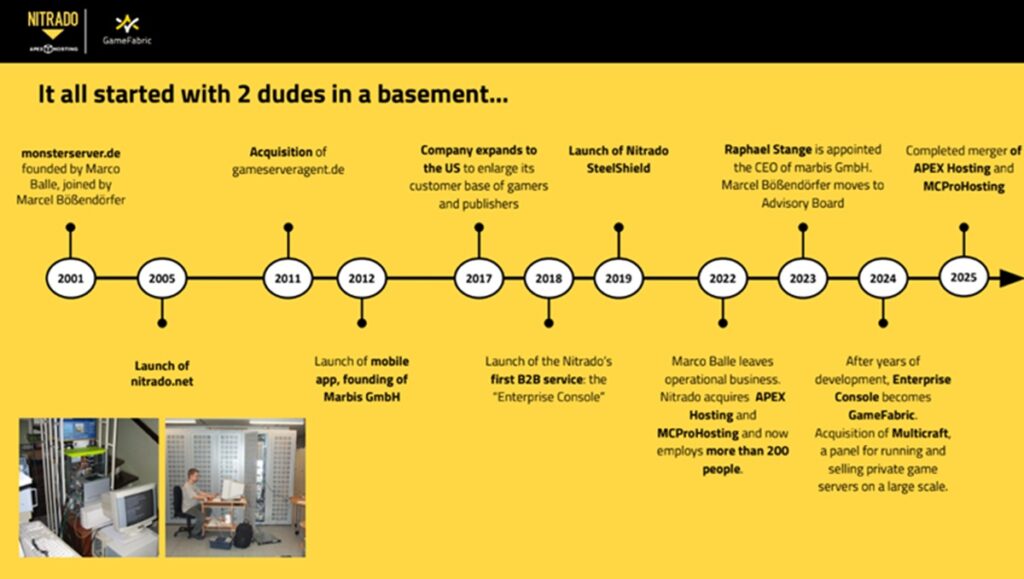
Nitrado was founded in 2001 by Marcel Bößendörfer and Marco Balle.
Nitrado’s core business focused on paid, persistent game servers for titles that thrive on modding, private worlds, and long‑tail communities. The company’s revenue model was built around recurring subscription hosting; high-margin add-ons like mods, performance tiers and backups; premium support and migration services; and enterprise hosting for studios and publishers.
It so happened that survival games — with big worlds, persistent progression and lots of modding — were well-suited for paid hosting. Nitrado became the backend infrastructure of choice for ARK, DayZ, Conan Exiles and Minecraft communities. It filled the gap when official servers degraded or failed to support mods.
In 2021, Flex Capital acquired Nitrado and then Balle stepped down and Bößendörfer continued to run the company. Then Stange replaced Bößendörfer and joined as Nitrado’s CEO in 2023.
Recent, the company migrated MC Pro hosting to Apex hosting, and now its operates as Apex hosting in the U.S., with a focus on Minecraft and Nitrado globally. It has about 75 titles in the catalog, and so it is no longer focused on a single title.
The company’s roots are in renting game servers to players for the games that allow players to operate their own servers. These are games like Minecraft or the ARK: Survival franchise. Those players are the modders who are providing user-generated content. That’s why Nitrato has been serving for 25 years, and now it’s having a big moment. This is why Nitrato now has many millions of users renting servers.
Stange said the company staff has grown around the globe because game server hosting is international by its nature. Stange himself is based in Berlin, Germany, with the German staff. But most of the company works remotely.
In 2021, the company acquired rival Apex Hosting in the U.S., breaking into Minecraft server hosting.
“When we bought them, they only were hosting Minecraft service, and we bought Minecraft Pro Hosting, called MC Pro Hosting, which is a U.S.-based company as well. These two companies were fierce competitors in the U.S. market.
Taking over Hathora
Nitrado recently took over the technology developed by the Hathora team, which in turn was acqui-hired by Fireworks AI and exited the game infrastructure business.
“We were an owner-led company for the first 22 years of the existence. In 2021, there was a transition between the original founder and the new owners, and they basically hired me. But in our core, we are in our philosophy a bootstrapped founder-owner style company,” Stange said. “We don’t push as much marketing budget into that business.
Much of Nitrado’s stack has a focus on open source, based on Google-developed and open sourced Kubernetes and Agones technology, which is a good match for the Hathora tech.
“We’ve picked up a lot of customers along the way,” Stange said. “It’s important that these studios are being professionally serviced in the future, and this is what we promised.”
Complementing the work of hyperscalers
Hyperscalers were once viewed as a single source of computing for game servers, but that idea is less attractive than it was a few years ago, Stange said.
“Since 2022 our industry is troubled. It has lost around 50,000 jobs. During the pandemic, a lot of money had been put into our markets. A lot of studios were funded, and money was not the big problem. Now this situation is very different. Studios have to really look at their funds and look at their cash spend,” Stange said.
He said hyperscalers rent game studios a game server instance, or many of them, by the day.
“If you want to have a car available, if you rent it by the day, and then you drive it for two years on a day rate, you will pay a lot of money,” Stange said. “You have a very high flexibility. That is what hyperscalers do. They give you a car for a day, rent, and you ride it for two years. That, in the car analogy, very few would actually do that.”
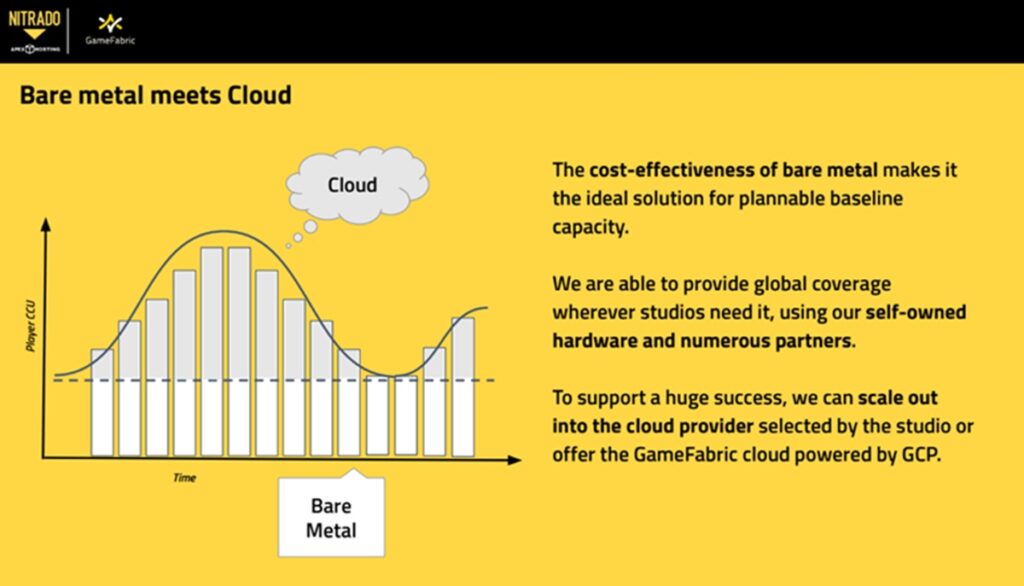
He noted that more people would likely want something different than flexibility at all costs. Nitrado offers physical bare metal machines in data centers. The firm co-operates nine data centers around the world and it rents them out to studios at rates that are half of the hyperscalers. The only catch is that customers have to commit to a certain volume and time frame for usage.
“It’s a bit comparable to car leasing. On our end, it’s one month. So you have to lock in one month for for a number of machines,” Stange said. “You can’t scale up and down by the day as the hyperscalers do, but by the month, and we start from very low. You can rent one machine from us for a month, and you will have a very low price, like low in terms of money spenth.”
That’s attractive for many developers who are pinching pennies now. On the bare metal layer, customers often don’t need flexibility, and they can predict more reliably that they will use that bare-metal server 100% of the time.
“What actually happens is our orchestration layer, Game Fabric is sitting and making sure that the hyperscaler of choice of the studio gets this traffic that is not being supplied by the bare metal,” he said. “This is what we call a hybrid hosting model. It is much more price efficient, and you have still flexibility on the cloud part, but you don’t pay as much for this flexibility.”
Where the game industry is growing
Based on traffic patterns in the last couple of years, there is strong mid-tier growth in games. The games below the top 20 have been continuously growing.
“We see strong mid-tier growth. About 44% of PC play time is outside the top 20 games now,” Stange said. “There’s a good 50% or 60% of PC revenue outside of the top 20. What we offer to them is basically the hybrid hosting we were talking about.”
Nitrado supplies them with their official servers.
“We have very specialized and experienced engineers that are extremely good at large-scale multiplayer hosting, and for the studio it is very valuable to be able to cooperate with our developers, engineers,” Stange said. “This is how we have been growing in recent years.”
In games like ARC Raiders, the user base is split into peaceful and player-killer gamers. So it’s very important in matchmaking to combine the right players together.
AI-fueled growth?

“Currently, 2026 will be quite a good year for us. So we have closely cooperated with the Hightail team. We have created parts of the multiplayer specifications that are now being used by everybody that hosts servers, regardless of commercially or private,” Stange said. “We co-created them with them, and obviously we have been benefiting from the beginning. They are at the beginning of their journey.”
Because of AI, the company has been able to grow both revenue and demand with the same number of people on staff.
“Before AI, if you had a problem with playing one of our titles, we had a customer service that had a ticketing system, and you would be serviced by email. Now, with AI, we were able to reintroduce the chat, and it is not a chatbot only that is chatting with customers that come in on a chat. It is a combination of AI chatbot and a real customer service agent taking over from a certain stage,” Stange said. “So we increased our service level, and we have been able to do this through the usage of AI in the same tech teams.”
And he said, “Bottom line, we are able to provide more revenue, more games, and more customers as well on the studio side as on the player side through AI and through learning and streamlining processes and doing our homework as entrepreneurs.”