
UltraSense Systems announced a new generation of touch technology to improve user interfaces in augmented reality (AR) glasses.
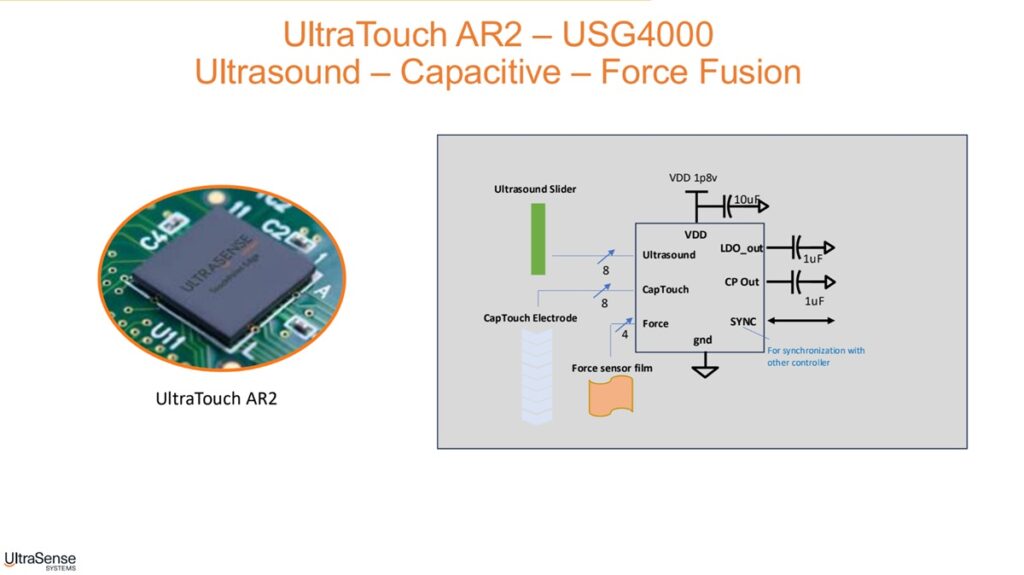
The company specializes in ultrasound and multi-modal user interfaces, and today it is unveiling its next-generation UltraTouch AR2 Interaction Platform. Classified as the USG4000 Series, it’s a high-integration HMI controller family created specifically for AR glasses.
The platform combines ultrasound, capacitive, and force sensing to deliver reliable, intuitive controls across magnesium, titanium, and plastic frames, targeting the next wave of AI-powered AR wearables. And it’s just in time for CES 2026 in Las Vegas next month.
As AR glasses rapidly evolve into the next compute platform, OEMs are ramping programs that must manage display, media, calls, camera, and AI assistants in a tiny, fashion-critical form factor. First-generation products leaned heavily on simple capacitive strips but that approach is now running into hard limits.
Capacitive alone can’t scale to the next AR generation
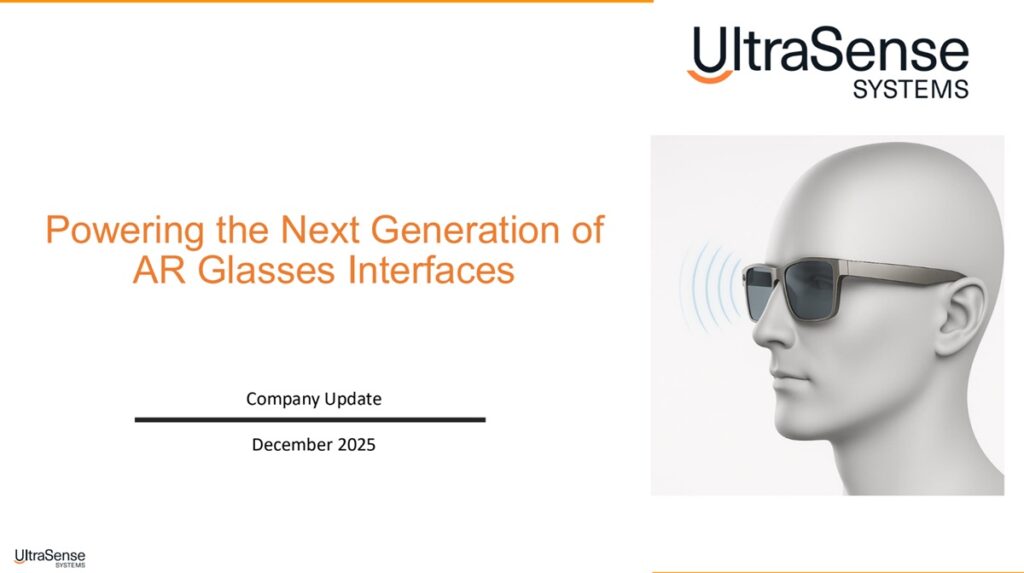
Unreliable in the real world, pure capacitive sensing may have been acceptable for
early AR devices, but it struggles in high-volume, high-quality products.
Wet hair, sweat, and incidental contact routinely create false triggers and poor user experience. Gesture overload on one pad – As LCOS and MicroLED displays roll out, UI
requirements explode.
Trying to run display, media, calls, and camera through complex multi-finger gestures on a single 2D capacitive pad is unrealistic and not intuitive for mainstream users.
They’re not a good solution for metal frames either. Today’s capacitive-only solutions cannot support magnesium and titanium frames, blocking the premium, fashionable designs consumers expect.
UltraTouch AR2 / USG4000: Multi-modal, not multi-finger
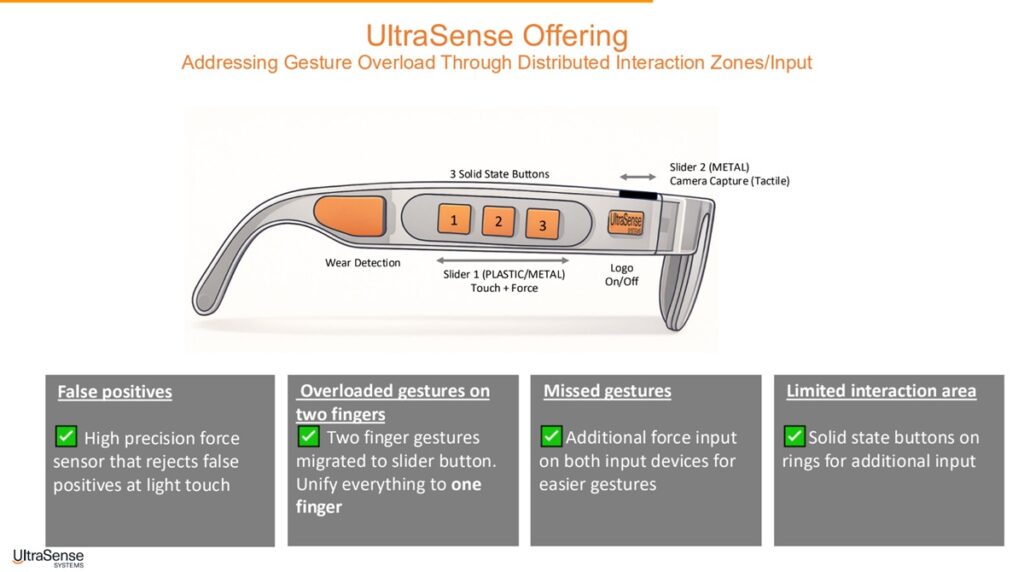
UltraSense addresses these issues with a multi-modal, 1D zone-based architecture rather than overloading one 2D pad:
CapForce with Force Fusion – A co-polymer layer adds force sensing to capacitive, dramatically reducing false triggers from wet hair and sweat while adding minimal thickness and enabling retrofit designs.
UltraForce for metal, CapForce for plastic – Ultrasound-based UltraForce enables seamless interaction in magnesium and titanium; CapForce covers plastic temples. Both support soft buttons, sliders, and press depth.
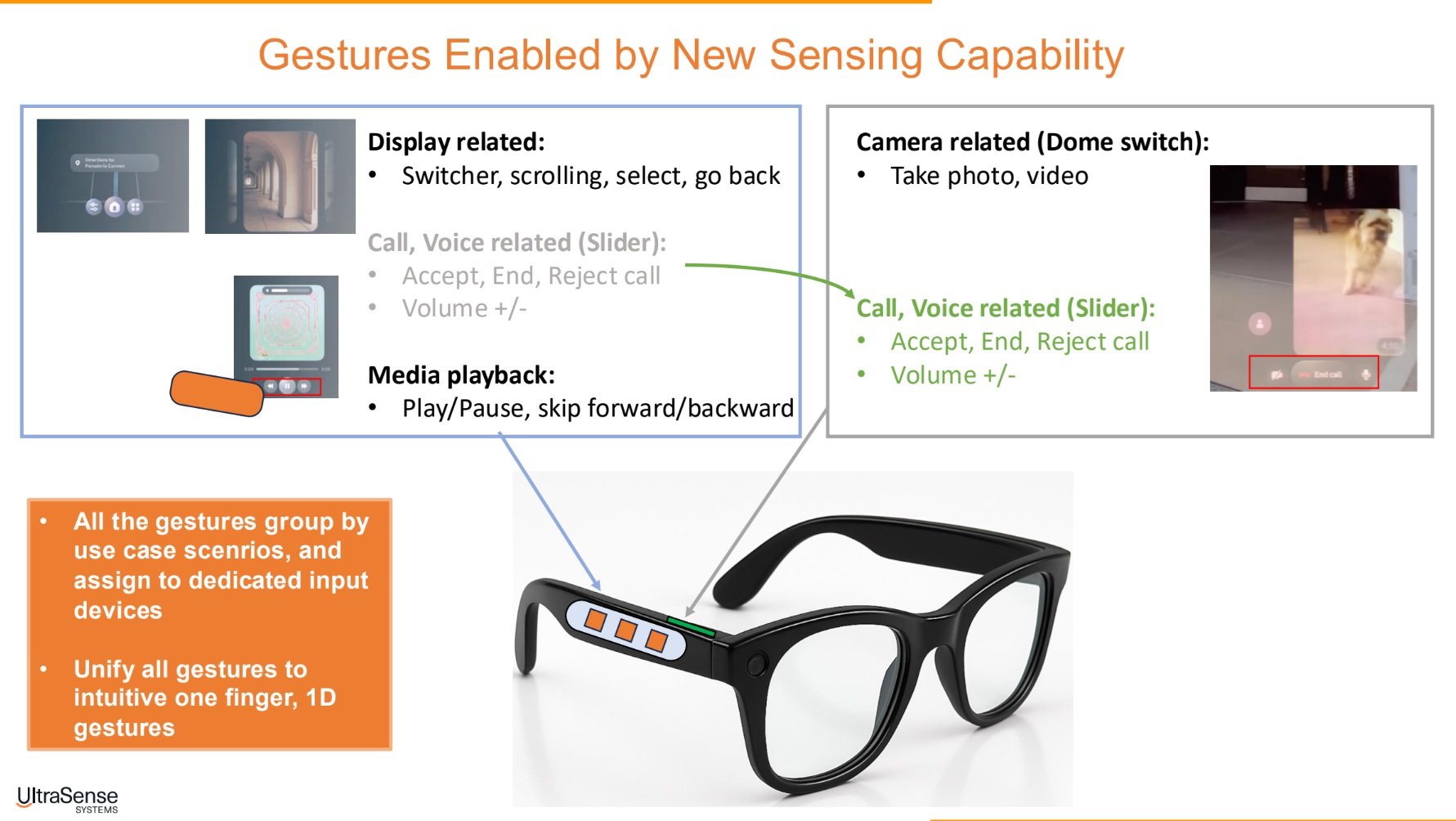
Functional zones, like a phone layout – Different regions of the frame are dedicated to different jobs:
o Calls (accept / end / reject, volume ±) via metal slider + tactile button at the tip
of the frame (UltraForce)
o Camera (photo / video) via a short slider or tactile dome near the hinge or tip,
with light vs hard press semantics
o Media & Display navigation (play/pause, skip, scroll, select, back) via side-
temple slider or pad using CapForce or UltraForce
Each zone uses simple one-finger, 1D gestures—tap, swipe, short/long press, light vs firm press.
Combining location, gesture type, and force level creates a rich command vocabulary without awkward multi-finger chords. This lowers gesture load, improves discoverability, and boosts reliability. The platform also supports wear on/off detection and anticipates auxiliary devices like rings or wristbands for even richer control.
Origins
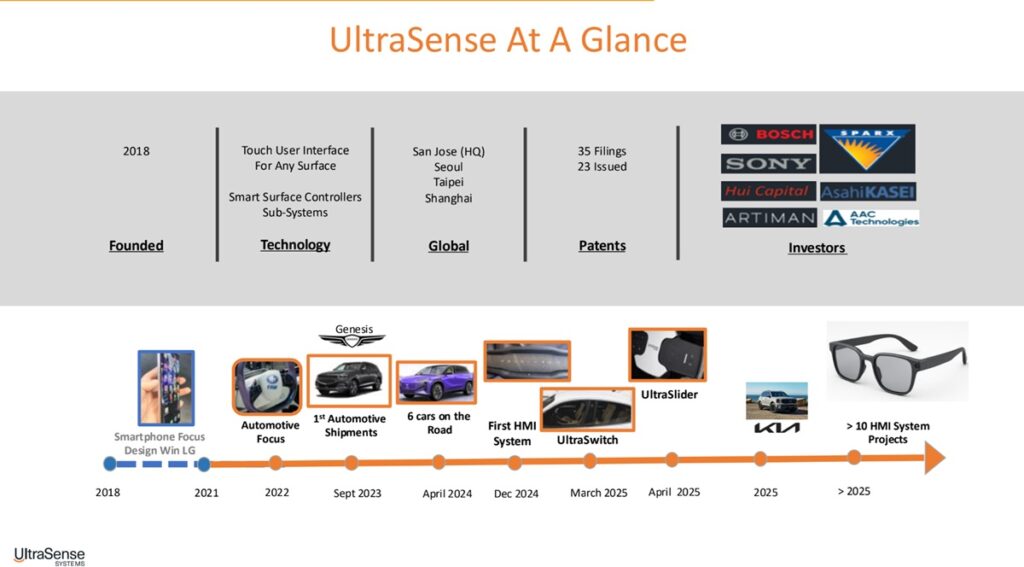
UltraSense started six years ago with a focus on smartphones, said Maghsoudnia. The core technology comes from ultrasound.
“We can bring a touch user interface to any metal surface. With ultrasound, we are basically material agnostic, so we can work on any type of material,” he said.
Using this tech, the company has been able to replace mechanical buttons on smartphones.
“We started out with LG on smartphones, and then we got pulled into automotive,” Maghsoudnia said. “The technology is actually proving itself in automotive. We are in a number of different cars today — Hyundai Motors, Tesla — and we are now taking the same user interface to AR glasses today.”
With the traction, the tech has moved through a market inflection point, he said.
“We are seeing this big tsunami coming on AR glasses, with many companies trying to explore the next platform for compute,” Maghsoudnia said. “We certainly see a lot of activity, and we have been pulled into the market because the user experience plays a key role in the success of AR glasses going forward.”
How the tech works
It works on metals including magnesium, titanium and aluminum. At the same time, the company has a force element that helps to alleviate a lot of the false triggering which people are seeing with capacitive sensing.
“Capacitive sensing, which is the workhorse of the industry today, only works on thin glass and plastics,” Maghsoudnia said. “It’s more of a proximity touch.”
It’s not so precise that it can work the same as a button press, Maghsoudnia said. That makes engineers reluctant to use capacitive touch in the automotive space.
“With glasses, we are seeing the same issues with false triggering as well, where capacity is sensitive to environmental issues. That means if you have a wet hair, or sweat, it will start to false trigger.”
One of the biggest benefits of this technology is aesthetic.
“We offer is the ability to go over to more stylish frames using magnesium and titanium, which is really a big portion of what the optical market today,” Maghsoudnia said. “We think that for AR glasses to kick into that next level, it needs to be changed from the bulk plastic that it comes with today to more of a fashionable metal type of a frame.”
Challenges to overcome: sensor overload
I pointed out to him that the Ray-ban Meta Glasses that I have have a big plastic side panel where you have to use two fingers for some of the gestures. These kinds of gestures are pretty hard for people to remember, he said, and the result is “sensor fusion overload.”
He said, “If you take a look at many glasses, there is only one side of it that is used for the user interface, and that’s a big issue. It is popping up where you have to manage the camera, you have to manage the call, you have to manage the media, and on top of that, you have to manage the display.”
The simple and imprecise gestures of capacitive touch aren’t accurate enough, and that messes up the user experience, he said.
“Where we come to play with our technology is to alleviate many of these issues that AR glasses have,” Maghsoudnia said. “We believe that there are two things that have to work for the AR glasses to kick off. One, it has to be fashionable. It cannot be that bulky plastic going on your face. And then the second thing is that the user interface has to be the best of user experience that one can get. It should be simple like your smartphones.”
The tech has to be good enough to avoid false triggers, but that’s hard to do with a small pad area to manage a bunch of functions.
“It’s easy to have accidental touches in terms of taking pictures and all that,” he said.
And with the displays coming inside lenses for AR glasses, it’s getting harder still to control the complex screens without things like traditional keyboards.
“They’re using two fingers or three fingers, moving forward. It’s a very complex task, and it’s not easily adopted,” Maghsoudnia said. “That’s the other issue that we are trying to address as we are moving forward with our solutions and our technologies.”
On the Meta glasses, you have to use two fingers to increase volume or swipe backward with two fingers to decrease volume. That’s pretty hard to remember.
“Thinking about using multiple fingers for a user interface is a recipe for disaster,” he said.
But UltraSound’s tech works on both plastic and metal. And it can add force to the controls, so you can press harder with what UltraSense calls “cap force technology.” It minimizes false triggers from wet hair and more. With the combination of finger movements and finger pressures, UltraSense can create “virtual buttons” or sliders.
It can put three buttons on the side of a glasses frame, and you can distinguish between them by using a finger to detect a tactile indentation — a serrated pattern — in the plastic or metal. It’s not a button, but just something to tell your finger that there are three buttons there.
“You have the tactile sensing, but you can also use a slider for volume plus, volume minus, or zoom in, zoom out. And then if you hold it, it can switch from video to photo, and it can do different gestures, and therefore different functions,” Maghsoudnia said. “The intent is to minimize the gesture loading by creating more of what we call distributed interaction zones inputs. Because, right now, you only have one small 2D pad to do it. Now we are adding more zones.”
The solution will ultimately be more intuitive. On top of that, UltraSense can add to both sides of the glasses frames, the left or the right bar. Maghsoudnia said his firm’s agenda is to push metal for aesthetic reasons, and it enables thinner frames. But UltraSense can be agnostic on the material.
“All of the big issues in AR glasses converge on one challenge: how to deliver a simple, reliable user experience while the system gets more capable, the frames get thinner, and materials shift to magnesium and titanium,” said Mo Maghsoudnia, CEO of UltraSense Systems. “With UltraTouch AR2 and the USG4000 Series, we move beyond capacitive-only thinking. By fusing ultrasound, capacitive, and force in one material-agnostic chip, we solve false triggering, eliminate gesture overload, and enable truly fashionable AR glasses that people will want to wear every day.”
The USG4000 Series HMI controller can power all UI functions—side sliders, virtual on/off, camera shutter, volume, media, and display control—on both metal and plastic frames, delivering one chip for all AR UI. UltraSense’s platform offers sub-5 mm thickness, ultra- low power operation, and a seamless industrial design path for next-generation AR devices.
UltraSense Systems is transforming human-machine interfaces through its proprietary ultrasound and piezoelectric sensing technologies. With deep semiconductor and systems expertise, UltraSense enables seamless, intuitive interactions on any surface—metal, glass, plastic, or fabric—across automotive, consumer, medical, and AR/VR applications.
The next generation of tech
UltraSense has 33 people and it has raised more than $50 million to date. Maghsoudnia said the company is talking to 15 big potential customers now, and the first one is likely going into production in the second half of 2026.
UltraSense is able to do this with its next generation of silicon, as it has a new chip that covers all of the functionality. It is embedded on a flexible circuit board. And it’s the kind of tech that can take the product from a million items sold to tens of millions, he said.
As for putting ultrasound waves near your head, Maghsoudnia said that it uses extremely low power and represents no hazard to users at all. You can’t hear it, and the energy used is very low.
“The whole intent is to make it as simple as possible and avoid using multiple fingers, because, again, we don’t use multiple fingers on the smartphone, right?” said Maghsoudnia.