
Ubisoft announced a major organizational, operational and portfolio reset that will result in the cancellation of six games and possibly large layoffs.
In a call with the press, Ubisoft chief financial officer Frederick Duguet said that the company will discontinue the development of six mostly unidentified games that include a number of brand new intellectual properties. It’s the latest in a series of org changes.
He said the company will allocate additional time to seven titles with updated revenue expectations that reflect a persistently more selective market. One of the canceled games is Prince of Persia The Sands of Time remake. Yves Guillemot, CEO of Ubisoft, addressed shareholders in this call.
These moves will result in free cash flow of -€400 million and -€500 million ($468 million to $585 million) and a reduction of debt to €150m and €250m ($175 million to $292 million) as of year-end FY26, with a cash and cash equivalents position of between €1.25bn and €1.35bn ($1.46 billion to $1.58 billion) vs. prior guidance of around €1.5bn ($1.76 billion).
The company has four new intellectual properties still in development. The company had 17,000 employees at the end of September, but it’s not clear how many of them will be laid off or reassigned to work on the seven major titles that will get more time and resources. The reorg is expected to be completed by April, said Duguet. He said Ubisoft hopes to get back to year-over-year free cash flow in three years.
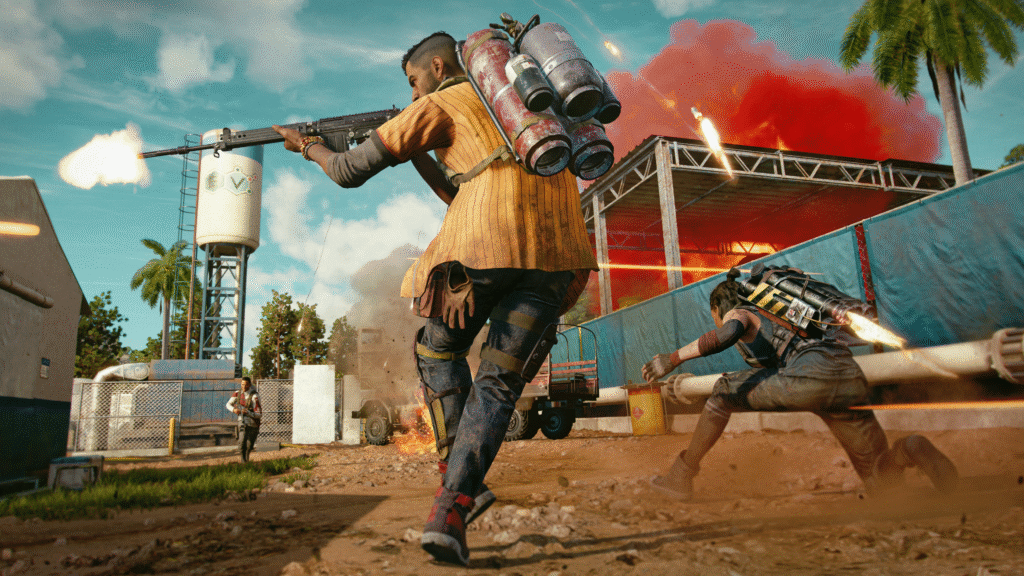
For context, Ubisoft received a $1.25 billion investment from China’s Tencent in a new subsidiary that contains its “creative houses” for its main franchises: Assassin’s Creed, Far Cry and Rainbow Six. Now the other shoe is dropping on other titles.
Duguet said the moves are designed to reclaim Ubisoft’s creative leadership, regain agility and drive a sharp rebound, renewing the group’s trajectory toward sustainable growth and robust cash generation. This will be delivered through three main pillars:
A new operating model; a refocused portfolio with a meaningfully revised 3-year roadmap; and the rightsizing of the organization.
Ubisoft’s strategic decision to undertake this major reset is driven by the continued shift toward a persistently more selective triple-A market and an increasingly competitive shooter landscape, combined with the growing challenge for publishers to create brands in a context of higher costs.
Nevertheless, when successful, exceptional triple-A content has more financial potential
than ever, the company said. While last years’ progress with its production processes translated into improved levels of quality for Ubisoft games in 2025, today’s market environment requires that the group step-changes how it is organized and operates with a view to delivering exceptional games quality at more competitive costs.
Against this backdrop, today’s announcement introduces a radically new value-creation model: a more gamer-centric organization, structured around creative genres, relying on integrated business units with faster, decentralized decision-making and a greater ability to quickly adapt to players’ expectations.
This transformation will be supported by a rightsized and more agile organization, delivering improved structural efficiencies over time.
The new operating model will further empower the execution of the group’s strategy, centered on Open World Adventures and GaaS-native experiences, supported by targeted investments, deeper specialization, and cutting-edge technology, including accelerated investments behind player-facing Generative AI.
Guillemot said in a statement, “On the one hand, the triple-A industry has become persistently more selective and competitive with rising development costs and greater challenges in creating brands. On the other hand, exceptional triple-A games, when successful, have more financial potential than ever.”
Guillemot added, “In this context, today we are announcing a major reset built to create the conditions for a return to sustainable growth over time. We are transforming Ubisoft’s operating model to produce exceptional quality games on the two core pillars of our strategy, Open World Adventures and GaaS-native experiences.”
Guillemot said that at the center of this transformation are Creative Houses, integrated business units now combining production and publishing and therefore unifying the gamer relationship. Each one is built around a clear genre and brand focus, with full responsibility and financial ownership, led by dedicated leadership teams. It is a radical move, relying on a more decentralized creative organization with faster decision making and best-in-class cross functional core services supporting and serving each Creative House.
“To put the Creative Houses in the best conditions to succeed, we decided to refocus our
portfolio with a meaningfully revised 3-year roadmap and accelerate our cost reductions
initiatives to rightsize the organization. We will discontinue several projects currently in
development and provide additional time to certain games, to ensure enhanced quality and maximize long term value,” Guillemot said. “We will also selectively close several studios and continue restructurings throughout the group. While these decisions are difficult, they are necessary for us to build a more focused, efficient and sustainable organization over the long term.”
And Guillemot said, “Taken together, these measures mark a decisive turning point for Ubisoft and reflect our determination to confront challenges head-on to reshape the group for the long term. The portfolio refocus will have a significant impact on the group’s short term financial trajectory, particularly in fiscal years 2026 and 2027, but this reset will strengthen the Group and enable it to renew with sustainable growth and robust cash generation. Ubisoft is entering a new phase – one designed to reclaim creative leadership and build value for players and stakeholders over the long term.”
A new Operating Model to support Ubisoft’s strategic focus
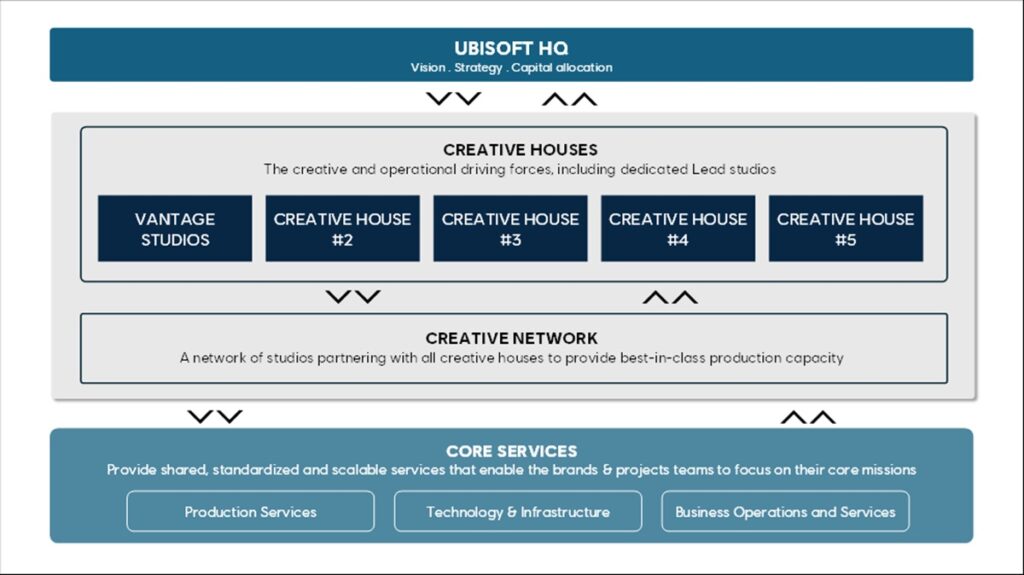
Ubisoft’s new operating model will be structured around five Creative Houses (previously there were the aforementioned three). These will be supported by a Creative Network providing development resources, shared Core Services and a reshaped HQ. This new organization will start operating early April.
By simplifying the organization and placing creative and financial accountability closer to where value is created, the group is strengthening its ability to innovate and execute with greater discipline, flexibility and speed. The new model will allow Ubisoft to better deploy its creative and technical resources on a refocused portfolio.
To support the effective implementation and operation of this new model, the group also
intends to return to five days per week on site for all teams, complemented by an annual
allowance of working-from-home days. This evolution is intended to strengthen collaboration, including constant knowledge sharing, and the collective dynamic across teams. In-person collaboration is a key enabler of collective efficiency, creativity and success in a persistently more selective triple-A market.
Five Creative Houses, built on a decentralized model
At the heart of this reset is a new and decentralized operating model structured around five
Creative Houses. These integrated business units will feature 3 major changes:
They will combine game development and go-to-market functions with a gamer-centric
approach, and be fully responsible for brand development, content strategy as well as
editorial direction; They will be shaped by distinct creative ‘genres’ led by dedicated high-profile, incentivized teams with a unique set of expertise in those genres; and they will have full financial ownership and account for economic performance.
Core services will provide shared, standardized and scalable services that enable the brands & projects teams to focus on their core missions.
One of the studios will be called Vantage Studios. It will includethe creative and operational driving forces, including dedicated lead studios. A network of studios partnering with all creative houses will provide best-in-class production capacity.
They will be driven by clear objectives and guiding principles:
- A gamer-centric approach, shaped by a unique set of skills and expertise towards a
distinct creative ‘genre’ and a dedicated leadership team incentivized for long-term,
cash-generating revenue growth Each Creative House will be organized around a distinct creative genre and designed to concentrate deep expertise in specific types of player experiences. Each Creative House will be responsible for fully owning the gamer relationship, developing must-play experiences for specific audiences and engaging player communities earlier and constantly throughout the development process. - Creative House 1(Vantage Studios), will be focused on scaling and extending Ubisoft’s largest and established franchises to turn them into annual billionaire brands. Brands: Assassin’s Creed, Far Cry, Rainbow Six
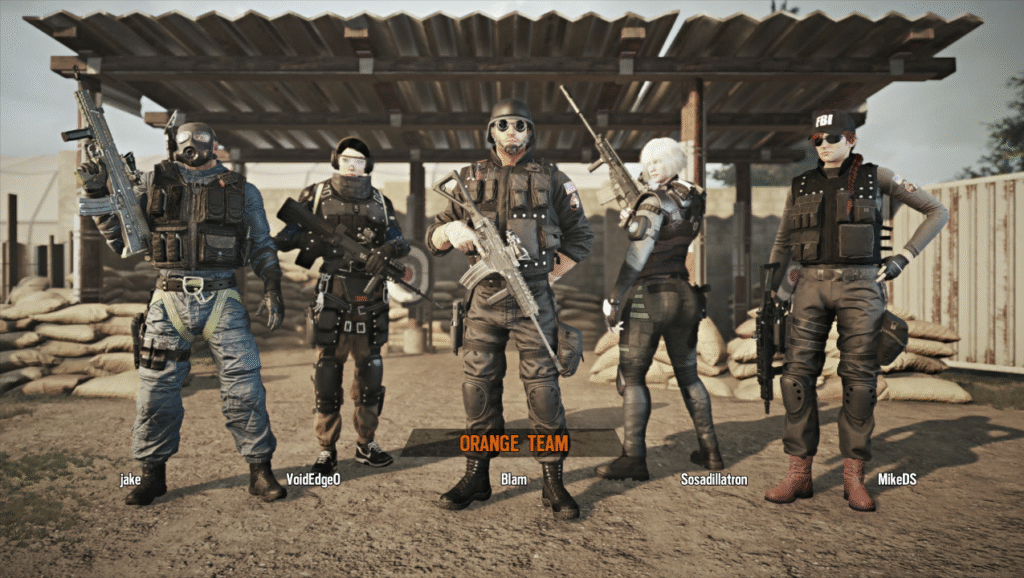
- CH2 dedicated to competitive and cooperative shooter experiences; Brands including The Division, Ghost Recon, Splinter Cell
- CH3 designed to operate a roster of select, sharp Live experiences; Brands including For Honor, The Crew, Riders Republic, Brawlhalla, Skull & Bones
- CH4 dedicated to immersive fantasy worlds and narrative-driven universes; Brands including Anno, Might & Magic, Rayman, Prince of Persia, Beyond Good & Evil
- CH5 focused on reclaiming position in casual and family-friendly games. Brands including Just Dance, Idle Miner Tycoon, Ketchapp, Hungry Shark, Invincible: Guarding the Globe, Uno, Hasbro
In addition, there are four new IPs currently in development, including March of Giants.
Ubisoft will communicate on their respective creative home at a later stage. Each Creative House will benefit from dedicated leadership with a clear creative mandate and accountability. These leadership teams will include high-profile talent coming from the industry. They will be tasked with attracting and developing top-level, specialist talent, and supported by incentive schemes aligned with creative success, player engagement and long-term value creation.
Full creative and brand responsibility as well as financial ownership
Each Creative House will have end-to-end responsibility for its portfolio, overseeing the full creative and brand scope from development to publishing (brand, marketing and sales go-to-market strategy). They will also be financially accountable, both in terms of P&L and cash generation. This structure will sharpen strategic focus, reinforce execution discipline and ensure that investment decisions will be taken closer to where value is created.
The model also enhances visibility into development pipelines, milestones and key risks,
supporting more informed decision-making throughout development cycles.
At group level, a new organization supporting each Creative House
The Group will set up a streamlined organization designed to serve all the Creative Houses, while preserving scale benefits and reducing complexity. The new organization will be composed of:
- The Creative Network, which will bring together a powerful set of studios providing
best-in-class production capacity and cross-functional creative expertise serving the
Creative Houses. Operating within a structured, project-by-project collaboration framework, the Creative Network studios can deliver both co-development or end-to-end mandates under the strategic direction of each Creative House. - Core Services providing the backbone of Ubisoft’s ecosystem and acting as an
enabler for the Creative Houses and the Creative Network. They will focus on
delivering scalable technology, production capabilities and operational excellence
across the Group and will notably be responsible for:
o Production services including production standards and tools, localization,
playtests, game analytics, QA/QC.
o Technology & infrastructure including game engines, online services, GenAI
initiatives, IT infrastructure.
o Business operations and services including media planning execution, influencer
and direct-to-player capabilities, pricing and distribution management, customer
support.
A reshaped headquarters
Ubisoft’s headquarters will be reshaped to focus on strategy, governance, performance management and capital discipline. The new operating model will be underpinned by a reshaped headquarters which will set the group’s strategic priorities, ensure support for all Creative Houses and maintain a forward-looking view on industry trends, including technological developments and market innovations.
It will notably oversee the Group’s talent management strategy, corporate communication
strategy, legal services, capital allocation framework and financing, ensuring alignment
between long-term strategy, financial performance and value creation.
Ubisoft will introduce a refocused portfolio with a meaningfully revised roadmap In the context of a persistently more selective market as illustrated by the last quarter, and as
part of the finalization of the Group’s new operating model, Ubisoft has conducted a thorough review of its content pipeline over December and January.
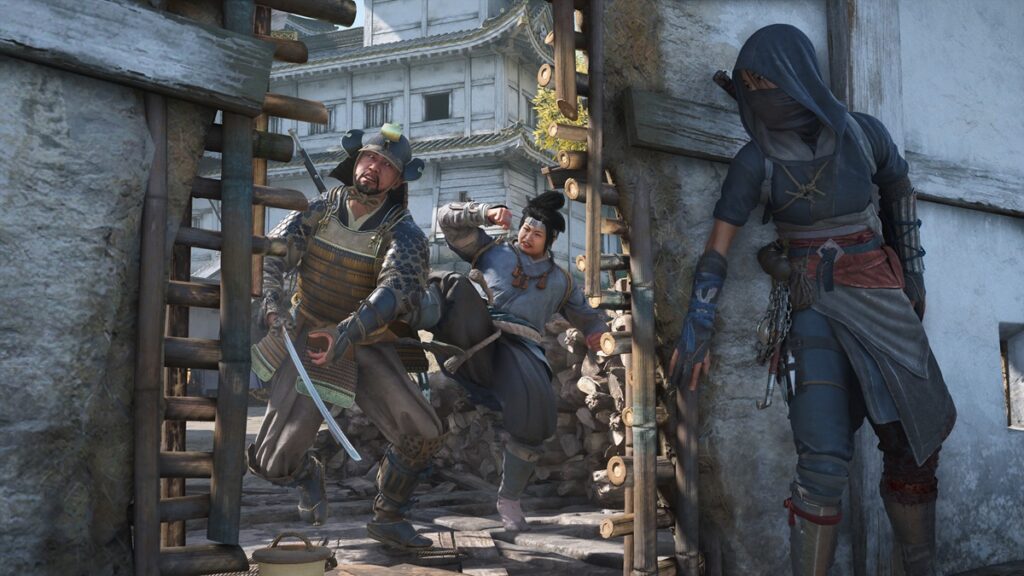
This has led to the strategic decision to refocus its portfolio, reallocate resources and comprehensively revise its roadmap over the next three years. This will support the objective to return to exceptional levels of quality on the Open-World Adventure segment and step-change the Group’s position in the GaaS-native experiences segment, as illustrated by the recently acquired project, March of Giants. The reshaped portfolio is designed to best position the Creative Houses for success. As a consequence, the measures taken are: Ubisoft has discontinued six games that do not meet the new enhanced quality as well as more selective portfolio prioritization criteria at group level. These include Prince of Persia The Sands of Time remake as well as four unannounced titles, including three new IP’s, and a mobile title.
In parallel, the Group will allocate additional development time to 7 games in order to ensure enhanced quality benchmarks are fully met and maximize long-term value creation. This includes the unannounced title initially planned for FY26, that has been delayed to FY27.
Acceleration of cost reduction initiatives to rightsize the organization and improve
structural efficiency Ubisoft is accelerating its cost reduction initiatives as part of the transformation of its operating model, with the objective of improving structural efficiency, restoring a much higher level of organizational agility and better aligning its cost base with its strategic and creative priorities.
This includes rightsizing the organization and focusing resources on core value-creating
activities, notably through further restructuring1 and strict hiring discipline across all functions.
The group also continues to consider potential asset divestitures. As part of this effort to streamline operations and adapt to evolving market conditions, the Group has already taken decisive actions to adjust its studio footprint. This includes the closure of the Halifax mobile studio earlier this month and the Stockholm studio, as well as restructurings at Abu Dhabi, RedLynx and Massive.
The current cost reduction program of at least €100 million in fixed cost savings2 versus
FY2024-25, is now expected to be fully achieved by March 2026, one year ahead of the initial FY2026-27 target.
Building on this momentum, the Group is defining a 3rd and final phase of its program by setting a new objective to reduce its fixed cost base by an additional €200 million over the next two years. This brings the total reduction in fixed costs since FY2022-23 to around €500 million.
This new objective is expected to bring total fixed costs to approximately €1.25 billion on a
run-rate basis by March 2028, compared to €1.75 billion in FY2022-23.
Ubisoft said it will reset its short-term financial outlook reflecting a major portfolio refocus and a meaningfully reviewed three-year roadmap. As part of its transformation, Ubisoft has taken a number of decisions impacting the Group’s release schedule and portfolio composition. As a consequence, the Group no longer considers its previously communicated FY2026-27 guidance to be an appropriate reference and will therefore update it in May 2026.
For FY2025-26, Ubisoft now expects:
- Net bookings of around €1.5bn, translating into approximately -€330m gross margin
reduction vs. guidance, mainly reflecting: - Changes to the current FY26 quarter release pipeline following the updated
roadmap - Decision to postpone negotiations on certain partnerships in the context of the
Group’s new operating model
This includes P&L structure costs + fixed portion of COGS (customer service and supply chain) + cash R&D (excluding performance-based royalties) and excludes all profitability bonuses.
- Non-IFRS EBIT of around -€1bn, mainly reflecting both the impact of the updated
FY26 net bookings assumptions described above and the following transformation-
related decisions that led to a one-off accelerated depreciation of around €650m:
- The discontinuation of 6 games
- The allocation of additional time to 7 titles with updated revenue expectations
reflecting a persistently more selective market - Free cash flow of between -€400m and -€500m
- Non-IFRS net debt of between €150m and €250m as of year-end FY26, with a cash
and cash equivalents position of between €1.25bn and €1.35bn vs. prior guidance
of around €1.5bn
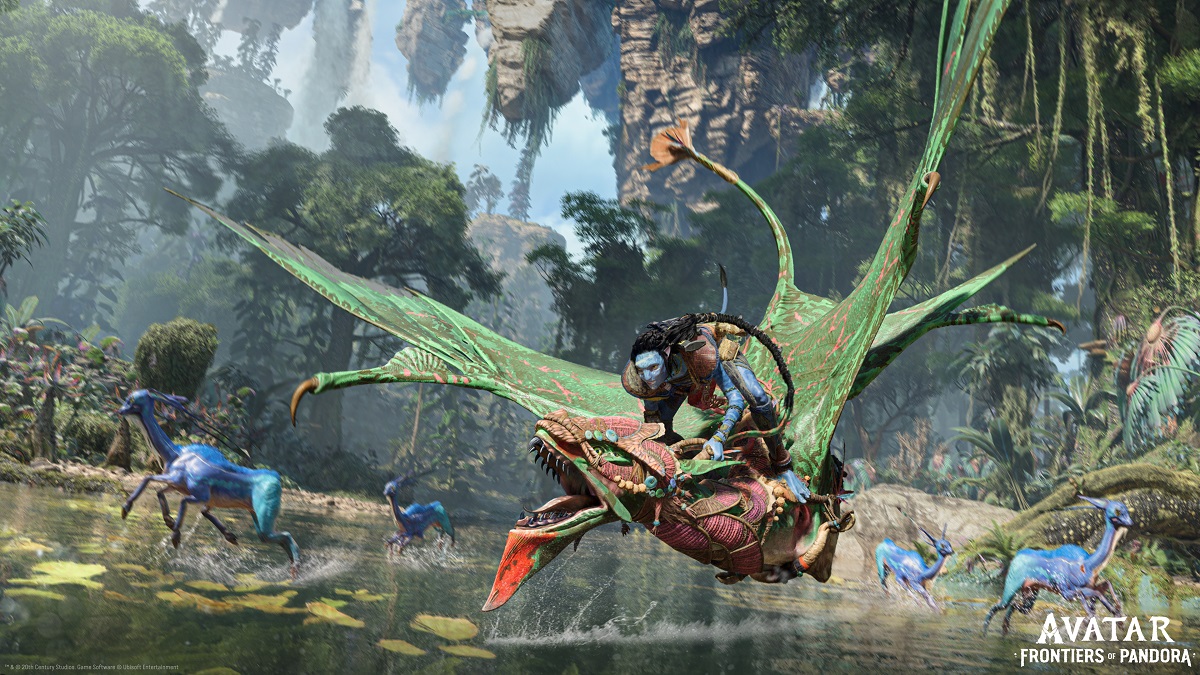
In addition, ahead of the publication of its Q3 FY2025-26 net bookings scheduled for February 12, Ubisoft is providing an indicative net bookings figure of approximately €330m, primarily driven by an overperformance linked to partnerships and reflecting a robust back-catalog. The quarter notably saw the releases of Anno 117: Pax Romana and the Avatar: Frontiers of Pandora From the Ashes expansion that were praised by players and critics alike. Further details will be provided on February 12.