
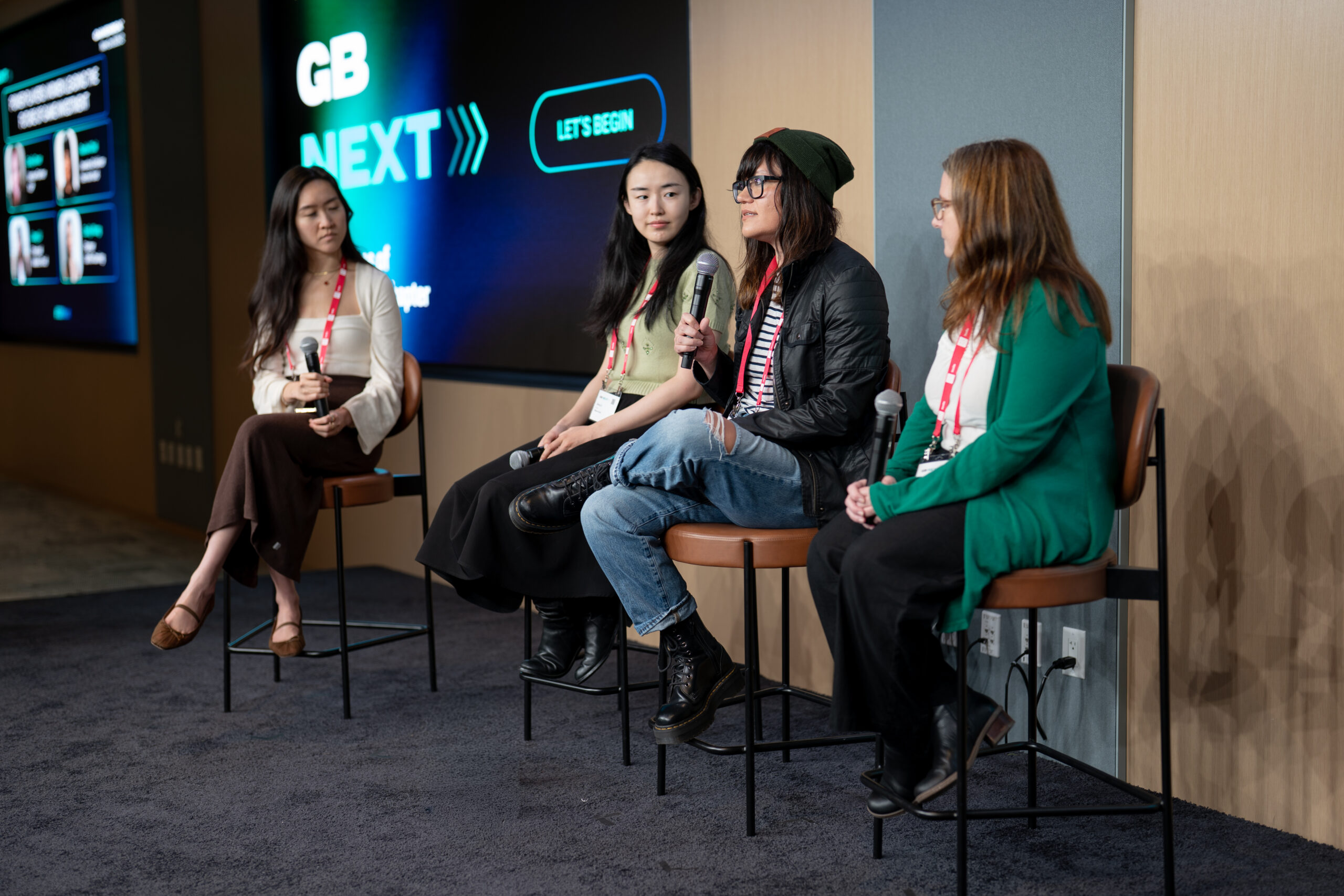
At GamesBeat Next, a group of prominent women investors in the gaming industry took the stage to discuss the evolving landscape of game investment, offering insights into mobile gaming dominance, geographic shifts in development and the complex role of AI in the industry’s future.
The discussion brought together Emily Greer (venture partner at One Up), Rachel Chai (The Mini Fund), Emily Wang (partner and CEO at Griffin Gaming Partners) and Jiang Li (Makers Fund) for a discussion about how recent M&A trends are reshaping investment strategies in the space. Wang noted that larger deals this year have predominantly occurred in mobile gaming, with increasing involvement from financial buyers rather than strategic acquirers.
The mobile gaming advantage
Mobile gaming emerged as a clear favorite among investors, with Greer explaining that mobile teams consistently perform best in One Up’s portfolio. She described successful mobile free-to-play games as “money printing machines” that attract numerous buyers, making them particularly well-aligned with venture capital’s staged investment approach. Mobile gaming typically represents about a third of One Up’s investments, which focus on $500,000 checks across various platforms and genres.
The geographic dimension of mobile development sparked considerable discussion, particularly regarding China’s growing influence. Li highlighted China’s advantages: development costs roughly one-fourth of U.S. prices, abundant talent pools with over a decade of live operations expertise and teams capable of scaling to 400 people within two years. Recent successes like Century Games’ “Last War” demonstrate the market’s winner-takes-all dynamics, while the Chinese PC gaming market has surged following the success of “Black Myth: Wukong.”
Community and founder quality
Despite China’s cost advantages, the panelists emphasized that talent and community exist across multiple geographies. Greer pointed to thriving ecosystems in Turkey, Israel, Eastern Europe and Latin America, where successful companies have created network effects and flourishing studio clusters.
Chai, based in the Bay Area, noted the region’s “supercharged” energy and strong foundational community. For The Mini Fund, which writes $250,000 checks at very early stages, founder quality trumps MVP quality. “We care about the quality of the founder,” Chai explained, emphasizing the importance of community support for game studio founders.
The AI reality check
The panel delivered sobering assessments of AI’s current role in gaming. While acknowledging AI’s value for operational efficiency and cost reduction, the investors expressed skepticism about AI-native games achieving meaningful product-market fit beyond chatbots and role-playing applications.
Li emphasized that “high quality has never been appreciated more,” arguing that players expect games with authentic creative vision and careful craft — expectations that AI tools don’t excuse developers from meeting. Even high-profile AI-native projects like “Whispers of the Stars” have achieved only modest sales despite exceptional quality.
Chai warned founders against “shoehorning” AI into products simply to attract investment, urging objectivity about AI as merely a tool. Greer drew parallels to Flash, another democratizing technology that made game development more accessible globally, suggesting AI’s impact will similarly prove complex rather than simply positive or negative.
Investment climate shifts
The conversation revealed significant changes from the industry’s 2021-2022 funding frenzy. Greer noted that deals once expected to raise multiple rounds now assume companies will reach market without additional financing. Teams are leaner, games are further along at seed stage and investors prioritize “entrepreneurial grittiness” over pedigree from prestigious studios.
The panelists agreed that the COVID-era bubble, when “money was free,” led to overcorrections that actually improved investment quality by forcing focus on founder aptitude rather than resume credentials. Li advocated for “long, non-linear and contrarian thinking,” praising founders who identified emerging opportunities like Roblox’s rewarded ads early.
Looking forward, the investors expressed cautious optimism. While mobile M&A appears healthiest, Greer worried about potential recession impacts creating “a hangover on a hangover.” Still, the abundance of talented founders launching new studios signals an exciting creative period ahead — even if the path forward remains uncertain.