

Take-Two Interactive is worth about $44.5 billion today, with its stock up about 3% as I write this thanks to the game company’s good earnings report for the fiscal quarter ended June 30.
Strauss Zelnick acknowledged that mobile growth slowed a bit but noted that Zynga’s results met expectations for the quarter. Meanwhile, anticipation is growing for the launch of Grand Theft Auto VI, as Zelnick said preorders were exceptional.
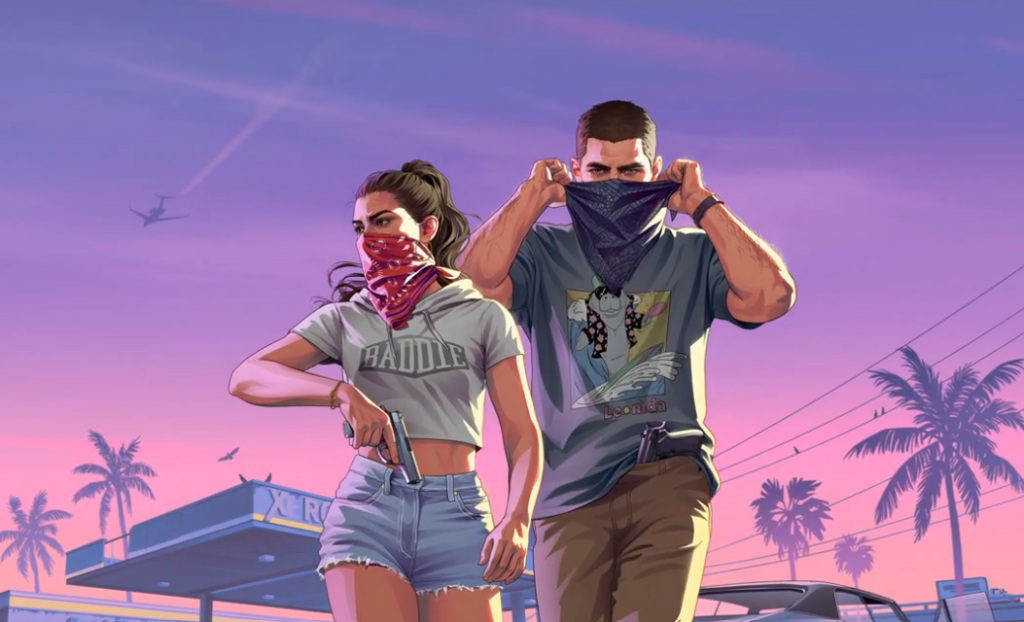
The game gets a deep dive on Netflix on August 27 and it launches on the PlayStation 5 and Xbox Series X/S on November 19, 2026. The game is still on schedule, and Newzoo estimates it could generate at least $3.25 billion in its first week of sales, which would make it the biggest entertainment launch in history.
For Take-Two and its Rockstar Games label, it’s a time to focus on delivery and execution and so Zelnick is not yet celebrating. Meanwhile, as Electronic Arts was taken private in a $55 billion acquisition by a Saudi-led group, Take-Two is now the biggest U.S. publicly traded company in the game industry.
I spoke with Zelnick this morning after the results came out and after the call with analysts. Here’s an edited transcript of our interview.
GamesBeat: Congrats on another nice quarter. I hope you guys stay public because you’re our only tea leaf now. I wonder also how does it feel to be the biggest publicly traded pure game company here in the U.S.?
Strauss Zelnick: I don’t love winning by attrition, but I’ll take it.
GamesBeat: Nice. And do you think there’s some significance to EA going private, and also good things about staying [as a public company]?
Zelnick: I don’t think EA becomes any less competitive from our point of view, and they have a great owner and they have a lot of other assets. We assume that our competition is always aggressive and performing, and we’re always running scared. So I don’t see any of that changing. We do think there are benefits to being a public company if you’re transparent, which we are, and honest, which we are. I’ve been running public companies since I was 29, and I’ve never had to restate financials, and never had any kind of compliance issues. And being a well-run public company, which we believe we are, gives you access to markets at a moment’s notice. And when you’re trading well, it can you give you a currency with which to pursue accretive acquisitions, which we’ve done. The people who hate running public companies are the people who hate telling the truth and showing up and doing the hardest thing and being compliant while they’re at it. That’s not troublesome for us.
GamesBeat: Do you want to disclose how many people are working on GTA VI?
Zelnick: We have thousands working on it. We have about 13,000 colleagues group wide.
GamesBeat: My guess is it sounds like about 3000, but I don’t know if you want to get that specific.
Zelnick: I don’t think we want to say the exact numbers of each label.
GamesBeat: I do wonder what that says about say triple-A development and and what it means for other game developers?
Zelnick: It’s really expensive. It’s really time consuming, and it’s really risky. For us, we aim to make the very best and biggest hits in the entertainment business, and thankfully, we get that right more than not. But it’s it’s big boy game, undoubtedly.
GamesBeat: I heard your remarks on pre-orders. If you’re not doing a victory lap yet, then how do you describe this moment?
Zelnick: Well, I said pre-orders are exceptional and vastly [beyond] our expectations, so that’s as close to a victory lap as I’m engaging in.
GamesBeat: I’m I am curious if you had any thoughts or observations about the Xbox layoffs, and what that means about how to structure very big game companies?
Zelnick: I don’t feel comfortable commenting on Xbox’s business, except say that they’re trusted and valued business partners that I wish them well.
GamesBeat: Do you think that there’s a direction that staffing at the biggest game companies is heading?
Zelnick: There definitely been layoffs. We’ve continued to be in growth mode more or less all of the time. We had some reductions in force around the Zynga acquisition. And we subsequently had some minor reductions in force, very selectively. But once again, we expect to be in growth mode creatively. We don’t want to expand the size of our business footprint, but I think we will probably continue to expand the size of our creative footprint as we aim to deliver more hits to the marketplace.
GamesBeat: You mentioned growth opportunities for for M&A, and some of it sounded geographic, like opportunities in India or the Middle East. Is that something that you think is is going to be a way to lift any kind of limiter on something like GTA’s potential?
Zelnick: I wasn’t necessarily suggesting that we pursue M&A in developing markets. In fact, to the contrary, I expect that that would be more of an organic growth story. And secondly, I was not really talking about any particular type in that context. I was really talking about our entire business.
GamesBeat: GTA’s potential is so wide and so far that the size of the game [audience] is maybe the limiter. And if if there’s something that you could do to increase the reach of games into other places, then that that would be an interesting strategy.
Zelnick: It would benefit all of our titles.
GamesBeat: Then do you see those territories like India or the Middle East or even China coming on in a way that really makes you optimistic about them being a bigger part of Take Two’s revenues.
Zelnick: Well, we continue to grow our business in developing markets. So, for example, we have mobile titles in China. We have NBA 2K All Stars with Tencent that is doing really well.
GamesBeat: We’ve seen different waves of investors coming into the game industry, and sometimes they come and go. The Middle East, China-it’s-it’s been very regional in some ways. I wonder if you expect a wave to of game investors to come from any particular place now?
Zelnick: We’ve certainly seen you know the PIF, which is a Saudi enterprise, become very aggressive in the interactive entertainment business in the last five years. It’s hard to say. China is obviously a huge player through Tencent and NetEase and others. Korea and Japan through Nexon and other businesses, and there are sizable companies in Scandinavia and Western Europe. There a broad distribution of international enterprises. Not so many at our scale or bigger, though.
GamesBeat: Your mobile business met expectations this quarter, but it seemed more exciting in terms of its growth in previous couple of quarters. I guess I wonder if there’s any explanation for that.
Zelnick: No. A year ago we had Color Block Jam (from Zynga’s Rollic studio) booming as it was growing from its initial launch. It’s a more mature cycle now. Hopefully, we have other hits coming, but we do feel very good about our mobile business. It’s performing very well.
GamesBeat: The memory chip crisis. You addressed that. I wonder if you see good solutions that could come quickly, or do you think this is something the industry is going to have to learn to live with?
Zelnick: Chips, as you know, are a highly cyclical business. Typically, what happens is there are chip shortages, and then there’s huge overbuilding. Then there’s chip oversupply, and then there’s a shortage. That’s the curve, and we’re still in the throes of hyper excitement about all things AI, and that’s reflected in chip shortages. But I fully expect that that will change.
GamesBeat: And then you said that interactive entertainment is the world’s pastime, and I wonder if you could elaborate on that that view?
Zelnick: There are many hundreds of millions of people who regularly and avidly consume video games. There are more more than 200 million gamers in the U.S. out of population of like [343 million]. Some casual. Worldwide, I think it’s 2.5 billion people play video games. It’s the biggest it’s the biggest entertainment business. Bigger than movies, bigger than music.
GamesBeat: Do you think it can push deeper into mass culture?
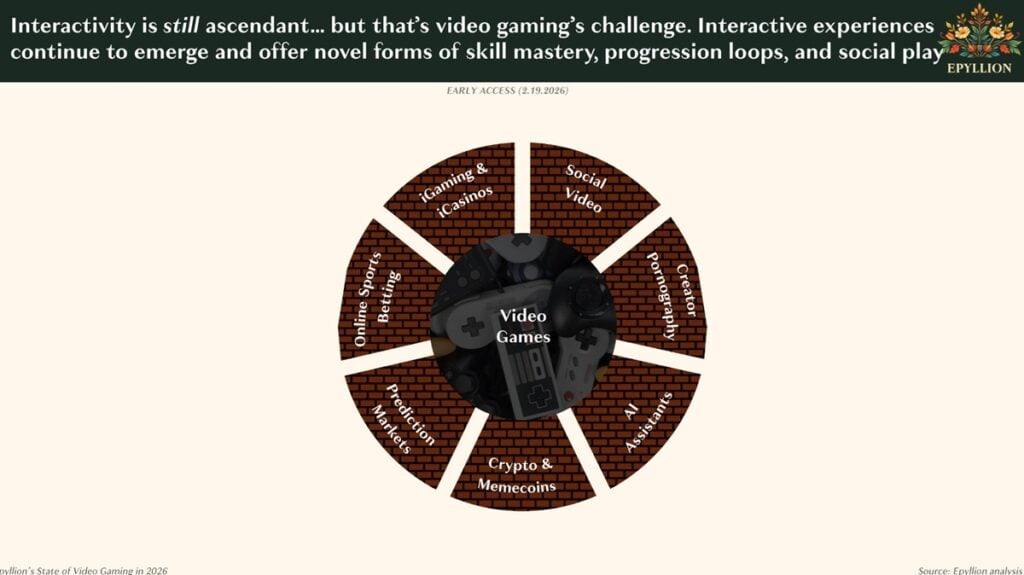
Zelnick: Undoubtedly. I think we’re scratching the surface still, both in terms of the size of the audience and the monetization of that audience.
GamesBeat: Then what kind of things does that mean people should be ready for? Beyond bigger and better?
Zelnick: It’s a good question. I think there will be new formats, new form factors in the fullness of time. I don’t think we’ve reached the creative or technical [peak of] aspects of the business.
GamesBeat: And do you think that in the context of the attention war that games can keep succeeding in beating everything else in mass culture where consumers are putting their time?
Zelnick: [Yes].
Take-Two analyst call excerpts
Here’s some additional things Zelnick said in the analyst call.

Zelnick said, “Fiscal 2027 is off to an excellent start, led by the power of our diverse portfolio and the strong, consistent execution of our strategy all through our business. We delivered first-quarter net bookings with approximately $1.39 billion, slightly above the high end of our guidance range, primarily due to the outperformance of FDA 2K and the Grand Theft Auto series.”
He added, “We’re reiterating our fiscal 2027 outlook for net bookings of $8 billion to $8.2 billion dollars, which reflects both ongoing positive trends in our business and our high degree of confidence around the November 19th release of Grand Theft Auto 6. We expect to sustain this new level of scale and generate strong cash flows for the next several years as we release our robust development pipeline, capitalize on the incremental opportunities within our highly established kit franchises, and continue to apply our proven long-term approach to managing the company.”
He said he thinks that passion for the title will grow further from now through the release date. Asked why Take-Two went with a Netflix special for the GTA VI extended look, Zelnick said it’s a first-of-its-kind venture with Netflix, which he said is a great partner, and it’s part of the overall Rockstar marketing strategy. The goal is to be on every social media channel on earth. Asked if Netflix paid a partnership, he did not say. He said Rockstar arranged it and he would not disclose the terms as to whether Netflix paid a premium for the exclusivity.
As to the pricing for GTA VI at $80 and $100, Zelnick said game prices have not kept up with the pace of inflation in the last couple of decades. He said it would be a gross understatement to say GTA VI would be an incredible bargain as Rockstar is known for over-delivering.
As to the rising cost of hardware, he said, “The rising cost of hardware is not a good thing. we would argue that it is. I I don’t think it will slow us down, and because we’re delivering sxperiences that people want. However, a lower price point of hardware would be a good thing because it would be more hardware in people’s hands. So I cannot argue this is a positive, but we don’t see it as a [headwind].”
He noted “the advent of streaming” is right around the corner and machines that could not play games in the past will be able to do so. He thinks the overall installed base for game machines will grow in a material way. He noted the PC was 2% of sales 20 years ago and it could be 40% to 50% in today’s markets. And he noted “interactive entertainment remains the world’s pastime.”
He also answered a question about AI.
“We are first and foremost an entertainment company and always have been,” Zelnick said. “However, we’re an entertainment company that creates its entertainment in computers and always has. So this company, its products and its approach were built on AI and machine learning well before AI became a. We’re dyed in the wool, full adopters of new technology to the extent it enhances our ability to do what we do through the three part strategy, two parts of which are innovation and efficiency,” he said.
He added, “We have projects that fall into both the basic research and applied research methods here. Basic research side of the art is possible, and the applied research side, how we can innovate more and how we can create additional efficiencies, and that threads through our entire company.”
And he said, “The first of our core pillars is creativity, and we have 13,000 colleagues around the world. The vast majority of our creators every day — and we believe that technology can enhance their creativity. We do not believe we can or should replace their creative, and ultimately we make bespoke entertainment products. We make the best ones in the world, and technology should make it easier for incredibly creative people to innovate. But for better for worse, I happen to think it’s very much for the better. Those tools are not going to replace anyone. Unlike some of our competitors who are announcing opportunities to save hundreds of billions of dollars in AI, I’ve said since the beginning, the history of new technology efficiencies are being created, but then we find ways to do bigger and bigger things, and you know we actually don’t reduce the cost of doing those things and increase quality….It means making bigger and bigger hits that appeal to more and more consumers, and that’s our job. Our job is not to lead in technology. Our job is to lead in entertainment, and as happens, we use technology trying to do that.”
Zelnick said the level of preorders is unprecedented and astonishing and he is greatful for that.
As for why the company hasn’t changed its guidance after receiving great preorders, Zelnick said, “One of the reasons that we’re not changing our guidance, to be clear, is we haven’t sold one unit yet. You can cancel a preorder. We’re allergic to victory laps. One thing we certainly don’t do is take a victory lap before we run the event. The news is great so far. We’re incredibly excited. We couldn’t be more excited than we are, and yet we are, realistic and at best cautiously optimistic.”