
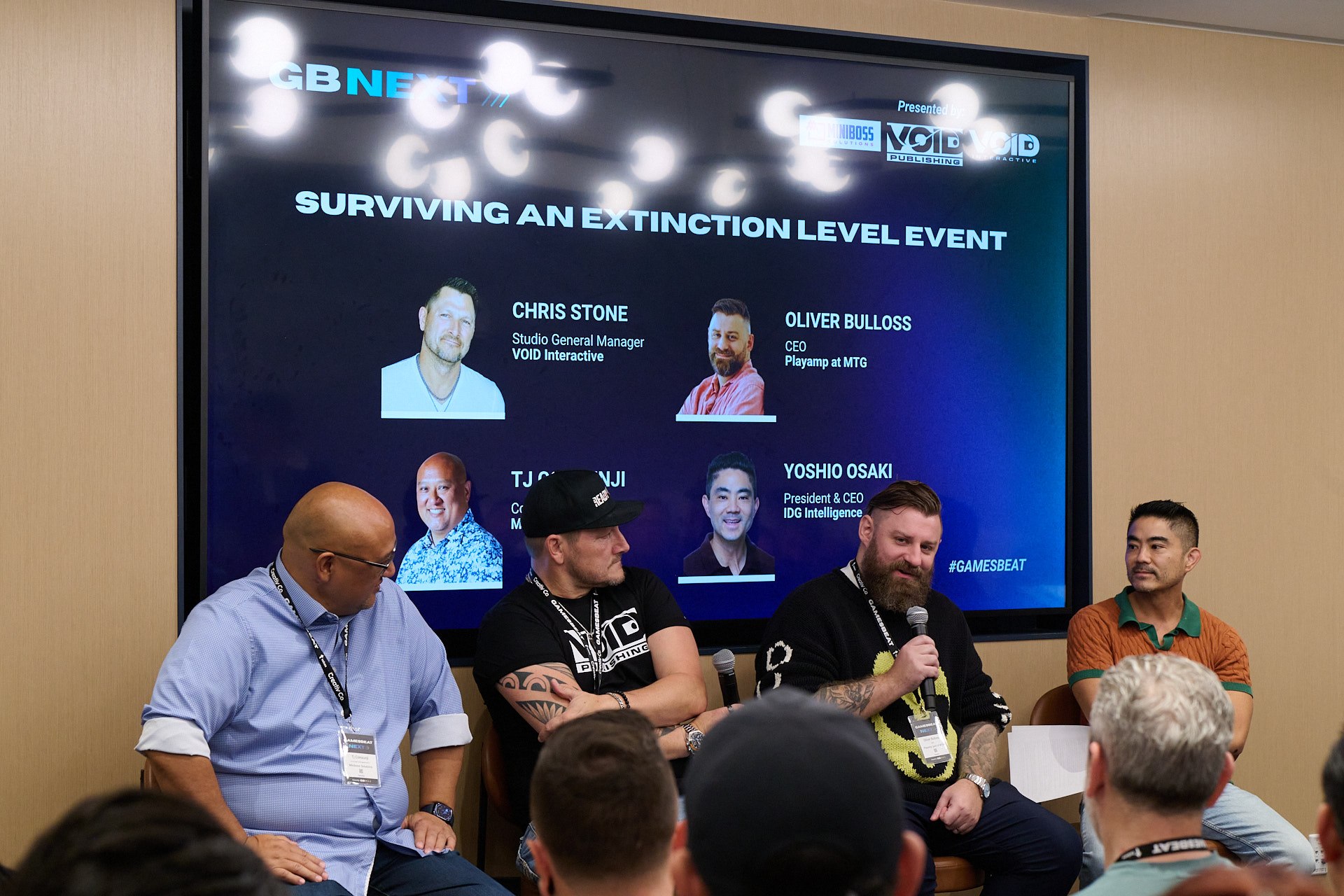
At GamesBeat Next 2026 in San Francisco on November 3, three leaders from the independent and double-A side of the gaming industry argued that smaller companies can apply triple-A lessons to today’s market and have a better chance of surviving than the big publishers they referred to as dinosaurs.
The session, “Surviving an Extinction Level Event,” featured Chris Stone, studio general manager at Void Interactive; Oliver Bulloss, CEO of Playamp at MTG; and TJ Consunji, co-founder of Miniboss. The panel was moderated by Yoshio Osaki, president and CEO of IDG Intelligence.
Osaki opened the session by saying the fastest-growing part of the market in monthly and daily active users is indie and double-A, and that the same segment is where most new IP originates across all platforms. He also pointed to a widening gap between the haves and the have-nots, with discoverability getting harder. His argument was that studios that manage risk with the right partners can take on more of it than publishers making bets of $200 million, $500 million or $1 billion, which leave little room for error.
Stone, who has worked in the industry for more than 30 years, including at Electronic Arts and Activision, said the lesson he took from triple-A was the quality bar, rather than the spending. He explained how big publishers push mass scale with little thought for cost, while Void builds relationships with partners instead of staffing large teams.
“You build great relationships with great partners that help you come in and do the things you need to do as you do them,” Stone said.
Void’s Ready or Not had been on PC for three years and had nearly 9 million units sold when it launched on console last year. Rather than present it as an old game, Void and Miniboss rebranded it, designed new key art and launched it as a new tactical first-person shooter. Stone said the game is now on the brink of reaching 18 million units.
Consunji, who had spent 18 years working on PlayStation’s first-party brand team, described Miniboss as an embedded publisher. His team at Miniboss energized PC players to talk to their console-owning friends while treating the console release as new. Developers keep the IP and the decision-making, he said, and Miniboss gives recommendations with alternatives.
When a team is unable to outspend rivals, Consunji said, it needs to find what makes its game stand out against the competition. For Ready or Not, in which players are SWAT officers who must follow rules of engagement, that meant “feel the weight of the badge” positioning aimed at an existing fan base.
“Understand what makes you unique, and lean in hard on that,” Consunji said.
Stone said Void is now using the same approach through VOID Publishing, which he described as a boutique, case-by-case publisher. It targets games that need a few million dollars, in the range of $5 million to $15 million, along with help on marketing and audience targeting. He said VOID wants to be a partner, not an owner, and has multiple games in its queue that it expects to discuss soon.
Bulloss, who has worked at Zynga, Rovio and King, oversees six studios around the world and a services team, about 2,000 people in all, at Playamp. He said the company is a big mammal, not a dinosaur, because its studios keep creative freedom and day-to-day ownership and there is no central green-light process. Part of his job is making sure no single bet grows to $100 million or $200 million, so Playamp deliberately spreads its games across genres and platforms, including taking mobile games to PC.
“You can be a public company without being corporate,” Bulloss said.
He said the model has limits. Playamp mostly buys studios and then operates them, and some things are not negotiable, such as cybersecurity, financial reporting and a single company-wide marketing stack. Those conversations happen during the acquisition, he said, because founders who expect life after the deal to match life before it “have a really bad time.”
“You can’t pretend that you’re going to be the same fluffy indie you were before,” Bulloss said.
On free-to-play mobile versus premium games, he said monetization differs but the core is the same: finding the fun. Players also judge a new game against established ones as they are today, he said, so it has to launch with something strong and different.
With Grand Theft Auto VI 16 days away at the time of the panel, Osaki asked the panelists whether a studio should hide or counter-program. Stone said it depends on the studio and its market, called the game’s scale unprecedented, and recalled studios steering clear of Call of Duty launches. He said many players only buy a game or two a year, but a studio can still capture players who want more of something after the big release.
Consunji was more definite. He called a head-on launch “a water balloon against the tsunami” and advised developers to “let the wave pass.” A cozy game or a platform exclusive might be an exception, he said.
Bulloss said players today spend more time in fewer games, especially in mobile, so a new game is competing against the years of investment players have already made in others. He said he gave all of Playamp’s employees the afternoon off on November 19 because he expected them to be playing the game anyway.
When Osaki asked the panelists what big publishers could still learn, the consensus was to take more risks. Consunji said he misses the quirky PlayStation games and sees too much sequelitis. Stone said there are enough shooters already and urged small bets and agility.
“You don’t have to go for the freaking long bomb every time,” Stone said.
Bulloss said quality doesn’t scale in a straight line with team size or budget, and that giving a developer $20 million or $30 million instead of $100 million can focus its spending on what players care about. Osaki closed by saying he has helped about 39 of the 142 job seekers in his inbox find work, and that resources exist for developers with good ideas.