

A new study shows that 80% of mobile game developers believe the industry’s engagement and retention strategies are going stale, according to an in-depth survey of 195 mobile gaming industry leaders.
The Retention & Engagement Challenge study was commissioned by ZBD to better understand the current pain points in player retention and engagement while looking ahead at future growth levers. With developers needing to reduce their reliance on UA, and megatrends like D2C reshaping profit margins, post-install player engagement is a growing opportunity to create incremental revenue. While the study shows there is a path forward, many games are using standardized engagement strategies, and several other factors are also currently limiting innovation and growth.
“We are entering an era in mobile gaming where engagement and retention models are evolving. This is largely due to necessity rather than for the pure joy of innovation. Over the last decade, free-to-play monetization and engagement systems have been trialed and tweaked until a specific, consistent style was created,” said Gordon Thornton, CCO at ZBD, in a press release. “However, these practices worked so well that almost every major mobile game is using them and fatigue is starting to set in. It’s a familiar story for any fast-paced industry and a common sentiment that we’ve been hearing from our partners, and so we wanted to dig a layer deeper. With this report we aim to capture a snapshot of the mobile gaming industry as it currently stands in 2026 and provide a glimpse of what could come next.”
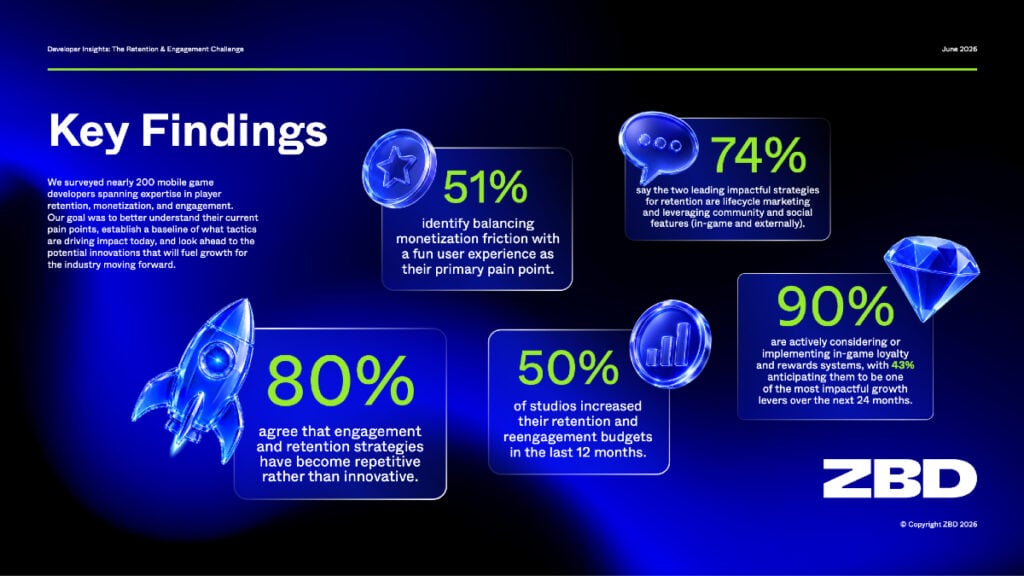
45% of developers are finding it difficult to retain and engage their spending players, while 39% shared difficulty tailoring experiences to different user segments. But the biggest concern is the more than half (51%) of developers who are struggling to balance monetization friction with a fun user experience. Subsequently, gains from existing engagement systems are starting to see diminishing returns and the opportunity to differentiate in a saturated market continues to be reduced.
It comes down to economics. UA has become more expensive and harder to scale efficiently, and standardized game mechanics in a saturated market have made differentiation harder to achieve. Post-install growth is a higher priority than ever, which means studios have to think much more strategically about how they stand out and drive that growth. Beyond that, games are essentially competing against everything else for consumers’ attention and spend. The playing field looks nothing like it did five years ago.
“Retention has become the biggest lever of growth, and fortunately, it’s one that devs retain high control over. Studios have to find new ways to build stronger, longer-term relationships with players. What we’re seeing work is a move from one-way, purely transactional engagement toward a two-way value exchange that keeps players coming back,” Thornton said in a written interview with GamesBeat.
When asked why the study was commissioned, Thornton said that his company had repeatedly heard from game studios that their existing retention and engagement strategies were starting to feel “cookie-cutter,” despite their recognition of the growing need to focus on player retention.
“We wanted to conduct a broader pulse check and set a reference point for the industry as it looks ahead,” he said. “It was important to dig into whether developers felt that the mechanics that drive retention were still delivering meaningful value, and whether devs are playing it safe given market conditions or if the risk appetite is high enough to spark a paradigm shift.”
The study also highlights that 50% of devs have increased their retention budgets over the past year and are looking to reshape their growth strategies by focusing on stronger personalized player experiences and integrating in-game reward systems with real-money rewards. While those who take risks to innovate can often seize first mover advantage, it’s notable that nearly 40% of developers state innovation is limited due to a fear of negatively impacting KPIs.
“Mobile games can’t rely on buying growth forever. CPIs continue to rise, making retention the ‘new UA’ and the fastest path to scale, and increasingly about creating more value from players you’ve already acquired. The studios that win won’t be the ones with the biggest content calendars, but the ones that turn engagement, loyalty, and monetization into experiences players actively want to return to, time and time again,” said chief executive officer of Turborilla John Wright in the press release.