
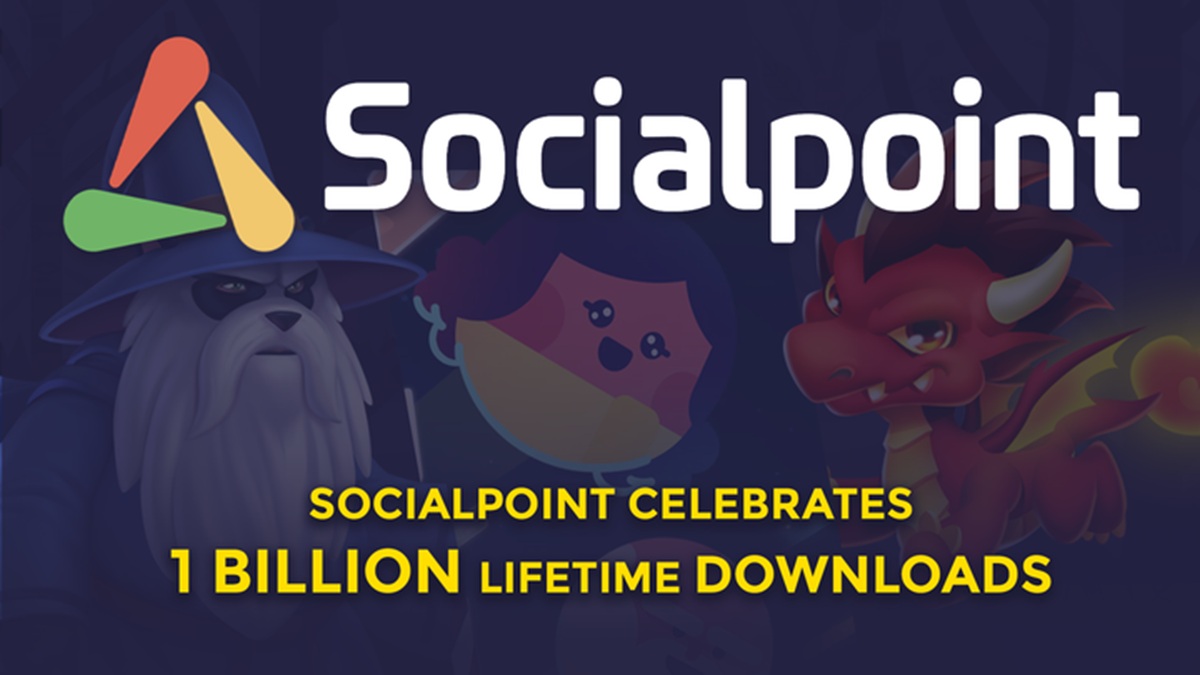
Socialpoint is at a big mobile moment. The company, a mobile gaming studio at Take-Two’s Zynga, has surpassed a billion lifetime downloads across all of its games.
That means it’s one more game among Zynga’s studios that have hit that milestone, with the mantra of connecting the world through games, said Akshay Bharadwaj, head of Socialpoint, in an exclusive interview with GamesBeat. The news comes at a time when Strauss Zelnick, CEO of Take-Two, credited 19% growth for the mobile game business as a reason why the company beat expectations for its most recent quarterly report.
Socialpoint’s achievement represents billions of moments where players chose to laugh, compete, strategize, collect and escape into the worlds Socialpoint helped create.
The mobile game studio, based in Barcelona, made it to the milestone on the strength of multiple games, including its biggest hit Dragon City, as well as Monster Legends and Two Dots.
Those games have resonated over time with players across multiple cultures and generations. Each individual download represents a part of a players’ daily routines and shared memories between friends, siblings, partners and entire communities.
Dragon City is a game that sparked the imaginations of millions. From breeding
adorable dragons to building dynamic cities floating in the sky, Dragon City blends creativity with strategy in a way that invites players to return again and again. Its longevity and continued engagement are a testament to the team’s dedication to evolution and responsive design informed by Socialpoint’s audience.
Take Two Dots, a minimalist puzzle experience that launched with a simple premise of
connecting dots in thoughtful ways and has grown into a beloved title that’s been engaging players for more than a decade. With colorful worlds, relaxing music and clever level design, Two Dots became a companion for casual moments everywhere, and its 11th anniversary sweepstakes last June reminded the studio yet again of how deeply its players care about shared experiences and celebration.
And Monster Legends is a franchise that has grown into a true cornerstone of Socialpoint’s portfolio, with its deep monster collecting systems and strategic turn-based combat. The game has developed and maintained a passionate audience for more than a decade and continues to evolve by regularly introducing new monsters, in-game events and competitive features, keeping it fresh while rewarding long term mastery.
These games prove that great games aren’t just built at launch. They live through the ongoing relationships the devs build with players and something the studio strives for is to not only create engaging core gameplay, but also to evolve those experiences with in-game events, gameplay updates and ever-expanding ways to bring players together.
As the team looks ahead, this milestone is both a capstone of what it has achieved and a spark for what comes next. With new ideas in development and a community that continues to grow and evolve, the next billion moments are already on the horizon.
To everyone who has played, shared or smiled over one of our games, thank you, said Bharadwaj.
“This achievement is yours as much as it is ours. Here’s to the next chapter of play and our continued mission to unite the world through games,” Bharadwaj said.
A long journey
Bharadwaj said the studio started as an ambitious local studio in Barcelona in 2008. Horacio Martos and Andrés Bou started the company and Marc Canaleta joined them early on as CTO. They were one of many successful global studios in Spain. They started out with Facebook games like Social Empires and Social Wars.
“The journey has been about truly scaling up the company and keeping the soul of what we care about, which is building games and building them with love and care,” Bharadwaj said. “It was essentially an ambitious local startup, and over the years, took the journey. I think the true game changer came in 2013 when it pivoted from Facebook to mobile growth with Dragon City.”
Dragon City was also big as a Facebook game, but that success from Dragon City essentially took off on mobile.
“I’m sure you remember the race. It was a different era. Games like Farmville and Zynga Poker. Dragon city was the success that put Socialpoint on a path to exponential growth. And the next milestone was in 2017, when we also had the release of Monster Legends, which was another iconic game coming out of Socialpoint.”
Take-Two acquired Socialpoint in 2017 and then it became a part of Zynga in 2022 when Take-Two acquired Zynga for more than $12 billion. That was when Bharadwaj became head of the studio. Before that, he was part of Zynga’s casual games and new games business.
“Today, we’ve become more than just a pure game making company. This is our bread and butter. We also are a primarily a strategic hub for the whole EMEA region. We also have other teams. We also have regional management from Zynga here. So we’re focusing on more on the game making, as well as being a hub across Europe,” Bharadwaj said. “We have world class talent.”
Other big titles were World Life, Word Chef and Tasty Town. Bharadwaj said he could not comment on the number of people in the studio or the number of downloads for each of the big games. But the primary contributors are Dragon City and Monster Legends. Socialpoint also provides support for global teams in Barcelona.
Surviving the industry’s trends and cycles
As for recent milestones, Bharadwaj said Socialpoint has been focused on the live game portfolio, focusing on audience metrics, helping scale the games, and managing the Two Dots acquisition. Zynga continues to invest in live operations of existing games and new titles like Top Troops.
“We are we are focused on efficiency and we are focused on creativity and innovation and doing it at scale in a way that’s profitable for the company,” Bharadwaj said. “And as you saw from the earnings report, the mobile portfolio is doing very well for Take-Two, and we are contributing to it as well.”
I noted that took over during a tough time for mobile games, with Apple favoring privacy over targeted ads with its changes to the Identifier for Advertisers (IDFA). Mobile games started declining in 2021 after that was phased in.
“That’s a fantastic question, and I think that I still believe that we are in a state of evolution. That’s my honest answer,” he said. “IDFA was was a shock to the whole gaming industry. It was not something that any of us anticipated. But from our view, we’ve had internal changes in how we operate. We are able to also focus mostly on what players love, what our audience needs. We’ve gone back to the basics in listening to their audience, adapting their feedback, and not only meeting their needs, but anticipating them.”
What works in Socialpoint’s and Zynga’s favor, he said, is a lot of their audiences are built over many years. They’re not built overnight.
“That’s something that, as a live games portfolio company, works in our favor,” he said. “So when you have people spending many years with you, it’s in some sense a different business to run, versus an average mobile games business.”
That is where Zynga and Socialpoint had players opting in to share their data to get rewards and other advantages in the games. With more trust built with players over time, the companies have some advantages that are like tailwinds for the business despite IDFA.
Asked why the game has done well, Dragon City has complex lore based on local Catalan lore and history. The team also helped built trust with players over more than a decade, and now the game is becoming a multigenerational game where parents can play with kids.
On monetization, AI and embracing change
As for monetization, he said that the team focuses on long-term retention and engagement, and monetization is something that flows from that.
I asked about the generative AI experiments that are taking place across the company, which Zelnick talked about in our interview.
“There’s definitely a lot of talk about AI. As a company, given the scale of where AI is and how much it is eventually going to impact humanity overall, we are, as a company, [not disclosing what we are working on] until we are comfortable sharing a playbook or our comments. I’d rather stay away from commenting on AI yet, because it might come across as being more speculative than not. So at this moment, I’ll hold back, but I do hope that at a later point, because I’m so excited about it personally, talk about the possibilities.
Bharadwaj said he is investing more time at a personal level in not just learning the tech but also engaging in systems thinking and looking at second order and third order impact.
“There’s a lot happening. At a personal level, I’m very fascinated, and I feel like a student, a child, all over again, going through what’s happening. But I do feel like at a company level, hopefully I’ll be able to share more,” Bharadwaj said.
Bharadwaj said, “Every quarter we’ve got to stay on top of our game. We’ve got to execute hard, not take it easy, right? We’ve got to be paranoid. We’ve got to stay on top of our game to continue scaling. I feel for the industry at where we are. It’s not an easy place. So I know that we are privileged to be on the right end of it now, but I want to also make sure that we ride on this and grow to more success.”