
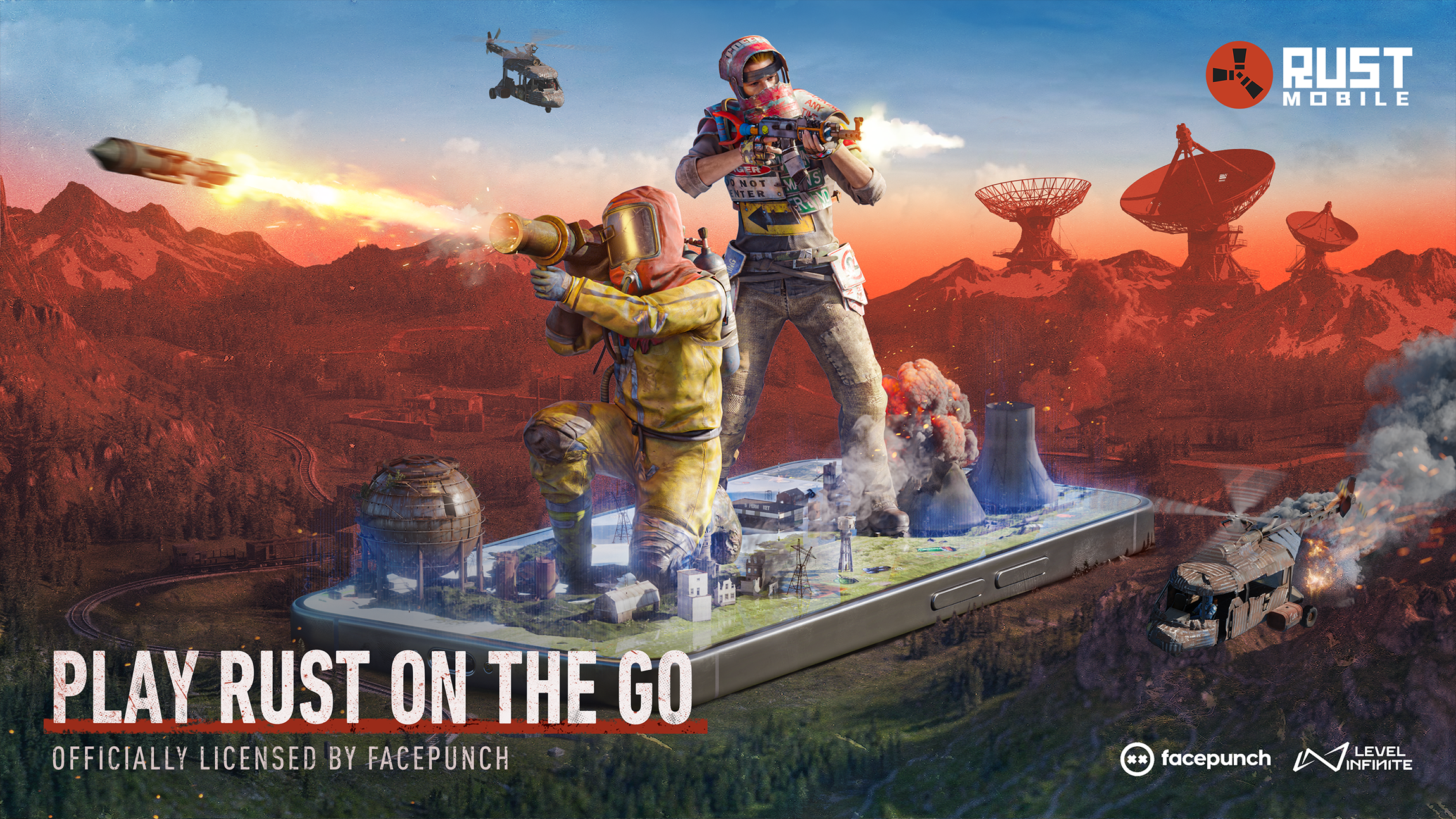
After nearly a decade as one of PC gaming’s most unforgiving and influential survival games, Rust is finally heading to mobile platforms in the form of Rust Mobile.
Developed in partnership with Tencent publishing label Level Infinite and Facepunch Studios, Rust Mobile is being positioned not as a straight port, but as a fully standalone, mobile-first reimagining of the franchise’s core survival experience. The excitement is strong, as the game amassed over one million pre-registrations for its closed beta test.
At its heart, Rust Mobile aims to preserve what made the original game so compelling: emergent PvP, player-driven storytelling, and the constant tension of losing everything at a moment’s notice.
According to Level Infinite producer Edwin Zheng, that ruthless identity was non-negotiable—even as the team adapted the experience for touch controls, smaller screens, and a vastly different audience reach.
“At its core, Rust is a ruthless, high-stakes survival game,” Zheng said in an email interview with GamesBeat. “Players explore the open world, scavenge for raw materials to build up a home base, and raid and pillage other players’ bases to get ahead. The world of Rust tests players’ ability to survive amidst dynamic weather conditions, a variety of biomes and terrain to traverse, and a real-time day-night cycle, all while trying to protect what is theirs. It’s incredibly ruthless and incredibly fun, once you’ve honed your strategy to survive.”
That loop of risk, reward, loss, and recovery remains the foundation of Rust Mobile. What’s changing is how that experience is delivered, and who it’s being built for.
Rust Mobile has been a long time coming. Zheng said the project’s roots stretch back to 2020, when Level Infinite first began formal discussions with Facepunch about expanding Rust beyond PC. For both companies, the goal wasn’t speed, but rather fidelity.
“With Rust Mobile, we wanted our players to be able to take the full game experience with them, wherever they went,” Zheng said. “We have kept this vision since 2020 when our team at Level Infinite (Tencent) met with Facepunch at a global event. After almost 5 years, we are truly glad to be closer to that vision.”
From an industry perspective, the timing makes sense. Mobile remains the largest gaming platform in the world by audience size, and survival games have, overall, entered a second wave of popularity driven by titles like Valheim, Grounded, Enshrouded, and Palworld. Rust Mobile enters that market not as a simplified spinoff, but as a live-service product designed to coexist alongside Rust PC rather than replace or dilute it.
That separation is both intentional and strategic.
Rust Mobile is a standalone experience
One of the clearest signals of Rust Mobile’s direction is what it won’t support. There will be no cross-platform progression, and no cross-play between PC and mobile players. Zheng said that decision came down to balance, fairness, and long-term sustainability.
“Rust Mobile is designed as a standalone experience,” Zheng said. “Cross-platform progression with PC isn’t planned because balance would be difficult to maintain across different control schemes and hardware. Mobile also reaches a different and much broader player audience, so we’ve made targeted adaptations to ensure the experience feels authentic while being optimized for mobile play.”
This approach reflects a broader industry lesson: ports that try to bridge PC and mobile too tightly often struggle to satisfy either audience. By giving Rust Mobile its own roadmap, Level Infinite can tune pacing, progression, and systems specifically for mobile usage patterns without compromising the PC version’s identity.
This is similar to strategies that have worked well for both PUBG and PUBG Mobile, as well as Call of Duty and Call of Duty Mobile.
-1024x576.png)
“Rust Mobile and Rust PC are separate products with independent roadmaps,” Zheng said. “Any PC updates will continue to come from Facepunch, so we can’t answer this question on behalf of them.”
Adapting Rust’s complex systems to mobile required rebuilding major components rather than shrinking the PC experience. Zheng outlined three key focus areas: controls, UI, and performance.
“To replace keyboard/mouse controls, the team designed completely new controls using a virtual joystick, context-sensitive interactions, and [add other control updates. We also redesigned the UI from scratch to fit mobile devices and simplified the HUD, rather than just porting the PC displays. We’ve created new menus, new item and inventory layouts, and made significant camera adjustments. And since the product is still in its early testing phase, we will continue expanding and refining performance based on test data to better support more regions and a broader variety of player devices.”
This ground-up approach mirrors what has worked for other successful mobile adaptations of PC franchises: preserve depth, but reframe interaction to suit shorter sessions and touch-driven play.
-1024x576.png)
Adapting Rust for a new audience
Rust Mobile will launch as a free-to-play live-service game, a major shift from Rust PC’s premium pricing model. Zheng emphasized, however, that the team is committed to avoiding pay-to-win mechanics, which is an especially sensitive issue in PvP-heavy survival games.
“Rust Mobile is a live-service free-to-play title, with no pay-to-win mechanics,” Zheng said. “As of now, Rust Mobile is still in its early phase, and we don’t have a detailed monetization plan to share yet, but the overall model will be primarily cosmetic-focused, with no pay-to-win mechanics. We will run monetization tests in the future and continue refining the system based on player feedback.”
This places Rust Mobile squarely within the modern mobile live-service framework: long-term engagement, iterative updates, and monetization systems shaped by player behavior rather than fixed upfront assumptions.
For Zheng, Rust Mobile is as much about expansion as preservation. Mobile unlocks access to players who may never have touched the PC version but are eager for competitive, emergent survival experiences.
“Honestly, it feels more like a renaissance of survival games,” Zheng said. “For us, it’s a breath of fresh air that pushes all of us to be better, and that’s a future we’re incredibly excited to be a part of. For now, what we can say is that we’re glad to see the survival genre continue to grow, and we’re just trying to add our own little campfire to the growing circle by remaining committed to delivering the best Rust experience we can on mobile.”