

Qualcomm announced Snapdragon Wear Elite Platform, a personal AI platform designed to unlock the next generation of truly personal, always-on, intelligent wearable computing devices.
Personal AI devices will be a critical layer of the intelligent network for the AI era and Snapdragon Wear Elite is the world’s first Personal AI wearable platform that works across WearOS by Google, Android, and Linux with a NPU for on-device AI and advanced suite of ultra-low power connectivity solutions.
“Snapdragon is transforming personal computing by enabling a new category of Personal AI devices. Spanning a broad range of form factors, these devices are no longer simply extensions of the smartphone, but active participants in a distributed AI network across
mobile, compute, XR, wearables, and more,” said Alex Katouzian, EVP of Mobile, Compute, & XR (MCX) at Qualcomm, in a statement. “Snapdragon Wear Elite delivers powerful edge AI with an integrated NPU architecture and advanced sensor processing, enabling true, Personal AI experiences. This is our next step toward our vision of the ‘Ecosystem of You’, where intelligence seamlessly travels with the user, learning and adapting to their context across their personal devices.”
Snapdragon Wear Elite in the Ecosystem of You
Personal AI reaches its full potential when your devices work as one—an “Ecosystem of
You”—where intelligent, multimodal AI agents move with you, understand your context,
and anticipate your needs across every device.
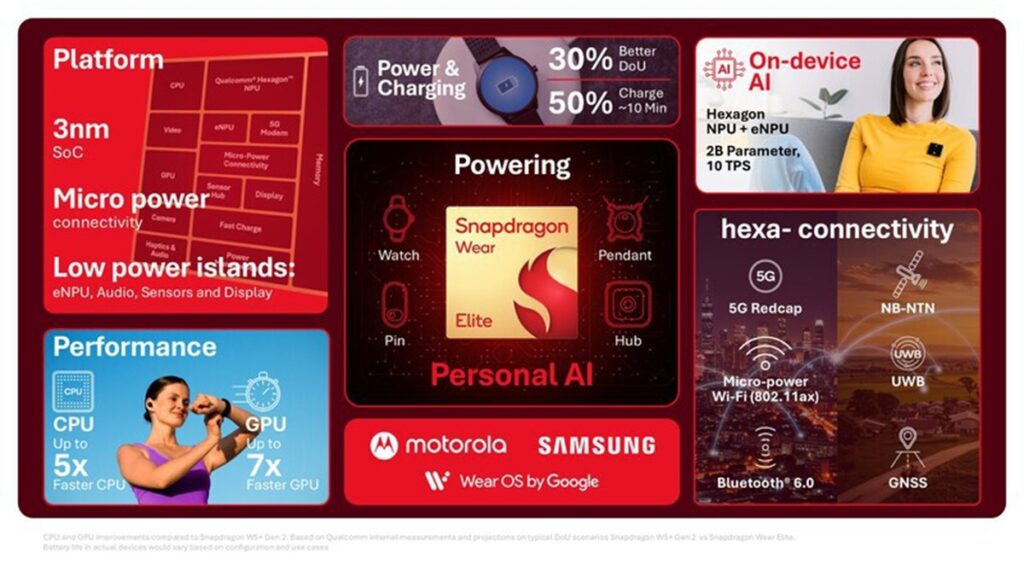
Snapdragon Wear Elite delivers key on‑device capabilities that support rich, real‑time agentic experiences. By integrating the Qualcomm Hexagon NPU to support up to billion‑parameter models at the edge, and pairing it with advanced sensor fusion, high
performance, low-power connectivity and computing, Snapdragon Wear Elite enables a
new class of Personal AI experiences, including context‑aware recommendations, natural
voice interactions, life logging, and AI agents that can take actions and orchestrate tasks on users’ behalf.
Unrivaled speed and efficiency for longer experiences
Snapdragon Wear Elite delivers a massive leap in power efficiency with unrivaled speed
and fluidity. Backed by 5x improvement on single-core CPU performance and up to 7x
faster GPU1, for app launching, multitasking, and smoother rendering.
Additionally, the platform supports multi-day battery life, reducing charging sessions, while advanced power management enables 30% longer day of use compared to the previous generation. When recharging is needed, rapid charging powers a device up to 50% in approximately 10 minutes.
The new Snapdragon Wear platform introduces a first‑of‑its‑kind multi‑mode connectivity
architecture integrating six advanced technologies: 5G RedCap, Micro‑Power Wi‑Fi, Bluetooth 6.0, UWB, GNSS, and NB‑NTN.
Siemens autonomous factory production
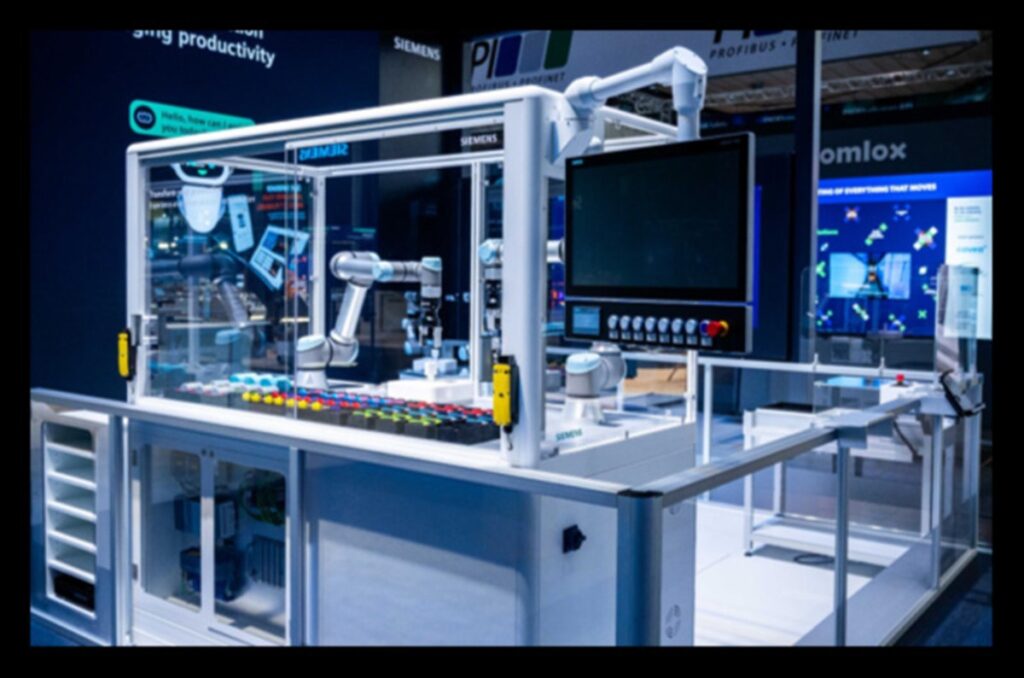
Qualcomm also announced a showcase with manufacturing giant Siemens AG to accelerate autonomous factory production. Qualcomm will be demonstrating on‑premise
intelligence with AI integrated into a Siemens autonomous factory model.
Together, the companies showcase the integration of private Industrial 5G connectivity with edge AI based use-cases to enable more dynamic, efficient and intelligent autonomous production Modern industrial environments increasingly rely on distributed, autonomous production cells and mobile robotics that must coordinate locally, intelligently, and more securely without dependence on centralized Manufacturing Execution Systems (MES).
To support this shift, Qualcomm Technologies is showcasing industrial‑grade computing with high‑performance edge AI and deterministic 5G communications from Siemens to enable faster decision‑making, enhanced safety, and smarter manufacturing workflows.
6G by 2029

Qualcomm also revealed a strategic coalition with leading industry partners to accelerate the development and global deployment of 6G. Revealed at MWC Barcelona 2026, the collaboration establishes a clear, milestone-driven roadmap focused on delivering 6G commercial systems starting from 2029 onwards.
6G is being designed as an AI-native system that builds upon three key pillars: connectivity, wide-area sensing, and high-performance compute. These next generation networks will feature new and advanced capabilities, including intelligent radios with integrated wide area sensing capabilities, virtualized and cloud RAN with high-performance and energy efficient compute, AI-based network autonomy, as well as edge and centralized data centers for entirely new AI workloads.
6G systems will enable higher levels of efficiency and performance for telecommunication
applications, new agentic consumer and enterprise devices, and new classes of AI enabled services, ranging from context-relevant data, low-altitude aerial and terrestrial traffic management, data insights and analytics at scale, and many more. 6G is a generational opportunity for the transformation and growth of the telecom sector enabled by the combination of wireless, efficient computing and AI.
“6G is more than the next step in wireless evolution. It is the foundation for an AI-native future that distributes intelligence across devices, the edge, and the cloud, and transforms network providers into AI-driven enterprises,” said Cristiano Amon, CEO of Qualcomm, in a statement. “Having led multiple generations of global wireless innovation, Qualcomm brings deep expertise and capabilities to the development and commercialization of 6G. As with every wireless transition, success will depend on strong and dedicated partnerships, shared purpose and joint innovation. This group of industry leaders is making a united commitment to invest and innovate to deliver on a common 6G vision, with the rollout from 2029 onwards.”
The collaboration focuses on three core architectural domains: devices, networks, and
cloud infrastructure. The companies participating in this effort are committed to a shared
objective to advance 6G as an intelligent, AI-native device and network platform.
This includes driving timely development of essential 6G standards, early system validation, demonstration of 6G spec-compliant pre-commercial devices and networks in 2028, establishing a common industry benchmark for 6G readiness, and initial rollout of global and interoperable commercial 6G systems starting from 2029 onwards. Together, the members will also build capabilities for new business models and services to accelerate adoption and create value across the 6G ecosystem.
Wi-Fi 8 progress
Qualcomm also announced its industry-leading Wi-Fi 8 portfolio, a key step toward building the connectivity foundation for the AI era.
The comprehensive portfolio features the Qualcomm FastConnect 8800 Mobile Connectivity System and five new Qualcomm Dragonwing Networking Platforms.
Each is engineered to deliver the connectivity and compute performance required to
anchor a new generation of products, leveraging unparalleled intelligence with breakthrough architecture for today’s AI demand realities.
“Today’s network traffic profile is fundamentally changing as AI-fueled demand requires a
re-thinking the core architecture. Qualcomm is redefining that architecture to enable AI everywhere,” said Gautam Sheoran, SVP of Connectivity, Broadband and Networking, Qualcomm Technologies, in a statement. “Next-gen networks and devices not only need to be AI-native, but they need a new breed of intelligent, high-performance connectivity. Qualcomm Technologies’ Wi-Fi 8 generation of products is the whole package: faster speeds, higher reliability, longer range, and powerful AI.”