
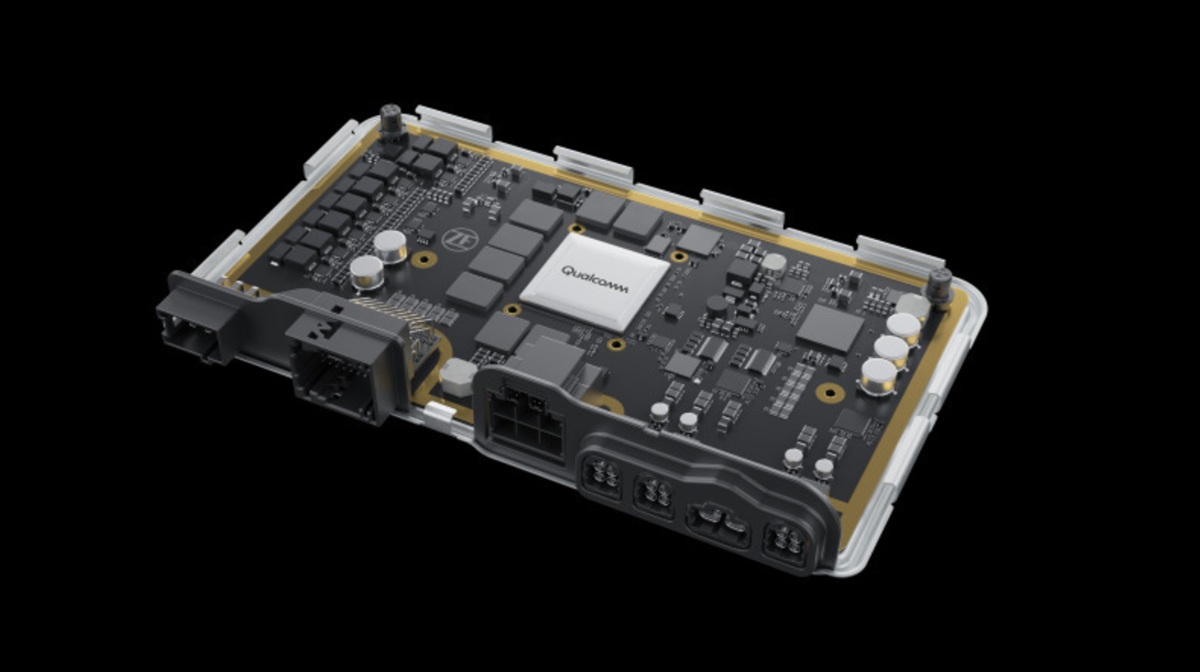
Qualcomm announced advanced driver assistance systems tech deals with ZF, Google and Leapmotor today at CES 2026.
The collab will provide a scalable ADAS solution that combines advanced AI compute and perception capabilities. Powered by Qualcomm’s Snapdragon Ride system-on-chips (SoCs), the solutions will deliver powerful and flexible platforms for automated driving.
ZF’s ProAI supercomputer additionally integrates Snapdragon Ride Pilot and Vision stack for faster time-to-market and delivers turn-key systems to automotive manufacturers. This collaboration brings together state-of the-art automotive computing and real-time perception, enabling automakers to deploy scalable ADAS solutions across a wide range of vehicle types and automation levels—from regulatory functions up to Level 3.
With Snapdragon Ride, the ZF ProAI supercomputer is capable of serving as a domain, zone, or central controller, while supporting enhanced computer vision, sensor fusion, and decision-making control logic, or all of these functions in a single end-to-end (E2E) AI
model.
The result is a robust, open architecture that allows for seamless integration of
third-party software features, giving automakers the flexibility to tailor solutions to their
specific needs.
Key components of the collaboration include:
- ZF ProAI: The ProAI family from ZF is an automotive-grade central computer suitable
for all vehicle platforms, software applications and E2E architectures. The highest
configuration level is a multi-domain capable edition with multiple performance boards and a computing power of more than 1,500 TOPS. - ZF ADAS functions: ZF offers ADAS functions, encompassing approximately 25 safety, comfort, and parking features, including hands-off navigate on autopilot (NOA) as the most advanced feature. Vehicle manufacturers can select the functions they want to use for a particular vehicle series from a pool of functions in an individual, modular, and scalable manner. These functions are also available as stand-alone software-as-a-product.
- Snapdragon Ride Pilot: The system uses camera-based AI perception for detecting objects, recognizing lanes and signs, parking assistance, driver monitoring, and real-time mapping. System configurations scale from a single forward-facing camera to multi-camera perception. Surround sensing performance is improved through a high-fidelity bird’s-eye-view (BEV) architecture, advanced fisheye camera processing, and integration with radar to help minimize latency and to help enhance safety in complex scenarios. Hardware-software co-design and network optimization help manage computational resources efficiently. The system is ready to enable advanced hands-free highway cruising with automated lane changes and urban-assisted driving. Ride Pilot is a safety stack for regulatory functions proven and deployed in over 60 countries globally.
- Qualcomm Technologies’ open integration platform: Engineered with a modular system architecture, the platform supports dynamic allocation of compute resources and facilitates interoperability across heterogeneous vehicle electronic control units (ECUs). Its sophisticated abstraction layers and standardized interfaces enable seamless deployment of advanced ADAS and infotainment functionalities, with provisions for over-the-air (OTA) software updates and multiple vehicle feature enhancements over time.
- Enabled by a broad development toolchain: A central pillar in enabling seamless
integration of ADAS features. It comprises a robust set of software resources,
simulation environments, and APIs designed to accelerate development, testing,
and deployment of perception and compute capabilities on the Snapdragon Ride
platform. This toolchain empowers automakers and their engineering teams to
rapidly prototype, validate, and customize ADAS and infotainment functions,
offering flexibility for tailoring solutions to diverse vehicle requirements. By
streamlining workflows and supporting collaboration across hardware and software
layers, the development toolchain makes innovation not just possible, but more
efficient and scalable as systems and vehicle fleets evolve.
Together, ZF and Qualcomm Technologies are delivering the next generation of vehicle intelligence—designed to meet the growing demands of software-defined vehicles, improve safety, and accelerate the global adoption of automated driving technologies.
Google deal
Qualcomm and Google announced an expansion of their joint efforts, building on over a decade of successful collaboration in the automotive industry. This deepened alliance provides a leading foundation for transforming the automotive industry over the coming years, unlocking innovation, accelerating time-to-market, and opening new capabilities in the rapidly evolving era of agentic AI.
This collaboration establishes end-to-end automotive technology solutions that seamlessly
integrate Qualcomm Technologies’ leading Snapdragon Digital Chassis solutions with Google’s automotive software, empowering automakers to create next-generation vehicles that better anticipate, react and adapt to driver needs with agentic AI.
Together, Qualcomm Technologies and Google aim to deliver secure and scalable AI-powered experiences for millions of vehicles worldwide.
The decade-long collaboration between Qualcomm Technologies and Google began by pioneering Snapdragon-powered embedded Android infotainment. This foundational work helped drive Android Automotive OS (AAOS) adoption and helped create the industry’s first vehicles featuring Google built-in. Qualcomm Technologies and Google Cloud continue these joint efforts aimed at simplifying the deployment of advanced, next-generation AI agents with Gemini Enterprise for automotive — an evolution of Automotive AI Agent (AAA).
Qualcomm introduced Project Treble to streamline Android lifecycle management for automakers utilizing Snapdragon Cockpit Platforms. Project Treble is designed to ensure predictable, secure upgrades, reduce fragmentation, and enhance security across multi
generational platforms, and will cover four generations of Snapdragon Cockpit Platforms and over 14 individual system-on-chips (SoCs).
Through this collaboration, automakers can gain dramatically simplified Android updates, streamlined integration, lower engineering costs, and faster time-to-market, supported by a robust 10-year plan for critical software updates. For drivers, this can enable smarter, safer, and more connected vehicles with consistent, up-to-date features throughout their lifecycle.
The Leapmotor deal
Leapmotor and Qualcomm also introduced the world’s first cross‑domain integrated solution powered by Snapdragon Cockpit Elite and Snapdragon Ride Elite automotive platforms.
Making its debut at Qualcomm Technologies’ booth (West Hall, Booth #5001), the cross‑domain controller demonstrated how a dual‑chipset architecture delivers exceptional compute performance to streamline vehicle electronics, reduce system complexity, and enable more advanced AI capabilities across the entire vehicle. This collaboration highlights the growing value of deep chipmaker–automaker integration at the vehicle‑architecture level and provides a scalable blueprint as the industry accelerates toward centralized computing and fully software‑defined vehicles.
Entering mass production, Leapmotor’s flagship D19 is the first vehicle globally to launch with this high-performance central controller based on dual SA8797P. Leveraging two Snapdragon Elite automotive platforms, the central domain controller as the ability to unify key vehicle domains, such as intelligent cockpit, driver assistance, body controls (lighting, climate, doors, windows), and the vehicle gateway, into a single high‑performance system.
The dual‑chipset setup also provides the compute headroom needed for real‑time coordination and advanced AI, including emerging agentic AI workloads. With the Qualcomm Oryon CPU, Qualcomm Adreno GPU, and Qualcomm Hexagon NPU working in parallel, the platform can run both a full‑modality large AI model for the cockpit
and a VLA multimodal model for driver assistance, enabling more intelligent, responsive, and future‑ready driving experiences.