
Q-CTRL, a maker of quantum infrastructure software, today unveiled groundbreaking advancements in software-ruggedized quantum sensing for navigation.
In a major field trial with Australian Defence on board the Royal Australian Navy’s Multi-role Aviation Training Vessel (MATV), MV Sycamore, the company said its tech reinforced its claims.
“This has been kicked around for a while, but in the last 10 years, there’s been strong interest in whether this is viable, and we’re really among the first to start demonstrating that this could actually happen,” said Q-CTRL CEO Michael J. Biercuk, in an interview with GamesBeat.
The results of this major maritime trial reinforce Q-CTRL’s leadership in the development and deployment of quantum-assured navigation solutions, now expanding into maritime operations, the company said.
“Quantum sensors provide a near-term opportunity to achieve transformational defense capabilities, but previous deployments in the field have struggled to deliver defense-relevant performance,” said Biercuk. “Operating on a real moving vehicle is just not the same as conducting a science experiment; at Q-CTRL, we’ve taken a different approach to getting quantum sensors out of the lab, focusing on software as the critical enabler of performance in the real world.”
In these trials, Q-CTRL field deployed a quantum dual gravimeter, which measures tiny variations in Earth’s gravity as part of a next-generation quantum-assured positioning, navigation, and timing (PNT) system operable when GPS is unavailable or untrusted.
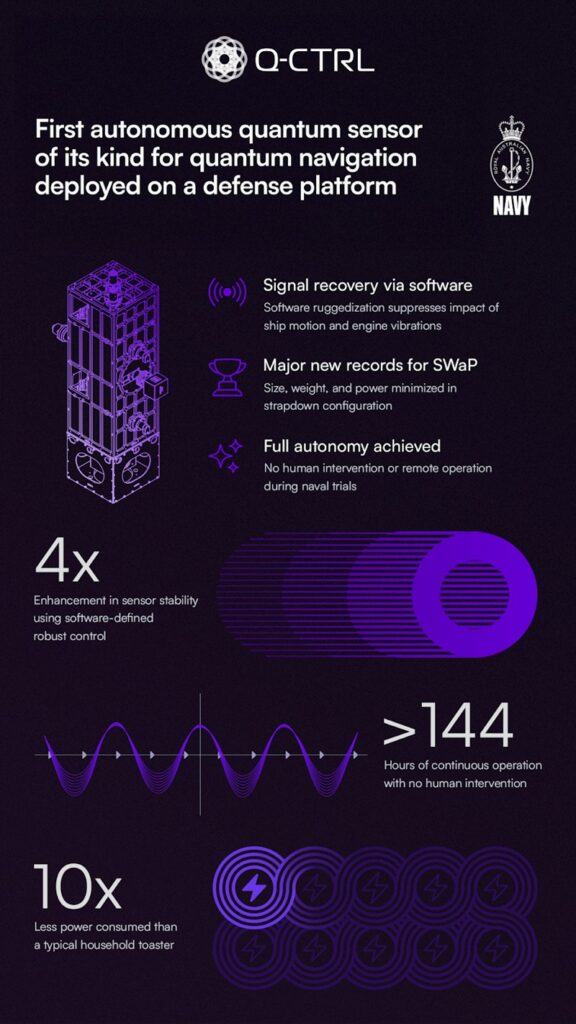
This first trial saw over 144 hours of continuous operation and successful data collection with no human intervention during real maritime operations.
Earlier this year, Q-CTRL announced successful airborne field trials of a new generation of quantum-magnetic navigation solutions, Ironstone Opal, validated for the first time to outperform comparable conventional alternatives in challenging real-world settings by 50 times.
The newly announced trials of Q-CTRL’s gravimetric navigation technology now open opportunities to bring quantum-assured navigation to maritime vessels where magnetic navigation can be less effective.
“GPS denial” is a real possibility, based on reports of spoofing attacks in Middle Eastern waters. Q-CTRL said GPS denial has become one of the most pressing strategic challenges in both defense and commercial settings. It risks major disruptions to civilian and military operations. Quantum navigation promises a robust and reliable GPS backup that cannot be jammed or spoofed.
Q-CTRL’s navigation capability is urgently needed in contested maritime environments, as instances of “spoofed” signals caused significant disruptions to ships in the Middle East waterways as recently as June 23. This causes not only critical logistical issues but disrupts collision avoidance efforts, revealing major safety implications.
In quantum gravimetric navigation, the quantum gravimeter continuously “sees” the otherwise invisible hills and valleys in Earth’s gravity, allowing a navigation computer to compare its observations against known gravity maps. This is similar to orienteering, where one can position oneself on a map by identifying landmarks like valleys, mountains, rivers, or roads. GPS is not needed, making it a robust backup in contested regions.
Q-CTRL’s demonstration with the Royal Australian Navy departs from most previous quantum sensing field trials in that these tests mandated peak performance with full autonomy and without the addition of any special infrastructure. The sensor had to operate just as a real navigation system would operate during a defense mission.
Developed and successfully fielded in just 14 months, the dual gravimeter was installed in a “strapdown” configuration (bolted to the floor) in the space of a single server rack in a communications room onboard MV Sycamore. The sensor consumed only 180 watts of power – about 10 times less than a household toaster, setting a record for SWaP (size, weight, and power).
Moreover, in this trial, the ship’s motion and engine vibrations were sufficient to cause total loss of signal using conventional operating techniques typically employed in research experiments. To address these losses, Q-CTRL’s unique software-ruggedization strategies recovered operation at near world-record levels even while MV Sycamore was underway, allowing the team to outpace international competitors interested in similar technology.
Quantum sensing leverages the physics of light and matter on the smallest scales to enable the detection of tiny signals. Because these devices work based on the fundamental laws of physics and are not affected by drift like other GPS alternatives, their outputs do not change over time, enabling new opportunities where long-term stability is essential. Generally, however, these devices are significantly degraded when taken from a research laboratory into the real world, an issue addressed by Q-CTRL’s software-ruggedization technology.
For more details on Q-CTRL’s software-ruggedized quantum sensing technology, read their peer-reviewed technical demonstration published in Nature.
Q-CTRL’s innovations in quantum sensing promise real-world benefits in critical applications including crewed and autonomous vehicle navigation, minerals exploration, and underground water monitoring. With BCC Research projecting the sensing market to surpass $300 billion by 2025, quantum sensing is poised to capture a significant market share from existing classical technologies due to its enhanced performance.
Unavailability of GPS poses a risk valued at over one billion dollars per day for short-term outages in the US alone. Recent GPS disruption events have impacted commercial aviation and maritime trade operations, prompting a renewed focus on developing reliable GPS alternatives.
When applied to the problem of GPS-free navigation, quantum sensors can detect multiple signatures, enabling safe navigation over extended periods – not for hours, but for weeks or months. Q-CTRL has built a portfolio of quantum-assured navigation solutions delivering new capabilities in all relevant operating environments. This includes gravimetric navigation for maritime vessels described here, magnetic navigation for airborne applications, and a new generation of quantum inertial sensors.
Defense engagement
Q-CTRL announced in 2023 a partnership with the Australian Department of Defence to deliver quantum-assured navigation for defense platforms. In addition, it has been contracted by the UK’s DASA accelerator and supported by the UK Royal Navy via the Disruptive Capabilities and Technologies Office to field trial mobile quantum-assured gravimetry for maritime operations. Q-CTRL was recently awarded a U.S. Defense Innovation Unit program in quantum navigation and has been separately selected to develop and trial its quantum navigation systems with the U.S. Department of Defense.
Origins
Founded by Michael J. Biercuk in November 2017, Q-CTRL has assembled a team of expert quantum-control engineers, providing solutions to global quantum technology leaders, including Fortune 500 companies, startups, national research labs, and academic institutions.
The company has international headquarters in Sydney, Los Angeles, San Francisco, Berlin, and Oxford.
Biercuk said that the genesis of the tech goes back to the founding of the company, when the focus was on how software could be a key enabler for quantum hardware. The company wanted to make software for quantum computing. But Biercuk had also worked on frequency division for atomic clocks.
“I had exposure to the various application areas of quantum technology, and through those experiences, I saw that there was this uniform challenge that going from the upsteam laboratory into the field where almost everything failed,” he said.
Then, at Sydney, Australia-based Q-CTRL, the focus was on building AI-powered infrastructure software to solve these problems, stabilizing the hardware, automating the hardware, and more. In 2021, the company began an effort at scale to deploy the tech into quantum sensing as a key vertical.
“We began building our own hardware, augmenting it with software, comparing what we could achieve with and without software. And through that effort, we began an engagement with the Australian Department of Defense, the Navy, and that led to the field trials for quantum sensing.
And that led to the creation of the quantum dual gravimeter. This uses quantum sensing to detect minute differences in the Earth’s gravity, which is generally constant at 9.8 meters per second squared. But in the details, the variations are plentiful across different parts of the planet at the sixth or seventh decimal places in calculations.
“So the company built a device to measure the tiny fluctuations in Earth’s gravity,” Biercuk said.
It captures small differences and output changes, or draft, over time.
“In order to do that, we built a quantum device. Quantum devices are very sensitive and they’re very stable, because the signal comes from the laws of nature, not some mass on a spring or a mechanical system,” he said. “Otherwise, the device is kind of like a modern version of Newton’s apple.”
That’s a reference to the parable of Isaac Newton discovering the force of gravity by the apple falling head on his head. The gravity measurement we perform is done by dropping a version of an apple.
“Our version of an apple is a small group of atoms that have been cooled with laser light,” Biercuk said. “They fall just like the apple falls. But because in quantum mechanics, atoms behave like waves, we can use some very fancy techniques that are broadly used in the telecommunications industry and other areas called interferometry, in order to very, very carefully measure how far they’ve fallen a certain amount of time. And that gives us this global measure of gravity.”
The dual gravimeter is really just two of these devices stacked on top of each other — two apples that fall together, and Q-CTRL can measure the average and the difference between the falling apples. With that measurement of gravity, the company can figure out exactly where on the planet the device doing the measurement is.
The measurement works anywhere on the planet, but there are issues on the seas that the particular instrument from Q-CTRL can deal with. The company’s software deals with vibrations from an engine, the heave and sway of a vessel, and the effect of big waves. Using tech to correct for lost signals, like putting the effect of noise canceling headphones on the device, Q-CTRL is able to recover the signal and figure out a location, even while in motion.
Dealing with GPS denial
On the land, the company can use its Ironstone Opa magnetic navigation, which leverages fluctuations in Earth’s magnetic fields in order to perform the same kind of positioning. But it needed another solution for maritime environments, and so it used the gravity solution for that part of the navigation at sea.
For years, the International Air Transport Association (IATA) has published maps for hotspots of “GPS denial.” This is where certain countries or parties use “GPS jammers” to interrupt satellite navigation communications. In March 2024, there was an “enormous uptick in GPS denial, from dozens of incidents a day to over 1,000 today,” he said.
And this is associated with conflict zones around the world, like near the Black Sea (the Russia-Ukraine conflict), northern Iraq and northern Iran, Poland and some key maritime areas like the Baltic Sea and the Red Sea (near Israel in the Middle East). Since satellite signals are weak, interfering with them with a jammer is relatively easy. That can interrupt anything, like a drone, a ship or an aircraft. Spoofing is harder, as it requires sending out a false signal that can trick a navigator.
“Ukraine is a like a blanket of GPS denial,” he said. It’s gotten to the point where drones are guided by spools of fiber optic cable so there’s no need to rely on radio or GPS.
That’s why backup is necessary for navigation.
Biercuk said the pricing for the service is appropriate for commercial shipping and commercial aircraft, with variants for drones. Each year, something like two million tactical drones will be built annually by 2030. As far cargo ships, there are 50,000 of them around the world and there are also 1,000 undersea autonomous vehicles.
The tech can be subject to export control laws, but the devices are not made in the U.S., Biercuk said. Over time, Biercuk believes the quantum tech will be useful for quantum computing. In the meantime, providing alternatives in cases of GPS denial could be a good market. The low-power devices can be installed on a ship and there’s no need for a Q-CTRL team to watch them.
“We built a fully autonomous system,” Biercuk said.