
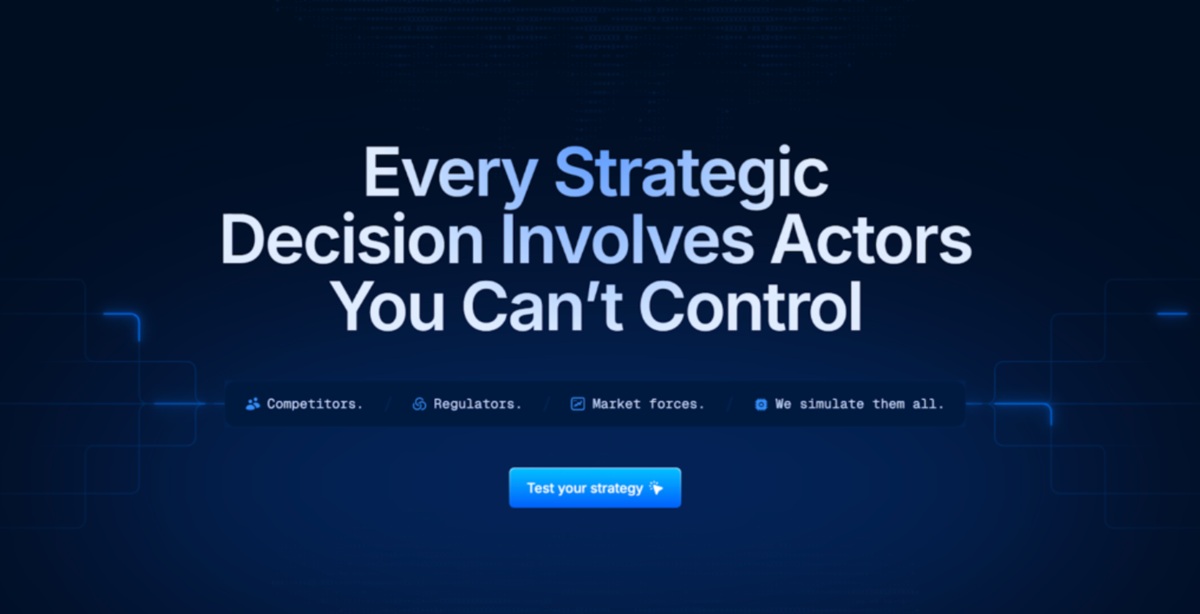
Principle, a strategic foresight AI platform that enables companies to simulate competitive futures before committing resources, has raised $2 million.
Strategic decisions at most companies are made with outdated information, gut instinct, and static planning documents that become obsolete the moment market conditions shift. While oil majors like Shell pioneered sophisticated scenario planning decades ago – maintaining teams of hundreds to craft and track strategic futures – this capability has remained locked inside organizations with deep pockets and long time horizons.
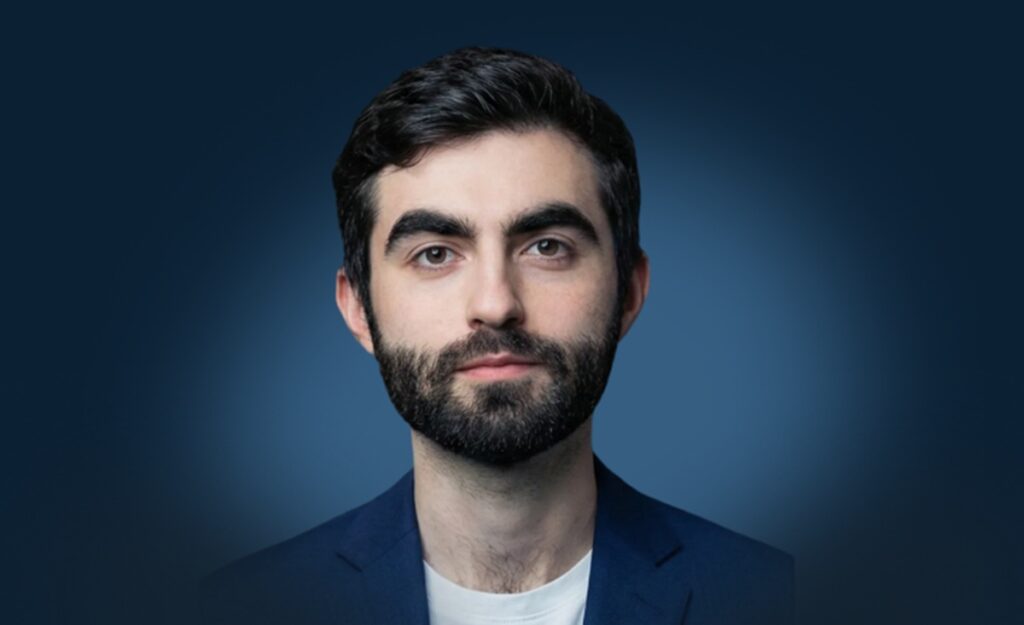
Artur Kiulian, CEO of Principle, said in an interview with GamesBeat that the company is bringing modern digital twin technology — often used to plan the building of factories — to company boardroom strategy sessions.
The pre-seed funding round was led by SMRK VC and SMOK VC, with participation from RideHome AI Fund, a16z Scout Fund, Bain Capital Scout Fund, and Unpopular Ventures.
“Every Fortune 500 company we talk to has the same pattern,” said Kiulian, cofounder of Principle, in a statement. “They misread market signals, they react too slowly to structural shifts, and by the time something obvious in hindsight becomes clear, it’s already too late. We’re building the infrastructure to make strategic foresight accessible to every company – not just the ones that can afford 100-person scenario planning teams.”
The funding is perhaps a recognition that prediction markets are taking off and businesses really need accurate forecasting, much like the generals fighting wars need frequent simulation updates to see if their battle plans are on track, said Yurii Filipchuk, cofounder of Principle, in an interview with GamesBeat.
Origins
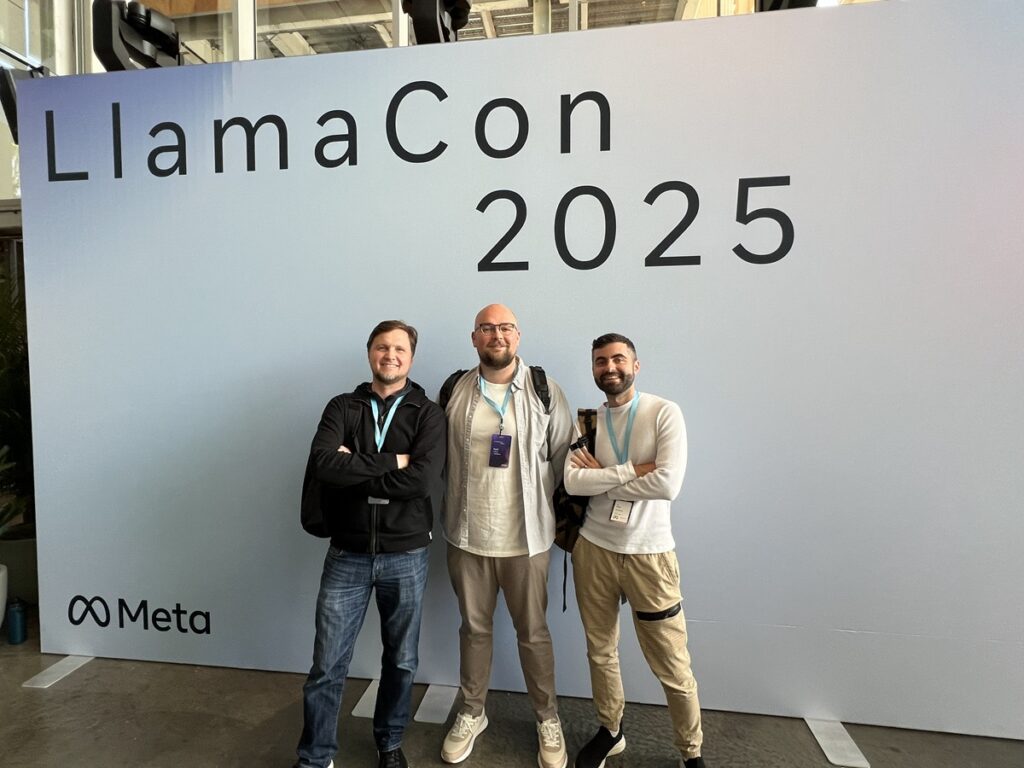
Kiulian was inspired by the works of Ray Dalio, author of the book Principles, a guide for personal and professional development. Dalio wrote about things like how empires are built and then die, or how these things affect financial cycles.
“That was my personal inspiration,” he said. “In terms of the future of Principle, it’s about, ‘What are you building your company on?’ What are the principles that are getting you prepared for what’s coming next?”
Kiulian, who is originally from Ukraine, moved to the U.S. and became an AI engineer. He moved into startups and entrepreneurship, and eventually founded a startup incubator in Los Angeles. He operated it for six years and built 65 startups and achieved seven exits.
“It was exciting, but it totally burned me out overall. So I beginning of 2020 I decided to shift gears and try to build a social impact, AI things, and that coincided with COVID, and I organized an initiative, CoronaWhy, to help the White House to coordinate the COVID research,” Kiulian said.
The AI tech was used to predict how the COVID pandemic would unfold. That project expanded rapidly and it eventually enabled him to leave venture capital and do something completely different, working with the government.
He was able to get a lot of smart folks in AI to join the effort and link up with the White House Technology Office to help educate the government. As the Russian invasion of Ukraine started in 2022, Kiulian started helping the Ukraine government to adapt the technology and build both technology and decision support tools.
Kiulian started a new company to basically do tech enablement for governments.
“That’s how we started working with more governments in the Middle East, and then it led us to basically what we’re doing right now, Principle, which is essentially bringing all of our experience working with governments and unfortunately, the military environment, where the wargaming is kind of like a conceptual way to prepare for bad things are happening,” he said.
Then they repackaged that offering and targeted it at enterprises so they could learn to anticipate many potential scenarios and outcomes. Principle provided tools to better deal with that uncertainty.
The age of digital twins
Now, with large language models and relatively inexpensive AI technology, the company is able to come up with world models that can bring the world of market dynamics into decisionmaking and geopolitics.
Kiulian said, “What LLMs enable us to do is tell it to shift from just a quantitative layer, which is where the simulations used to be before, to the level of qualitative interactions, where LLMs are giving us the certain plausibility of how certain events or market actors may act under certain conditions.”
The beauty of digital twins now is that companies can design a virtual factory. Once they get the design perfect, they start building the real factory. When it’s done, it has sensors that can deliver data back to the digital twin. Then that data can be used to make the digital twin more accurate. It creates an improvement flywheel.
“We can create a flywheel,” Kiulian said.
The value problem the company is working on is creating a digital twin that is a true snapshot of a company. Then that is combined in a competitive scenario with other external actors. When a competitor gets acquired or launches something, that’s a signal for the company. The team has helped enterprises simulate M&A strategies where they buy smaller companies and grow their market share. Kiulian’s Principle can model hundreds of scenarios and come up with different flavors of an M&A strategy.
One scenario suggested that instead of buying competitors, an enterprise getting advice from Principle should instead buy influencers in their specific vertical. The company is now pursuing that strategy. The digital twin analysis can be done quickly, but it depends on the complexity and the actual market space where a company operates. The resulting report is a text report and some visuals.
“The magic of compute is that if you throw a lot of GPUs at it, it can be very fast,” Kiulian said. “We first start working on the strategic directions, which is basically the concrete examples of potential strategies. Then we work on the macro scenarios, how their markets may develop. And then we present the simulated timelines and the actual visualization of how it happens, beat by beat. Then, for a snapshot, we use the same kind of after-action reports like in war.”
He added, “There’s a quick summary of what happened and what are the lessons learned. And from that, the company can explore and actually interact and ask questions of a specific timeline. So it’s almost like checking in with your potential future. Except you have multiple potential futures.”
From static strategy to living simulations
Principle creates digital twins of companies, competitors, regulators, and market forces, then runs adversarial simulations across hundreds of strategic directions. Unlike generic AI tools that provide stateless answers to one-off questions, Principle maintains persistent models that continuously update as new market intelligence arrives – competitor moves, regulatory changes, pricing shifts, M&A activity.
The platform is already in pilots with multiple Fortune 500 companies, governments, leaders in the energy market, and established technology companies exploring M&A pathways.
“Building AI products is only half the job — becoming AI-first requires changing how you plan and execute every day. It’s an organizational capability,” said Oleksandr Kosovan, CEO of MacPaw, in a statement. “Principle helps us build that muscle: turning strategy into an iterative process where we explore scenarios, learn quickly, and decide based on evidence, not intuition alone.”
“With Principle, strategic foresight is turning into a scalable product. Strategic foresight has always required deep vertical expertise, but until now, the infrastructure to operationalize it didn’t exist. We’re backing this round to help the team double down on Principle as their flagship product and bring it to enterprise customers globally,” said Sasha Yatsenko, principal at SMOK Ventures, in a statement.
Origin: From national AI models to strategic foresight
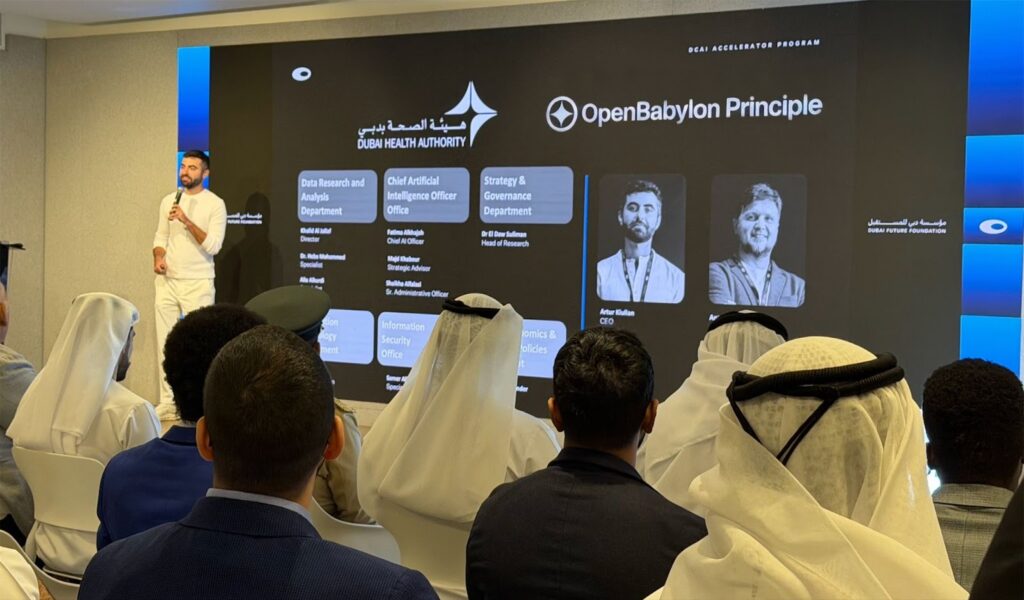
Principle emerged from an unexpected discovery. In 2025, the founding team signed an MOU with Ukraine’s Ministry of Digital Transformation to develop and implement national AI capabilities – work that produced collaborative research on sovereign models recognized in the best data journalism picks of 2025.
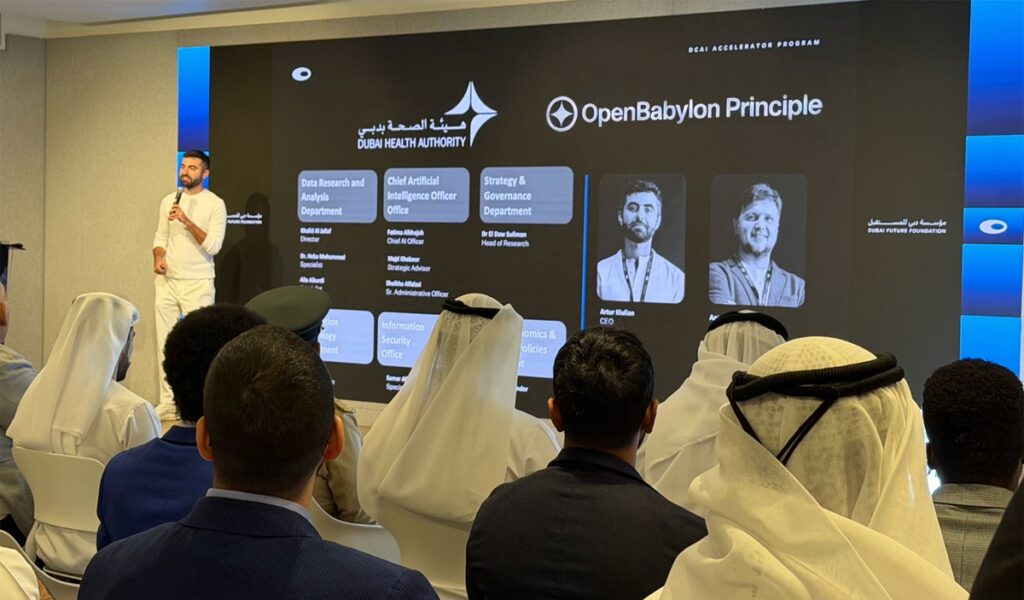
That engagement expanded to the Middle East, where the team partnered with Doha Graduate Studies University on benchmarking AI models as part of Qatar’s sovereign AI initiative and collaborated with Dubai Health Authority on an AI-driven population health strategy.
Across these projects, a consistent gap emerged: organizations could deploy powerful AI models, but struggled to translate them into high-stakes strategic decisions.
“We kept seeing the same pattern,” said Kiulian. “Governments and enterprises would invest heavily in AI infrastructure, then face a utilization problem. The models existed, but the frameworks for using them to navigate uncertainty didn’t. That’s when we realized the real opportunity wasn’t building more AI – it was building the decision layer on top of it.”
Working alongside Dubai Centre for Artificial Intelligence (DCAI), and Dubai Future Foundation, Principle developed scenario modeling that surfaced actionable pathways for health system resilience – validating the core thesis that strategic foresight could finally be made scalable.
“The future belongs to those who ask the most important questions,” said Khalfan Juma Belhoul, CEO of the Dubai Future Foundation at Dubai Future Forum 2025, in a statement.
“Principle’s approach to strategic foresight aligns with our belief that the future belongs to those who ask the most important questions – and have the tools to explore the answers,” said Veronica Murguia at DCAI, in a statement.
“Principle represents the next wave of founders who operate at the intersection of government and frontier AI, bringing those capabilities to enterprises worldwide. The team’s experience building AI infrastructure gives them a unique perspective on what it takes to make AI actually useful for strategic decisions,” said Vlad Tislenko, partner at SMRK VC, in a statement.
Why Now: LLMs as world models
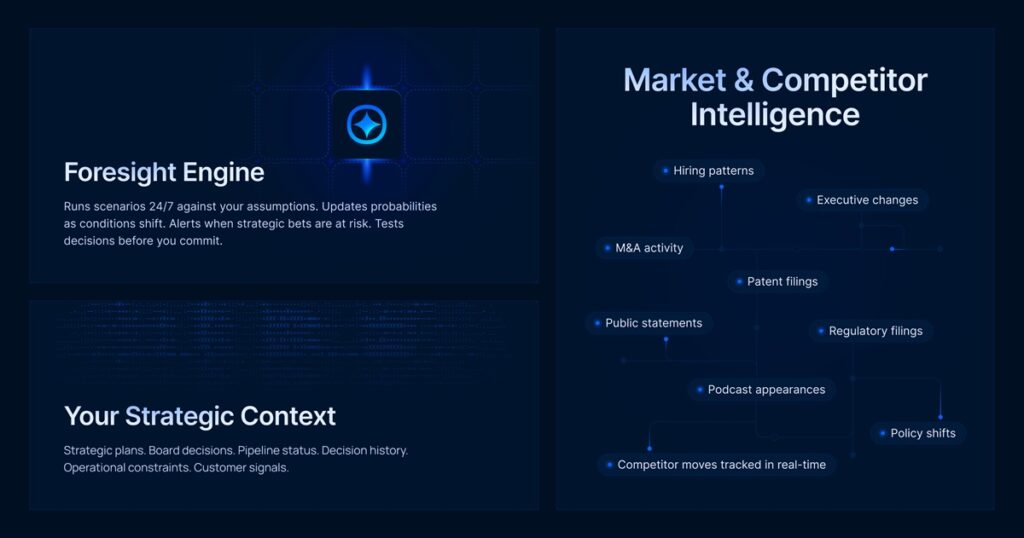
Recent advances in large language models have unlocked a new capability: the ability to simulate not just environments, but the logic of how markets, competitors, and organizations actually behave. Principle’s founding team – with backgrounds spanning Google’s behavioral simulation research, physics modeling at CERN, and strategic technology work for the White House – recognized that LLMs could finally make strategic foresight scalable.
“Every major platform shift creates new primitives for human interaction,” said Chris Messina, general partner at Ride Home AI Fund and inventor of the hashtag, in a statement. “Principle is creating new capabilities that were once illegible but gradually become ubiquitous, like the hashtag in social media.”
“The common objection we hear is ‘I can just use ChatGPT for this,'” said Kiulian. “But a generic LLM is stateless – it has no memory of your company, no persistent model of your competitors, no ability to track whether its predictions are calibrating against reality. We’re not prompting a model. We’re running continuous simulation engines that learn from outcomes.”
Principle has already begun building on this foundation, training a custom model on AWS’s Nova architecture to improve plausibility classification of future market events – joining early adopters like Reddit, Sony, and Booking.com in building domain-specific “Nova” models that embed deep vertical expertise.
Built for the Enterprise Blindspot
The company is initially targeting mid-market and Fortune 500 corporate strategy teams – organizations large enough to face complex competitive dynamics but lacking the resources to build in-house foresight capabilities. Early conversations reveal a consistent pattern: strategy functions at even large companies describe their planning processes as “generous to call it long-term planning,” with detailed forecasts rarely extending beyond 12 months despite multi-year capital commitments.
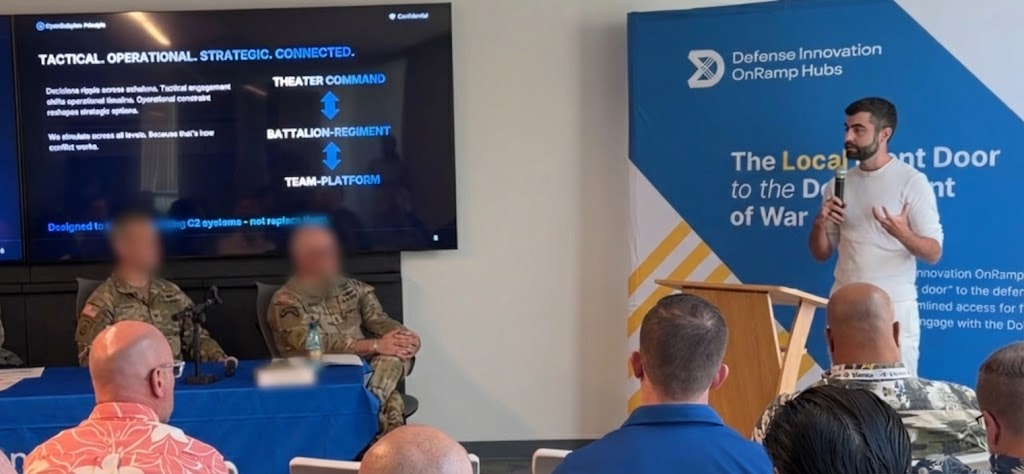
“The past two years of enterprise AI optimized individual productivity – coding assistants, document drafting, email triage”, said Yurii Filipchuk, cofounder of Principle, in a statement. “Executives got incrementally better dashboards showing what already happened. Palantir helps companies make their internal data work again but what’s missing is the layer that shapes where the business actually goes. We adopted military wargaming techniques – adversarial simulation, red-teaming, multi-actor modeling – and applied them to corporate strategy. Instead of optimizing what you have, we stress-test where you’re headed.”
Use of funds
The funding will accelerate Principle’s transition from high-touch pilot delivery to a productized platform, with investment in the simulation core, real-time market intelligence integration, and an interface that allows strategy operators to interact with scenarios directly. The company is also expanding its enterprise pilot program, targeting additional Fortune 500 customers across industrial, technology, and financial services verticals.
Asked whether this was a branch of business intelligence or simulation, Filipchuk said it felt more like a brand new category of business with the mission of how companies can interact with the future. The difference between now and 15 years ago is that the live systems that are available now can make sure that information isn’t outdated, Filipchuk said.
Founded in 2024 and headquartered in San Francisco, Principle serves enterprise clients across industrial, technology, and government sectors. Learn more at futureprinciple.com.
Seeing the future

One company that Principle analyzed was Royal Dutch Shell. The oil company has been a leader in this whole scenario planning approach for decades.
“They are referenced as the ones who popularized it and made it a practice. And what we learned was that they literally have hundreds of people that are crafting these scenarios and actively tracking them, updating all the signals and indicators that update those scenarios,” Kiulian said. “When we spoke with them in November, we were discussing the Venezuela scenario, and they told us that they had crafted a scenario five years ago and were now actively tracking it every single week.”
He said the company decided to take the ability that big oil companies had and others and then democratize it for everyone else.
“Everybody wants us to predict their future. We must say that, ‘No, we are not your whistleblower here. We cannot predict the future. But we can build foresight,” Fililpchuk said.