

Cerebras Systems saw its stock price soar into the AI stratosphere today after its initial public offering.
Shares closed at $311.07 after selling shares at $185, well above the company’s expected range. That values the chipmaker at about $95 billion. That compares to my last headline about the wafer-scale AI chip maker in a story that ran in September 2025: Cerebras Systems raises $1.1B at $8.1B valuation for wafer-scale AI chips.
The company sold 30 million shares in its offering yesterday, raising $5.55 billion. It was the largest IPO for a U.S. tech company since Uber’s debut in 2019, according to CNBC.
The stock opened at $350 a share. It went as high at $386 a share then fell in trading on Thursday. Kudos for CEO Andrew Feldman, who is now a big winner a couple of times around. It’s fun for me to see this arc for a remarkable Silicon Valley veteran.
I wrote one of the first feature stories on SeaMicro when I was at VentureBeat back in 2010. Then I wrote about how AMD bought that Sunnyvale, California microserver company for $334 million in 2012.
Then I also wrote about Feldman’s next startup when it came out of stealth in 2019: Cerebras Systems. The same idea of making computer servers more efficient and powerful drove that startup as the first one.
In the case of Cerebras, Feldman’s insight was that computer servers would need endless amounts of computing power, and that the way to do that processing most efficiently would be on a single piece of silicon, with networking, memory and processing shared across many chips.
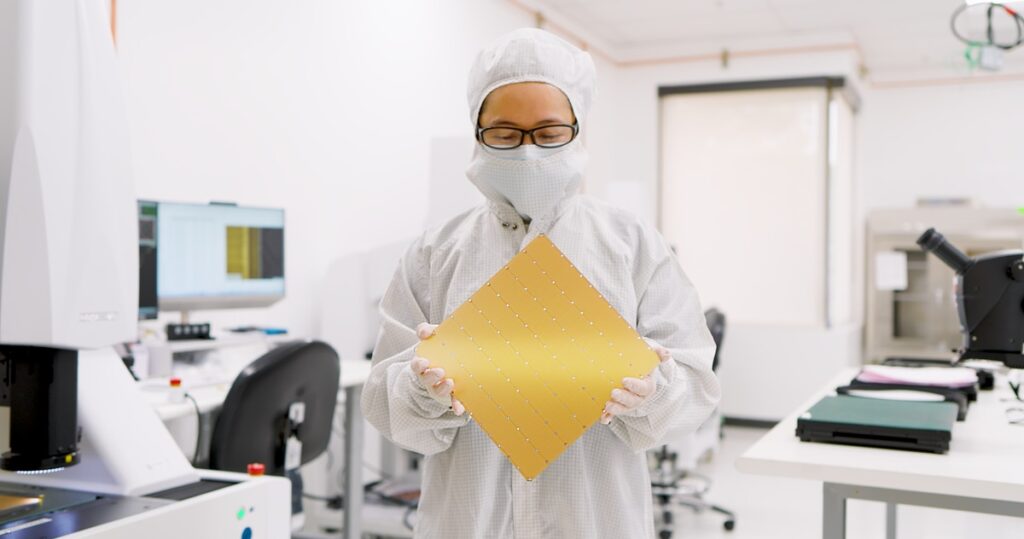
But he wouldn’t do it by connecting a bunch of chips with wiring on a circuit board. Rather, he would turn to the way that silicon chips were made, with wafers. In factories, silicon chips are made from the raw material of silicon-based crystalline cylinders. Those cylinders are sliced into wafers, often 12 inches in diameter. That than create processor patterns on those wafers and slice them into individual chips, Feldman decided to make the entire wafer into one giant chip with lots of uniform modules on it to handle memory, computing and networking. It was like having 400 chips on a single wafer.

It seemed like overkill compared to the competing solutions from Intel, AMD and Nvidia. But in the past few years, it became clear that this level of processing was necessary for high-end AI computing in supercomputers, racks and servers.
At the time in 2019, Samsung had actually built a flash memory chip, the eUFS, with 2 trillion transistors. But the Cerebras chip is built for processing, and it boasts 400,000 cores on 42,225 square millimeters. The Cerebras chip was 56.7 times larger than the largest Nvidia graphics processing unit, which measures 815 square millimeters and 21.1 billion transistors.
The WSE also contains 3,000 times more high-speed, on-chip memory and has 10,000 times more memory bandwidth.
The rise of generative AI fueled demand for Cerebras’ technology, and Feldman headed to his second big payday with yesterday’s IPO. The company filed to go public in September 2024, but it withdrew that filing after it seemed like the company was too dependent on one customer in the UAE. In April, the company filed again and market conditions were more favorable this time.
In 2025, Cerebas’ revenue was $510 million, with net income at $88 million. But while Cerebras’ $95 billion valuation is impressive, its big rival is Nvidia, which has become the world’s most valuable company at $5.7 trillion.
I think the lesson here is don’t bet against Feldman, just like people don’t bet against Jensen Huang. And also read more GamesBeat, if you want to catch the first story about a world-changing company. 🙂
It’s good to see the Silicon Valley dream is still coming true — sometimes twice in a lifetime — to inspire others who are coming behind them.