
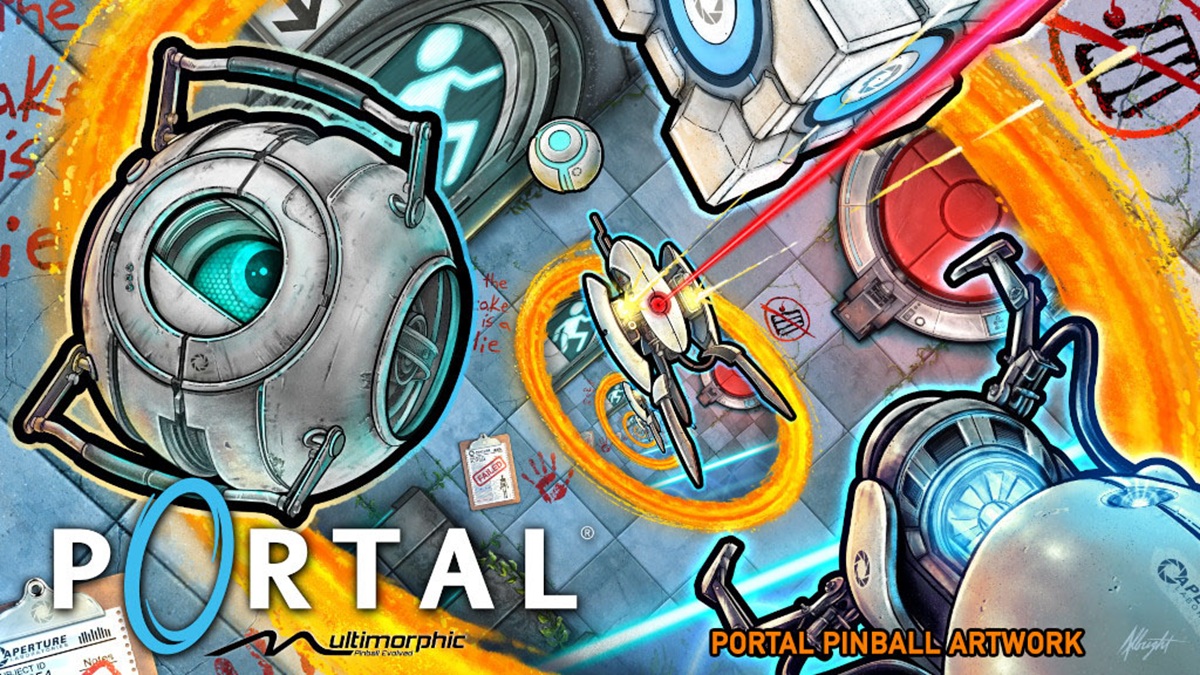
Eighteen years after Portal took the gaming world by storm and 14 years after its hit sequel Portal 2, gamers can play Portal as a pinball machine.
Thanks to Multimorphic, a retro-loving company in Round Rock, Texas, players can resume testing in Aperture Laboratories on the pinball table and “portal” from one part of the machine to another. I suppose you might joke and call it Portal 3.
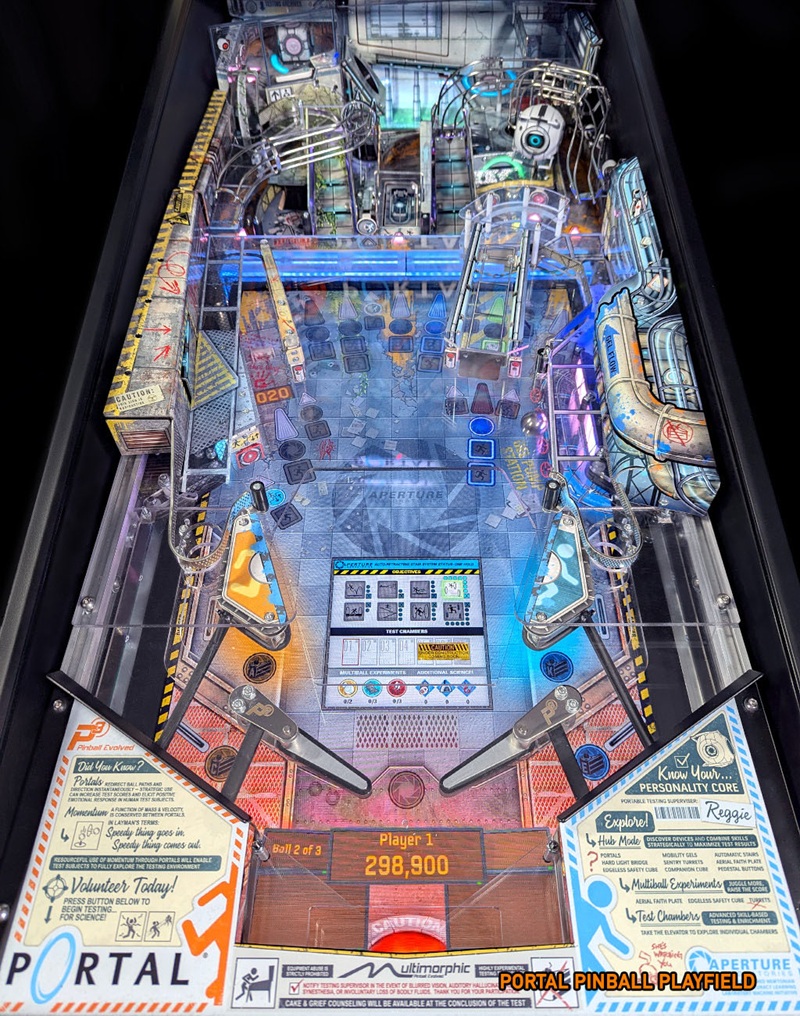
Portal pinball, now shipping, acts as a “portable test chamber,” presenting players with all-new puzzles to solve, portals to traverse and multiballs to manage — and features a pinball-launching Faith Plate, a Hard Light Bridge, a Momentum Jump, Repulsion Gel and more — and your trusty Companion Cube.
Pinball rises again
Pinball machines these days are selling to consumers. There is a large group of pinball fans around the world.
“Portal is our latest game for our platform, and it is being very well received. It’s an awesome game, said Gerry Stellenberg, founder of Multimorphic, in an interview with GamesBeat. “The Portal idea itself goes back about four years for us.
Stellenberg said the developers on the team are all huge fans of Valve and the Portal franchise.
Pinball machines these days are selling to consumers. There is a large group of pinball fans around the world.
“It’s a niche market, for sure. The pinball industry in general has had a resurgence in the last 15 or so years. COVID-19 drew people to pinball because they were stuck in their homes for a few years and were looking for things to do,” Stellenberg said.
“The business has been pretty good the last couple of years. We’re also doing something new and different and some people love it,” he said.
Multimorphic has about 25 people doing various tasks, some part-time and some full-time. About 15 are working on various stages of games and about eight are working in the factory, which is just down the street from Dell’s headquarters near Austin, Texas. Multimorphic is a family-owned firm.
Stellenberg said it’s becoming more fashionable to start pinball game companies, thanks to better routers and 3D printers that can convert ideas into real prototypes. The company releases a game just about every year, with more licenses in the queue.
Origins
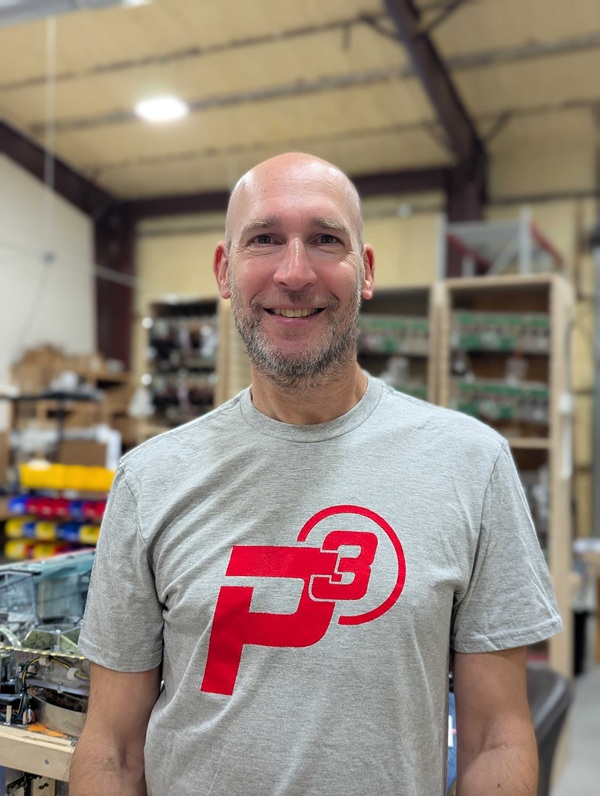
Stellenberg started the company in 2012 after developing the P-ROC, a circuit board to control older pinball games. It could be plugged into a traditional pinball game and connect it to a computer. Then he could write new rules for it.
“I started with that and parlayed that into a new custom idea I had, and that idea was a pinball machine with an LCD in the playfield that could track the ball,” Stellenberg said. “I built that for fun, took it to a toy trade show, and people liked it. They asked if they could buy it.”
Stellenberg said that led to the genesis of Multipmorphic.
“We developed a multi-game system based on that idea, and we now have nine playfield modules. You can change the physical components, the hardware, the ramps, the loops, the targets, the thematic elements,” Stellenberg said. “You can change that out in about two minutes, change the game completely and play something entirely different.”
The whole machine is called the P3, which first started shipping in 2017. People can buy the machine and swap out the games. Multimorphic now has 27 games for the system, including software add-on games.
The P3 platform has a big LCD display in the lower portion of the playfield, and all of the mechanical interactive part is above that in the upper portion of the playfield. More recently, the firm added a modular piece of hardware that plugs onto the machine over the top of the LCD, and that added physical elements closer to the flippers. There’s a lift ramp, a spinner, a kickback and a flipping wall plate that are closer to the flippers.
“It’s a leap forward for our platform because it adds a lot more content closer to the flippers,” he said.
Stellenberg’s team was determined to make the Portal game happen.
“We’d been talking about it for years, and I reached out to Valve through every email address I could find on the internet, and never heard back,” Stellenberg said.
Eventually, the team signed another developer and he had a connection to one of the developers on Portal. They reached out, the guy responded, and it went really quickly from there.
The team started developing the new game about 2.5 years ago and then launched it in March. All told, the development itself took a little less than two years. The cool thing is the ball lands in one place, disappears and reappears somewhere else.
“We have 18 physical places on the playfield where a ball can go in one place and come out another place, and it happens almost instantaneously because we have a lot of balls on the machine,” Stellenberg said.
In working with Valve, the team didn’t go in with a design already figured out.
“We knew that we could do the theme justice because of the hardware in our system. We could do balls through virtual portals and we just pitched, saying ‘We would love to do a pinball machine with your Portal IP. One of the guys on their team is a high-level tournament pinball player. So, between all of them, they agreed to give us the license. We were pretty closely talking to their team throughout the development cycle to make sure that we’re doing it justice.”
Previously, Multimorphic made a game based on Weird Al Yankovic and another one based on the movie The Princess Bride. The team sent concepts over to Valve and they tweaked some things. There was some iteration. The final machine does not connect to the internet the way some modern pinball machines do, and it uses GLaDOS’ voice from Portal 2.
Building Portal pinball
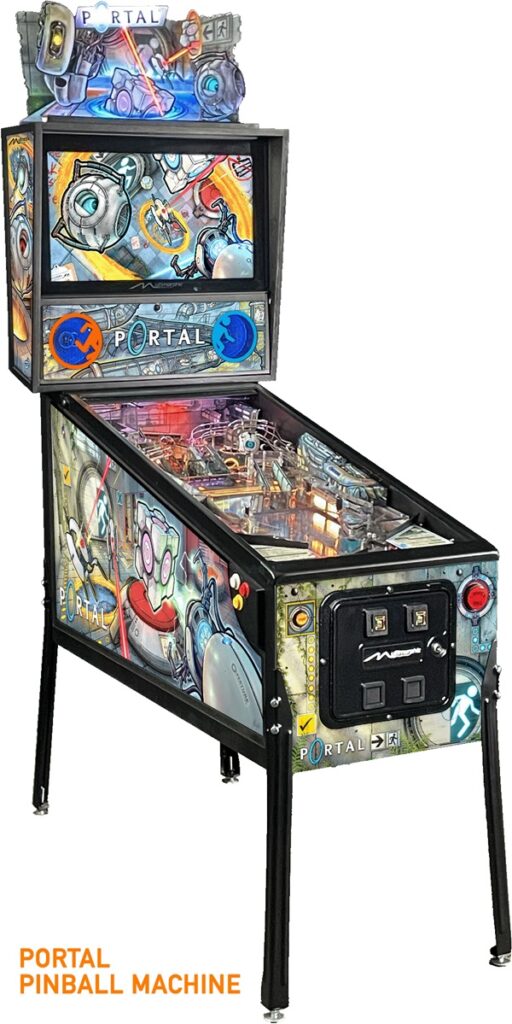
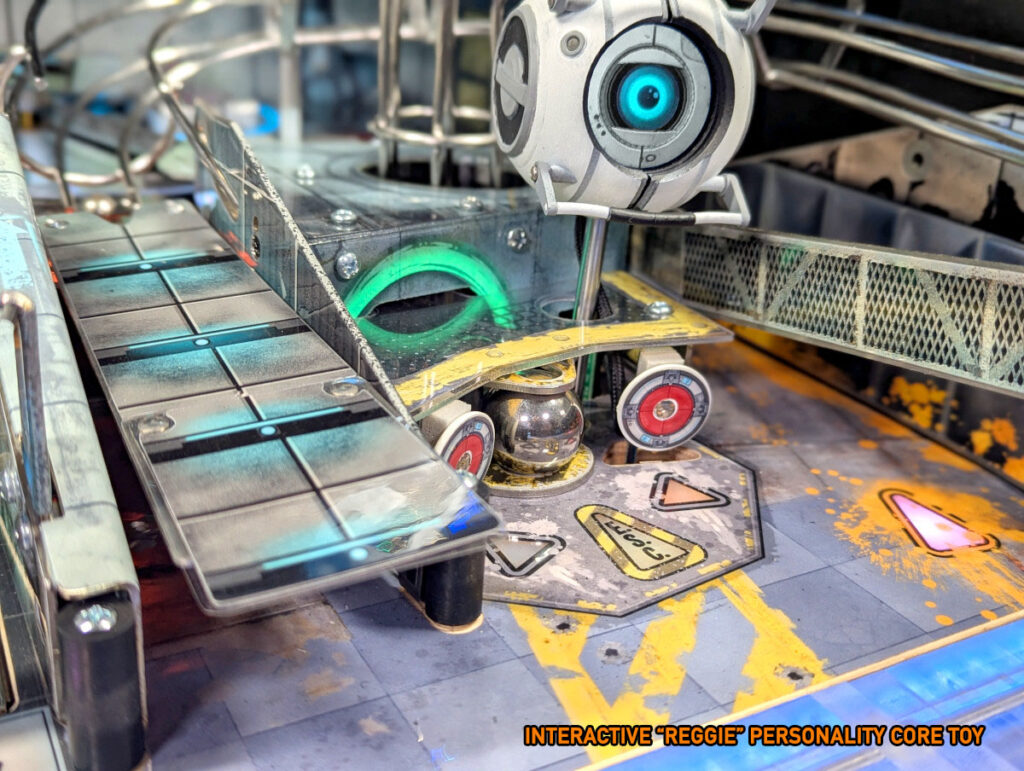
Portal pinball is fully licensed from Valve and the Multimorphic team worked collaboratively with the creator of the original to ensure their game fits seamlessly into the Portal universe. Voice actor Ellen McLain reprises her role as the voice of GLaDOS and the game introduces an all-new Personality Core named Reggie, voiced by Marc Silk.
Portal is a pinball game based on the Portal series of video games from Valve. While playing the game, you will interact with many physical and virtual features modeled after elements from the Portal 1 and Portal 2 video games. The physical playfield is packed full of interactive mechs and 10 RGB illuminated physical playfield portals and 6 additional scoop portals, through which the pinball can “travel through” instantly.
There are two editions of the game, Portal Standard and Portal Extended. Both editions include the same upper playfield module and game software, while the extended edition also includes the Portal module extension.
How it works
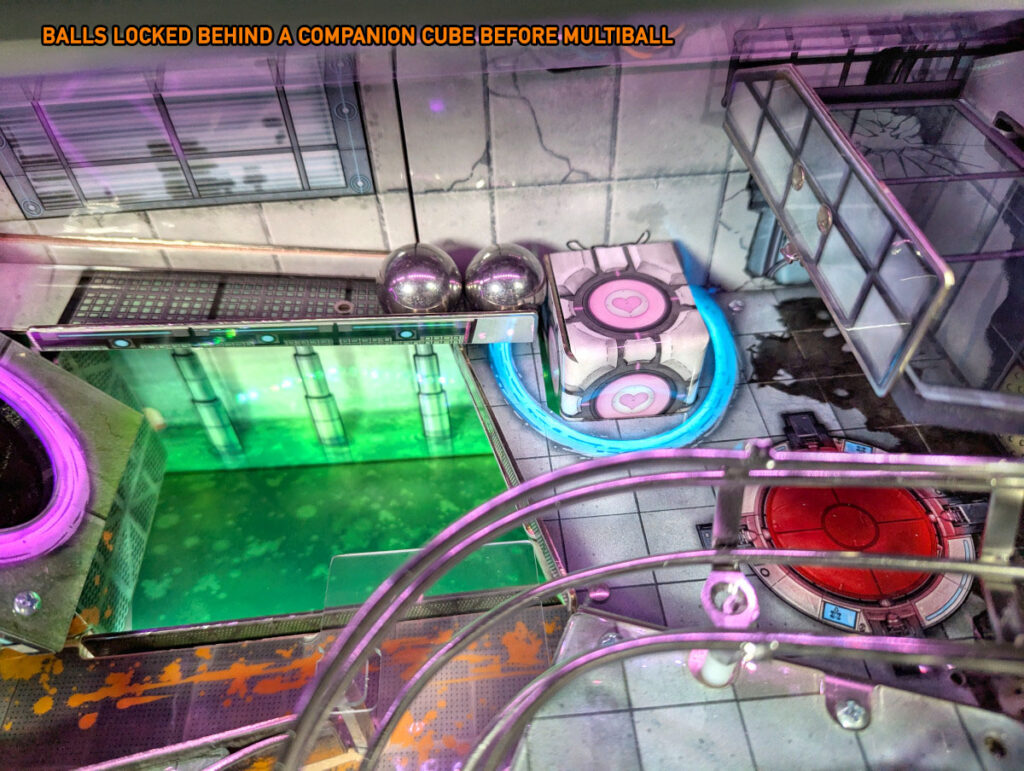
The Portal module extension floats over the screen and brings gameplay closer to the flippers with additional decorated catwalks, a physical spinner, four physical targets, a third dynamic ramp, the hidden gel tube kickback mechanism, and the elevated, cross-playfield Hard Light Bridge experience.
After adding a connection point to your left side target module, swapping in the Portal module extension is as simple as removing the inlane wireforms, lowering the module extension in from above, securing it with scfour rews, and connecting the cable harnesses to their mates on the sides of the upper playfield module. The game software detects the presence of the module extension and adjusts the game rules accordingly.
Portal Standard is a three-flipper game (including the flipper in the Loft on the module). Portal Extended also uses the left side target flipper, making it a four-flipper game. The Portal Extended Game Kit therefore requires a Left Side-Target Flipper Assembly. New P3s come with this flipper assembly pre-installed. P3s built prior to 2022 did not.
Each player starts gameplay in “the Hub” which is thematically similar to the Portal 2 Cooperative Testing Initiative location of the same name. In the Hub you will meet Reggie, the “Teambuilding” Personality Core (voiced by Marc Silk) who will encourage and direct you to complete specific objectives or enter and complete the 7 unique Test Chambers.
After completing all the chambers you will have the chance to battle GLaDOS, the AI antagonist who supervises and taunts you throughout the game. If you complete all the test chambers, you can play the final wizard mode: a face-to-face battle with GLaDOS.
When not in a specific Test Chamber, your goal in the Hub is to prove your skills and increase your score by completing each of 8 objectives and 3 stackable Multiball Modes. Each Objective and Multiball focuses on different aspects of the physical playfield. You could play the entire game in about 30 or 45 minutes. But if you lose all three of the balls, the game is over.
The shipping started in early October. Arcades around the U.S. are getting the games. The standard full machine with Portal costs $12,500, but those who already have a Multimorphic machine pay $5,500.
Other games are in the works, but Stellenberg isn’t talking about them yet.
“It’s all secret for now,” he said.