
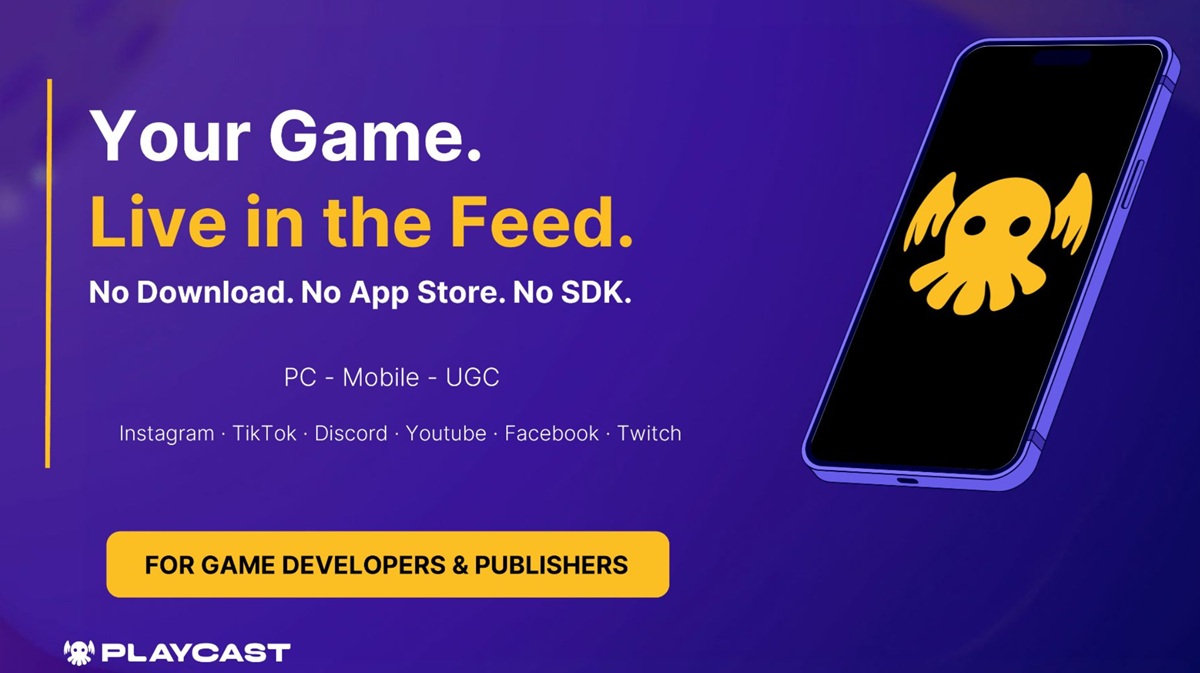
PlayCast, founded by gaming pioneer Alex St. John (of DirectX and Wild Tangent fame), is building the infrastructure for instant-play PC games on every device.
St. John’s company announced its launch partnership with Austin-based studio FarBridge to bring RWBY: Grimm Eclipse—a fan-favorite 4-player co-op PC and console title—to mobile and social platforms as a fully streamable instant-play experience.
“We’re really excited about our first commercial launch partnership, and we’ve got a whole bunch of stuff rolling in behind it,” said St. John, in an exclusive interview with GamesBeat. “Our first conversion of a PC game to mobile has interesting outcomes in terms of discovery and user acquisition as a result of that. And so we partnered with with the FarBridge team and their game RWBY: Grimm Eclipse.”
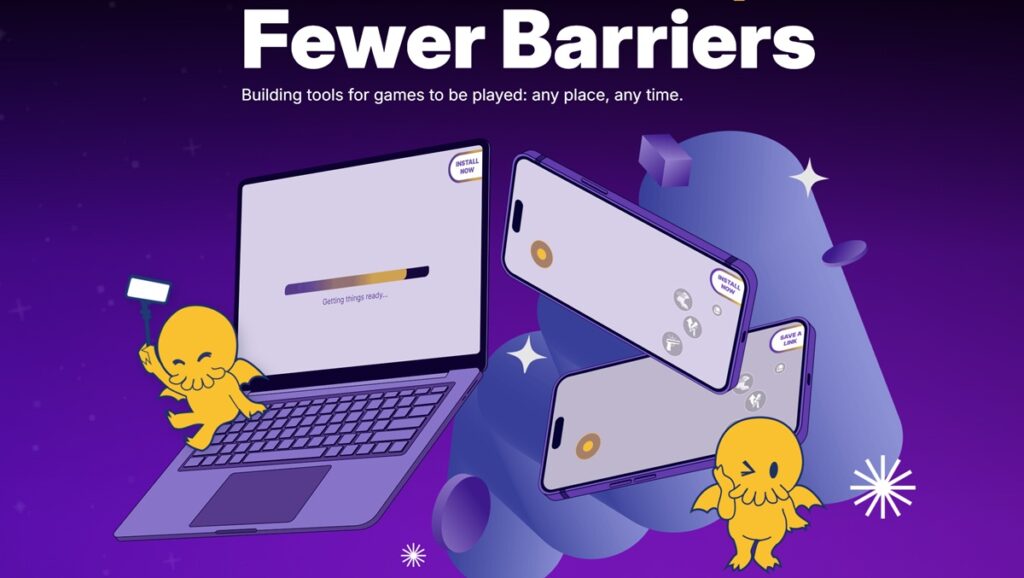
The game is available today across iOS, Android, Instagram, TikTok, YouTube, Discord, and Twitch. Players tap once and are inside the full PC game in seconds. There is no download, no install, no app store redirect, and no proprietary client, St. John said.
It’s kind of like a new version of the Playable Ad, where you can click on an ad and it magically plays the game being advertised. These ads have been around for years, but they’re mostly just demos of a game. St. John said that in the case of Playcast, you could click on an ad and play the entire game.
Most importantly for the industry, FarBridge shipped this launch without having to build a separate mobile SKU. The PC build runs unmodified, with overlay controls on PlayCast’s network. That is the headline: a top PC title can now reach a global mobile and social audience in days, not the 18–24 months a traditional mobile development demands.
A new pipeline for PC games to reach mobile and social
PlayCast is a platform for streaming PC experiences directly to browsers and social surfaces on any device. The platform is designed to complement—not replace—a publisher’s existing storefront, authentication, and commerce. It reduces the distance between “see it” and “play it” without asking the publisher to re-architect anything behind it.
For developers and publishers, this collapses the historical tradeoff between platform reach and engineering investment. A studio with a successful PC title no longer has to choose between leaving the mobile market on the table or absorbing a multi-million-dollar port. With PlayCast, the same build that ships on Steam reaches every iPhone, every Android device, and every social platform where the audience already lives.
Playable ads, instant trials, and a new UA model
PlayCast rewires user acquisition by making the playable itself the merchandising unit. A scroller on Instagram, TikTok, YouTube, Discord, or Twitch taps an ad, a Discord Activity, or a creator link and is playing the full PC game—streaming in their browser—in seconds. There is no app store handoff, no install-attribution decay, no funnel between impression and session.
PlayCast’s distributed network of community hosts pairs each instant-play request with a nearby available machine in real time, delivering low-latency play at a fraction of the cost of traditional cloud gaming. Time-boxed trials, event-driven activations, and reward-based unlocks for invites and community milestones can be configured and tuned from the web—giving publishers marketing levers they have never had inside the game itself.
For publishers, this opens a UA channel that has not previously existed: full-fidelity premium games delivered as native social content, with conversion measured in seconds rather than days. For platform operators like Discord and Twitch, it turns every server and every stream into a launch surface for the games being discussed.
“Every PC publisher we talk to wants the mobile and social audience. None of them want to spend two years and seven figures rebuilding their game to get it. PlayCast removes that math entirely,” said Alex St. John, Founder and CEO of PlayCast. “FarBridge handed us a finished PC build. We handed them iOS, Android, Instagram, TikTok, Discord, YouTube, and Twitch. That is the new pipeline—and the playable becomes the ad.”
“PlayCast let us put the full PC version of RWBY: Grimm Eclipse in front of a mobile and social audience without compromising the game and without diverting the team,” said Patrick Curry, CEO of FarBridge Games. “No mobile port, no extra integration work. That is a genuinely new option for our industry.”
In a message to GamesBeat, Curry elaborated. He said, “I’m personally really excited about what the Playcast tech can do for us at FarBridge. Porting games to new platforms can be an expensive endeavor, especially when we’re just experimenting with a new platform or thinking about reaching a new audience. We’ve scoped out the engineering work to port RWBY: Grimm Eclipse to mobile the ‘traditional way,’ and it’s no small feat.”
He added, “Being able to quickly and efficiently bring finished games to more platform is a huge win for us, especially in these unprecedented times. I think playable-ads are a great place to start our collaboration — folks are going to be pleasantly surprised by how high-fidelity the game is, even on mobile.”
And he said, “In the future I could see us launching pilots of entirely new games with Playcast before they hit Steam or the app stores — letting players on all platforms try out the game, give us feedback, and get involved and invested in its creation and completion. And that could all be based on a single build of the game, created at a fraction of the costs, letting us make strategic decisions about our products and go-to-market plans, better informed than ever before.”
Availability
Try it out here: https://demo.playcast.io/q/rwby_gamesbeat
RWBY: Grimm Eclipse is available today, April 24, 2026, free to play on iOS, Android, and across Instagram, TikTok, YouTube, Discord, and Twitch via PlayCast.
Origins
St. John started building the company four years ago after Bing Gordon, venture capitalist and former leader at Electronic Arts, asked St. John to start a tech platform to serve bames.
“What have you got for me?” Gordon asked.
“He persuaded me to get back into the gaming platform business. I wanted to do cloud gaming, and then I did a bunch of work on it with Bing, and found the economics were kind of a disaster,” St. John said. “I couldn’t make math work. No matter how you tried to scale it, the cloud was just too expensive for media and advertising models to work.”
St. John went back to the drawing board. He thought there should be a way to make the same thing happen through peer-to-peer networking, like the old Skype technology for calls.
“I missed the LAN party days,” he said. “I’m going to invent a technology that makes it possible to share games without any cloud, and that was the seed of Playcast. And now a few years later, we have a very powerful platform that anybody who installs our software on their computer becomes a full personal gaming service. And so we have a network of thousands of people who donate their computers for our network, and we can run gaming campaigns on them.”
He said because the people are local, there’s lower latency, or interaction delays, than games streamed via the cloud from expensive data centers.
“We matchmake through people who are hosting games for us in your neighborhood, rather than somewhere far away by a giant hydroelectric dam. I paid a lot of attention to Stadia and other streaming efforts that came and went. Having done the math, I know that they just can’t make the economics work. It’s a real struggle for them,” St. John said.
He added, “This is a pioneering effort in making it possible for people to just share games with no cloud and then make a business model out of it that allows game publishers to publish directly to their audiences and market to them through a peer to peer network.”
St. John said this was revolutionary.
“Everybody can stream a game in the cloud and have a terrible business model. We’re the only ones who can just do it with economics that work,” he said.
Gordon turned out to be the first investor in Playcast.
St. John said the origins of Playcast start with the efforts to run games on windows through DirectX, effectively shutting down Windows and using a different operating system on the machine to run games. Microsoft didn’t really want to admit this was happening, but it’s the kind of tech that split Windows from Xbox. Playcast is doing something similar, where it virtualizes Windows, essentially shutting it down and running something that can run games good, St. John said.
“What Playcast does is we replace the entire Windows Media driver layer with virtual drivers. So when you play a Playcast game on your cell phone’s hardware, Windows, thinks your cell phone screen is a local monitor. It thinks the touch screen is a local touch display. It thinks the cell phones, microphone and camera are plugged in via a 50-mile USB cable, and so that’s why the games require no integration and no SDK,” St. John said. “They think they’re just running on Windows, except it happens to be your cell phone. That’s why it’s so powerful. So an enormous operating system level engineering effort was required to make Playcast.”
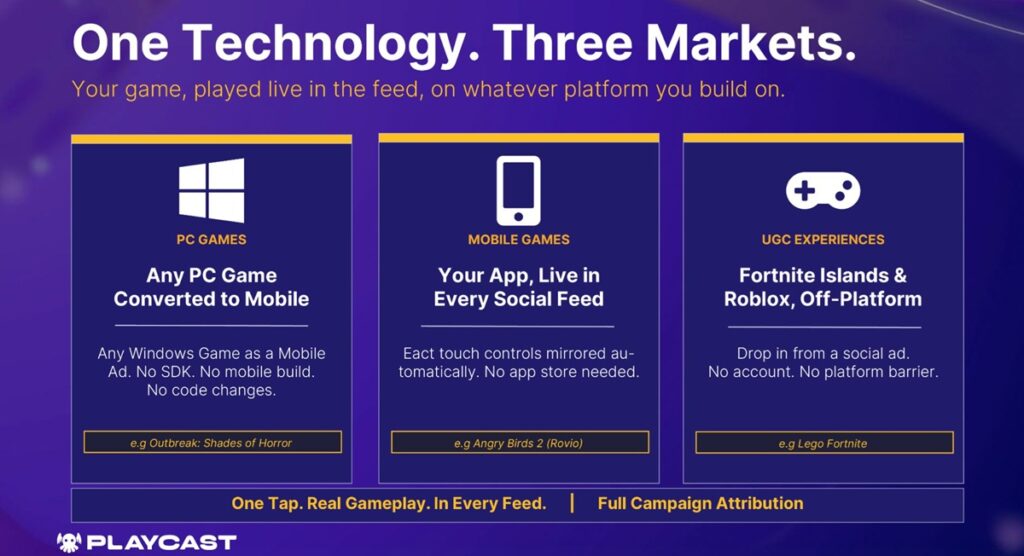
St. John said, “I’m the only person in the world that builds operating systems underneath Windows for a living successfully. And that’s what Playcast is. It’s an entire virtual layer underneath Windows that makes it possible to publish games this way. This works with all PC games, including all the anti-cheat and protected ones. It works with Fortnite. It works with League of Legends. It works with Valorant. This works with all mobile games on PC as well. So it’s it’s enormously elegant in its ability to to stream anything, absolutely anything, with no work. But that is very, very hard to do.”
And he said, “That’s the big achievement, plus making it peer to peer. So you even get rid of a cloud dependency. Now, ironically, you can run Windows in the cloud, install Playcast, and it’s a streaming game server on the cloud, and you can spend cloud money to do it there.”
How it works
St. John said his team of 19 people (funded with $10 million in capital) has done a lot of work so there is no developer integration work required.
“You don’t have to adopt an SDK. You don’t have to do anything. You can literally install absolutely any and every PC game on your computer, and we can stream it with a button click,” said St. John. “There’s a zero adoption [work for the] platform as well, and that’s one of the huge hurdles to cloud gaming, which is all the work you have to do as a small studio to try to get your game into a form that can be streamed, to get it at great expense. This doesn’t require any of it, either.”
He said the nice thing is that Playcast can work with a lot of small game developers who have no traditional marketing budget or strategy that can easily get them live on other platforms.
“We can get PC games that were not designed for mobile” and make them totally mobile, working outside the Apple App Store and Android, he said.
“We can drop links and icons right on the mobile phone desktop without any download,” he said.
The RWBY: Grimm Eclipse game will be playable on a mobile phone, and yet it’s not a mobile game, St. John said.
“We’ve done some really pioneering engineering in the Playcast platform to make it really practical to publish games in a streaming form and make money from it,” he said.
Playcast is running a campaign where players can click on an ad link and then launch a game within two seconds and give players full gameplay. The typical user will likely play that game for over three minutes.
“You’ve never seen user acquisition like this before,” said Dave Madden, chief business officer at Playcast, in an interview with GamesBeat. “We’ll bring this to mobile as well.”
St. John said, “That’s a mobile Android game running in Safari without running on a mobile phone. That’s a streamed version of the game served from a PC. You see there is the mobile version of Android, running the mobile game, but it’s running as a video stream, not installed. It’s not running on Android and we didn’t get it from an Android store or from an Apple store. It came from a web page.”
Solving the PC to mobile user-interface problem
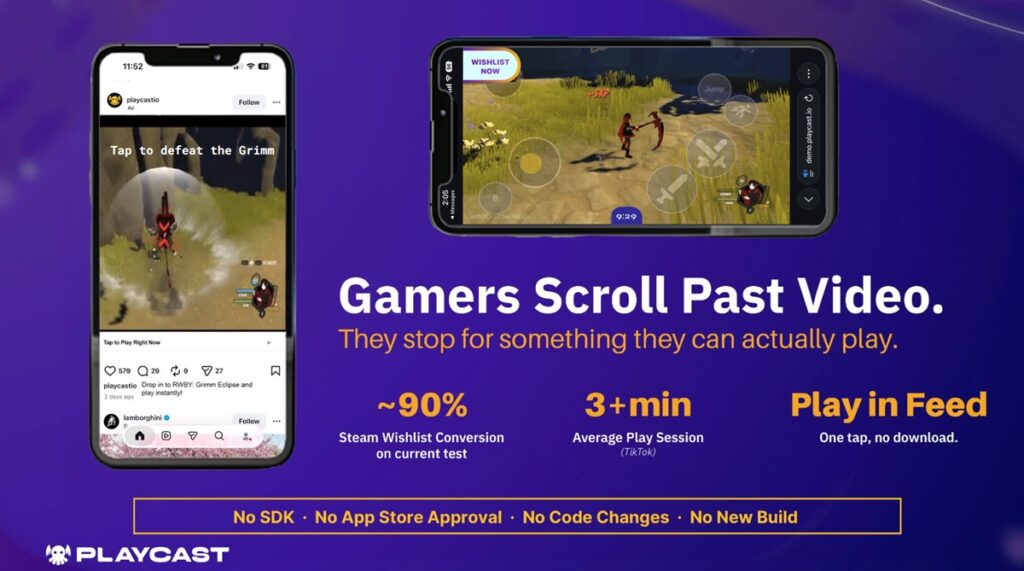
I asked how they can get the user interface to work, switching a game from a mouse and keyboard control to touchscreen controls.
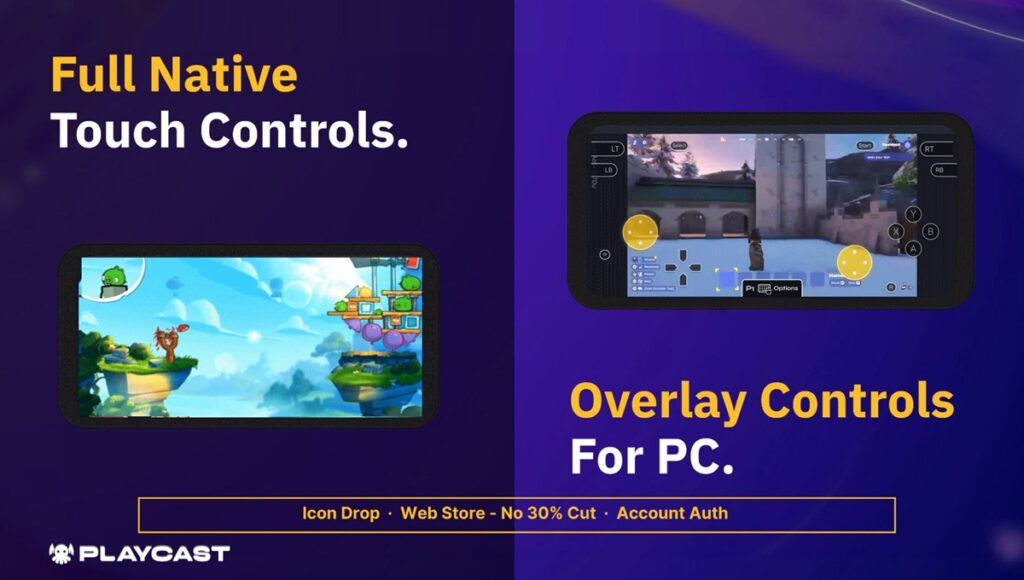
Playcast delivers the game as streaming video, and it can just add an overlay on top of it, he said.
“Most games are designed for gamepads. So the default thing we do for a game that isn’t customized at all is we overlay a touch gamepad on it, and it’s a generic one, and it works fine on mobile if you have a real mobile gamepad,” he said. “Like a Backbone. That works even better. But for advertising campaigns, our web designers just take an hour to make a customized UI, or touch UI for a game that’s much more native to mobile.”
St. John said that’s a small effort for Playcast.
“It’s web development, and very quick. It doesn’t take months and months of game design to do it, because it’s just web UI over video,” he said.
“The medium of streaming makes it easy to have a game to be touch-enabled, very easy compared to, trying to do it in the cloud,” St. John said.
Playcast will launch a site where developers can customize their own touch UIs for games and publish them themselves. But for advertising deals, as part of the package, Playcast will provide the touch UI for the developers itself, so they don’t have to do it, he said.
Making money and taking the games to social platforms
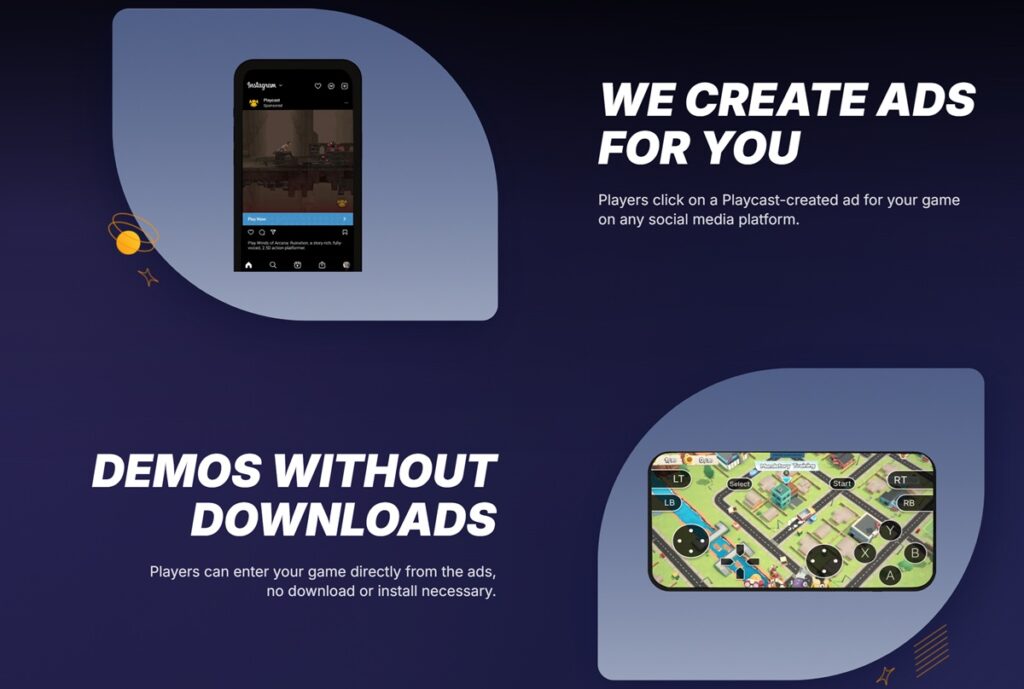
Playcast makes money as a media platform, selling its network, said David Madden, an investor in Playcast and an advertising veteran who worked at St. John’s Wild Tangent. Playcast makes the tech that makes “instant play” possible for a full game. Developers use Playcast to get their games in front of new audiences.
“We’re running ads for their games on their behalf, on Instagram and Tiktok and Twitch and other platforms, at Google and YouTube for that matter, and the players can just jump in and play the game,” Madden said.
St. John showed a phone to me with icons on it. But they weren’t icons for apps. They were just web links. They’re dropped on the phone by ads. They’re web links that take players directly to a game that is provided by Playcast. You tap the link, then it opens the Safari browser and the game starts playing, even if it is a Steam game. It exists on somebody else’s PC, and it is streamed from there to the user’s device. You can click on the link and buy the game directly if you wish.
“This is not a mobile game. We just added that touch UI to it,” St. John said.
Such a game takes Playcast about an hour or two of web development to make the nice touch UI for the game, he said.
“Then we package it as a mobile game. And presto, Steam games with mobile ads, and then those ad units work inside every social media platform,” he said. “We can embed them inside a Discord or Twitch or Instagram or X or any of those social media platforms.”
Since the game is playable video, you just click on it and Playcast opens the game right inside the social media platform, St. John said.
Changing the power dynamics of game developers, publishers and platforms
He said Playcast can automatically produce Discord activities. You can jump into a game in a lobby and share it with your friends on Discord. Discord becomes a multiplayer streaming video lobby for all PC games in the Playcast network, St. John said.
“And then we also do Twitch integrations where they’re Twitch extensions, so streamers can literally play the game with their audiences on Twitch. And those are just wrappers, because, again, we’ve turned the game into just a webpage, so that’s the same integration for absolutely every PC and UGC game ever made now,” St. John said.
In some ways, Playcast can disrupt Playable Ads, since Playcast can run full games rather than just playable demos of games through Playable Ads.
“If you want to make your own free-to-play games and monetize directly, well, here’s a way you can do that now,” St. John said.
“The high level is we’ve got the only platform in history that makes it possible for PC and user generated content developers to just directly promote their PC games and islands to anybody, virally, on mobile via social media,” St. John said. “Since we’ve made it, we’ve liberated the world of PC game marketing and publishing to be able to buy media through all the traditional platforms and on mobile device platforms without going through all the traditional gatekeepers. And RWBY’s the first game that we’ve done this publicly with.”
He added, “We make it so that Windows is streamable. And you’re right, that in addition to solving that problem, you still have the problem of Windows being pretty fat and bloated for gaming, right? So when people can become a host for us, we also strip Windows down.”
Streamers can benefit
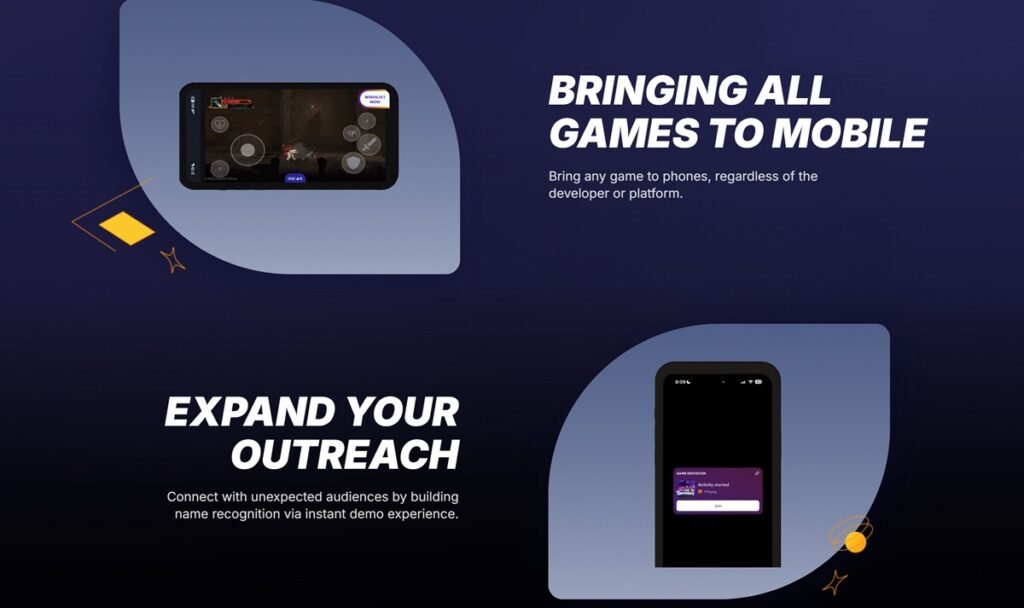
Streamers could play a game on a PC or on mobile and invite their fans to join them via a link. A couch co-op game is the exact same game in the same stream.
“And then we’re building a whole network of posts that will donate their computers to run campaigns. So it’s very low cost and also very low latency, because the hosts are near the people, not near the electric power plants,” St. John said.
Madden said the company is doing something different from a cloud gaming service, which offers games as a subscription via a model like Netflix’s.
“What we’re doing is, you know, very different. We’re basically opening up the lens for discovery and user acquisition off platform. Typically a player will discover a PC game and they have to download the game on Steam before they play it. We make it possible just to discover the game off platform,” St. John said.
For the stores like Roblox and Fortnite, there is a lot of friction and obstacles for user acquisition. If they can get you to play, they would be happy to monetize directly.
“This is not advertising in games. This is games advertising themselves, if you will,” St. John said.
Madden said, “We’re just taking platforms like Instagram, Tiktok, Twitch, YouTube, and turning them into instant play platforms so that a developer can do a lot more than just getting a 15-second video in front of someone. Instead, they’re getting their full game,” Madden said. “And the average game session is eight minutes for people playing these user acquisition campaigns for games.”
Another way to think of it is is democratizing game discovery. Playcast enables publishers to publish directly, to turn social media platforms directly into game discovery marketing platforms, St. John said.
“It’s an entirely different business model,” he said. “You don’t need an app store if the game is not running on anybody’s computer. And you can monetize directly, because anybody can take a commerce transaction,” St. John said.
FarBridge has a mobile game, bu they didn’t start out making a mobile game. They didn’t build a new SKU or hire a team. But the game is playable as a full mobile game.
“It’s not about being an advertising model, per se,” St. John said. “It’s that we’ve liberated the game market from game gatekeeping. You can publish your game and monetize it anywhere, on any platforms. None of those mobile games are mobile games, and none of them are going through an Apple or an Android store. They don’t need them anymore.”
He added, “That’s really the major point, because you don’t have to pay those app taxes if you don’t want to. These guys can acquire audiences and monetize them directly. So we’re hoping we create an era when game developers, especially PC game developers, can build and monetize their own audiences at a huge scale without needing all the walls and gatekeepers, taxing their business, if you will, and making it hard for their content to get discovered.”
Launching Playcast 1.0
The company launched the 1.0 consumer platform last year, while the company is now doing its first media campaign. Madden is also about to bring a whole lot more to the market.
St. John said the team went to GDC, knowing it would stream PC games and user-generated content games on platforms like Roblox and Fortnite.
St. John said the company will be launching mobile streaming campaigns on the heels of the RWBY: Grimm Eclipse campaign in a matter of weeks.
“The demand is very strong for user acquisition,” Madden said.
St. John added, “We can make playable ad units that jump straight into Roblox and Fortnite islands and levels, bypassing all the download and app install stuff. And so we’re working with UGC content creators who want to promote their worlds or their games directly to consumers without the massive amount of friction of going through the game, making the user remember where they are in the game and navigate through it. We drop them right in on social media. So it’s meant to be a massively viral mechanism for social media, social UGC games, to acquire audiences without without all the friction associated with going through the main game platform.”
Can the platforms stop this?
While platforms may not like Playcast, they may have a hard time stopping it.
“We’re in a browser,” St. John said. “There’s no rules in the browser other than what Apple limits the Safari browser to being capable of doing, and essentially, a streaming game in a Safari browser is a video conference call. It’s the same technology. So Apple has to break, Safari video conference calling to break streaming game delivery in that environment, and they don’t do it as a consequence.”
Apple blocked Microsoft’s xCloud cloud gaming application on the iOS platform. That’s why Microsoft joined in the litigation against Apple.
But St. John reiterated there are no app store rules or monetization inside the Safari browser. So you can publish anything you like that you can deliver in the Safari browser, and you can monetize any way you like, he said.
St. John believes the economics will not favor the cloud gaming companies.
“We think we’ve got the business model right, compared to the cloud economics,” he said.
Other companies like BlueStacks have converted Android games to run on computers.
“We have an automatic provisioning system to install the games on all our host machines. So when people sign up to be a host for us, we can put games on their machines, and we just run all games on an Android emulator, like Bluestacks, except one that’s stripped down for just running the game,” St. John said.
Why focus on peer-to-peer networking?
I asked why there aren’t more modern examples of peer-to-peer networking.
“There’s a lot of good reasons not to do one. It’s complicated. So peer to peer, because of all the security and network protocols, was quite hard. It became very difficult to establish a peer to peer connection,” St. John said.
Google solved part of the problem through Stadia in browsers with Web RTC. So Web RTC in order to enable peer to peer video conferencing, solved the map reversal problem for establishing peer to peer connections in a nice browser sandbox way, he said.
Second, peer to peer for gaming involves revealing people’s IP addresses, which is considered a security concern now. But in modern browsers, the IP address is hidden. Playcast obscures it by sandboxing it.
“You should mask IP addresses. It’s been done at so many levels that it’s not really a relevant concern anymore. And because we are streaming in a browser,” he said.
St. John said Playcast keeps control over what it’s streaming.
“We’re streaming games we choose on our protocol, encrypted on our network, so we don’t have to worry about people streaming something naughty on our network, because the only things that you can stream on our network are that we stream on our network,” St. John said.