
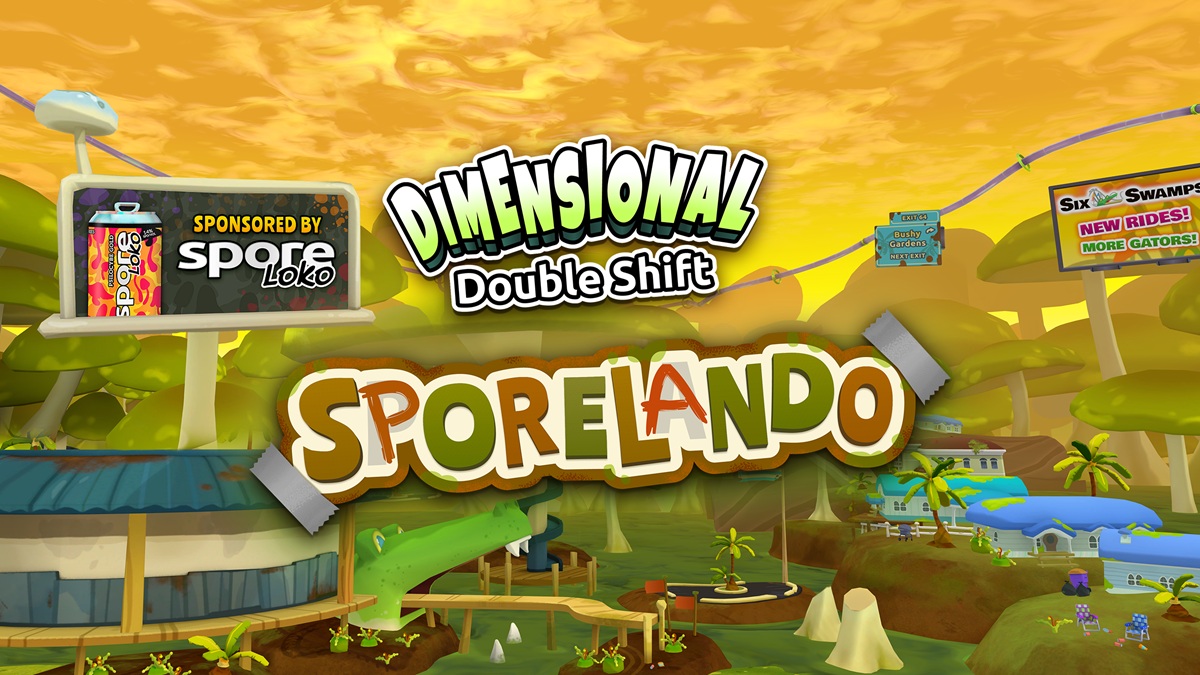
Owlchemy Labs, the VR studio behind platinum-selling titles Job Simulator and Vacation Simulator, announced Sporelando as the next Dimension Pack for its chaotic multiplayer VR title Dimensional Double Shift.
Revealed at the VR showcase, Sporelando will launch April 23 on Meta Quest and Android XR for $5. I got a chance to play it with Andrew Eiche, CEOwl at Owlchemy Labs, and Sandy Marshall of Owlchemy at GDC Festival of Gaming. We played Sporelando together on Galaxy XR headsets. Plus, I talked with them about the state of the VR gaming industry.
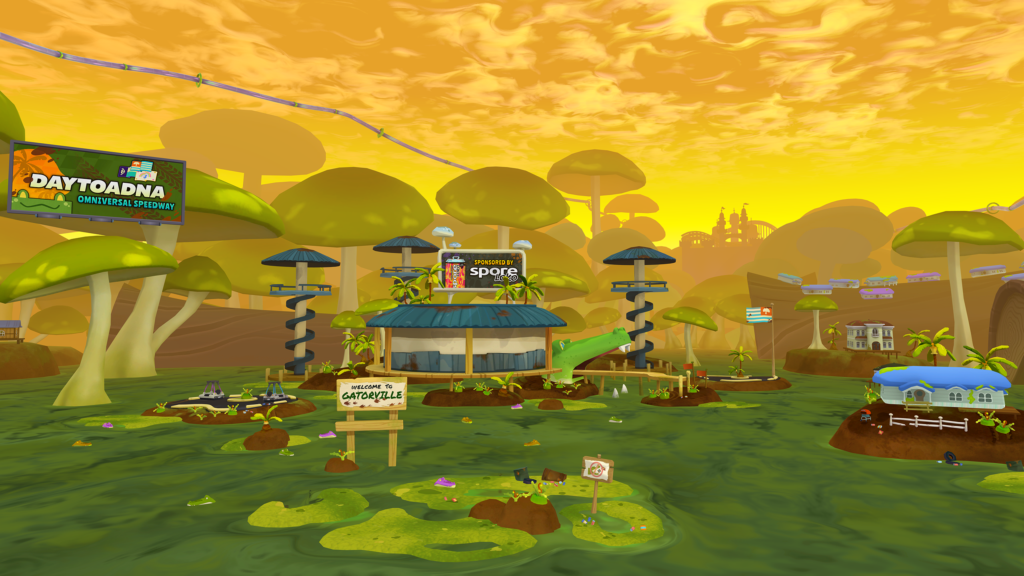
In Sporelando, players will clock-in to a humid suburban swamp where sentient fungi call the shots, golf carts seem to have a pulse, and the local diner is serving up exactly what you’d expect from a place built three highway exits past civilization. From patching up unruly vehicles to juggling swamp-side service, the dimension brings a messy, yet lovable, new flavor of chaos to Dimensional Double Shift, the company said.
“Every new dimension starts with a ‘what if’ that makes us laugh, and Sporelando started with: what if ‘Florida Man’ was actually a sentient mushroom?” said Andrew Eiche, CEOwl at Owlchemy Labs, in a statement. “It’s the kind of place that feels weirdly familiar until you realize your clients are fungi and the diner menu is… questionable. That tension between the mundane and the absurd is where the best co-op chaos lives.”
Sporelando Key Features include:
- Swamp Suburbia – Step into a humid suburban sprawl filled with overgrown streets, giant mushrooms, and roaming gators.
- Whippin’ in the Golf Cart – Patch up bizarre bio-mechanical golf carts with fresh repair gameplay, strange modules, and swamp-side mechanical chaos.
- Order Up, Swamp Style – Serve Sporelando’s local cuisine with diner tasks and food prep built for this soggy corner of the omniverse.
- Meet the Mushroom Neighbors – Work for the Sporidians, fungal locals who thrive in heat, humidity, and a little bit of chaos.
- One Pays, Everybody Plays – Just like previous Dimension Packs, only one member of the crew needs to purchase Sporelando (at $5) for the whole squad to jump in together.
Sporelando is the newest addition to Owlchemy Labs’ growing lineup of Dimensional Double Shift Dimension Packs, joining Treeattle, Hexas, and New Joysey. With three dimensions and well over a million downloads in 2025, Owlchemy Labs is continuing the momentum of Dimensional Double Shift with Sporelando.
Owlchemy’s growth
Founded in 2010 and based out of Austin, Texas, Owlchemy believes that natural, spatial interactions make virtual reality the ultimate destination for new forms of gameplay and immersion.
The team has created the award-winning, platinum-selling VR launch title Job Simulator, the Emmy-nominated Rick and Morty: Virtual Rick-ality, and the top ten VR title Vacation Simulator. Owlchemy was acquired by Google in 2017 and continues to share its pioneering experiments and VR best practices through blog posts, white papers, and talks around the globe.
Owlchemy has grown to about 80 people, and that’s where Eiche would like it to remain. The team can work on a couple of major games (like Dimensional Double Shift) at a time and do some smaller projects as well, including porting. The porting is easier in part because Owlchemy uses an abstraction platform. The team writes software to that platform and then adapts titles to particular platforms.
He noted that Unity has a horrible security bug and Owlchemy has to update all of its games. The company has Galaxy XR devices in-house and it’s working on those headsets. Eiche hopes to get big titles like Job Simulator and Vacation Simulator on all platforms.
“On the programming side, I think we’re going to see some real push with AI,” he said. “I think you’re gonna see an acceleration. I think the place where you’re going to see the biggest games for AI is actually not in VR but in traditional gaming.”
Playing on the Galaxy XR
The headset was easy to strap on. It has a bunch of sensors and a couple of 4K displays. It has external batteries so you can hot swap them out. The headsets debuted in October and the team has been working with them for a while as it’s part of Google. I learned the controls relatively quickly, using my fingers to make pinching motions to select menu items inside the VR experience.
Then the three of us in the room fired up Sporelando. We moved into a cartoon-style swampy space that was like marshes in Florida. There were carts that combined the functions of golf carts and fan boats in the same vehicle.
Then I had to manually start moving things around,m like grabbing a pole, flipping levels on panels, and drive the vehicle. It was raining. We started working on some puzzles in a kind of assembly line space and build some stuff. It was all a very physical experience, using my arms, hands and head. It was a bit of a wacky experience. I ran out of time so I couldn’t finish the demo, but Sporelando was a zany experience.
The state of the VR industry

I asked the CEOwl about his views on the state of VR gaming.
“I don’t think VR is particularly special. I think we’re just a more pronounced version of what you’re seeing across the industry, with studio layoffs [especially at Meta]. There are still lots of successful VR studios,” Eiche said.
He noted that Meta knew what was making money and what wasn’t in terms of the games for its Meta Quest VR headsets. Meta was building expensive and wonderful VR games based on big intellectual properties like Deadpool. But those games didn’t sell well.
Rather, smaller games like Gorilla Tag and Vacation Simulator were the ones that went viral.
“VR players are playing games that are very inexpensive to make, with lots of social and multiplayer dynamics,” Eiche said. “They’re not necessarilly playing these set-piece triple-A games like Deadpool. Twisted Pixel did a wonderful job making Deadpool. But Deadpool as a concept was not necessarily what VR players are attracted to. They’re attracted to games where they get to be themselves, and it’s very social.”
Now that Meta has made a lot of changes, Eiche said, “There is nowhere else to go.”
And in fact, Meta made some changes to its store that made it harder to get noticed or promote smaller games. Of course, new headsets are coming from Samsung and Google as well as Valve, and there’s a chance Apple will still refresh its Apple Vision Pro line. All of that means a lot, but Meta was the company with a 30-million-headset head start, he said.
“While we wait for the others to catch up, there isn’t a lot of space for alternative headsets,” Eiche said.
In the long run, however, Eiche is excited about what could rise from the low end of the market. Right now, Meta is selling millions of its AI glasses. There’s an $800 model, the Meta Ray-Ban Display, which also has an augmented reality (AR) display. You can speak to the glasses and get AI answers spoken into your ears. And the glasses are lightweight, just about as heavy as some sunglasses models.
“Meta has the AI glasses and that kind of form factor is coming down the line. And the thing that we’ve been saying is one of the biggest barriers to playing VR is you look kind of dorky. You look like a nerd wearing your nerd helmet, and so getting you out of that, and getting the sunglasses style — we’re very excited about that.”
Eiche said Owlchemy wants to be ready when these lightweight XR devices get into the market. I noted how I interviewed Tommy Palm inside an Apple Vision Pro, and it was the most realistic virtual interview I’ve ever done.
For business people, that works. But the cartoon-like avatars of the Horizon Worlds experiences aren’t really how people want to conduct business, Eiche said. Eiche is guessing that Apple is committed to its platform and he’s talking about the future with them.