
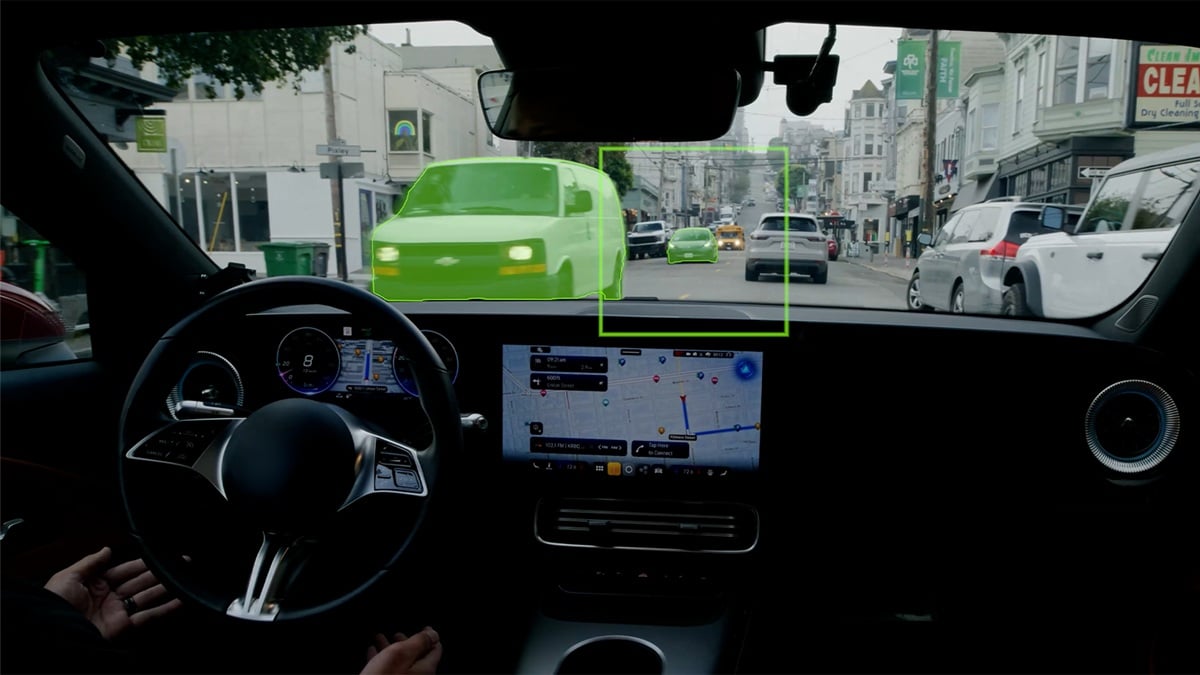
Nvidia introduced Nvidia Alpamayo 2 Super, a 32-billion-parameter reasoning‐based vision language action (VLA) model for robotaxis.
The model extends the Nvidia Alpamayo family of open AI models, simulation frameworks and physical AI datasets for safe, level 4 robotaxi development, said Jensen Huang, CEO of Nvidia, at Nvidia GTC Taipei and Computex. It’s all part of Nvidia’s strategy to accelerate the deployment of self-driving cars — in this case the robotaxis that can drive us around.
Alongside the model, the company announced new tools, models and agent skills that complete the pipeline from real-world data capture to closed-loop training and in-vehicle deployment, including Nvidia AlpaGym, Nvidia OmniDreams and new Nvidia Omniverse NuRec models.
Alpamayo 2 Super helps accelerate autonomous vehicle (AV) development by eliminating the need to build key autonomy infrastructure from scratch. It enables humanlike perception, reasoning and action, and provides the interpretability needed for safety validation and regulatory collaboration.
To better train models for on-road deployment, the AlpaGym framework provides a platform for closed-loop reinforcement learning (RL). The Nvidia OmniDreams generative world model for photorealistic closed-loop AV scenario generation enables developers to simulate rare and long-tail driving scenarios at scale.
To amplify developer productivity, Nvidia is providing physical AI agent skills for all of its AV development tools. For example, the Neural Reconstruction skill powered by Nvidia Omniverse NuRec uses real-world fleet driving scenarios for simulation and generates synthetic training data at scale.
“Alpamayo is the moment cars begin to safely reason, not just drive,” said Huang, in a statement. “Only Nvidia makes available open models, simulation, real-world data and agent skills so the entire global robotaxi ecosystem can develop level 4 capabilities that understand edge cases, explain decisions, earn trust and scale safely to millions of vehicles.”
Alpamayo 2 Super, Now Available for Reasoning-Based AVs
The Nvidia Alpamayo family now scales from 10 billion to 32 billion parameters with Alpamayo 2 Super — going beyond trajectory generation to reason, plan and act across the full driving stack. With multitask capabilities spanning reasoning, auto-labeling, scene understanding, model critiquing and distilling knowledge into smaller models, it provides the building blocks for scalable L4 AV development and deployment.
Key features include:
● 3x parameter scale: Built on Nvidia Cosmos world foundation models, Alpamayo 2 Super scales to 32 billion parameters compared with previous 10-billion-parameter generations, improving reasoning, 3D spatial understanding and trajectory prediction in long‐tail scenarios.
● Full-surround perception: Expands from front-focused cameras to 360-degree situational awareness across front, side and rear views, giving the model complete context for safer lane changes, merges and intersection crossing.
● Meta-Actions: Adds Meta-Action output — including macro actions such as yield, lane change and stop — so the model predicts high-level driving decisions for downstream planning in addition to trajectories and chain-of-causation (CoC) traces.
● Reasoning auto-labeling and 2D grounding: Introduces reasoning auto‐labeling with 2D grounding so the 32-billion-parameter foundation model can provide high-quality reasoning labels, compressing annotation cycles from months to days and reshaping AV data pipeline economics.
● Improved CoC and trajectory quality: Improved CoC traces and trajectories, especially in rare, complex, long‐tail scenarios where traditional imitation‐learning AV stacks struggle.
These advancements make Alpamayo 2 Super Nvidia’s most powerful open driving foundation model to date, the company said. Designed as a teacher model, Alpamayo 2 Super can be
distilled into compact models that run on the accelerated compute of the Nvidia Drive Hyperion platform — Nvidia Drive AGX Thor, which runs inside the vehicle.
As the teacher model scales from 10-billion-parameter models like Nvidia Alpamayo 1 Nano and Nvidia Alpamayo 1.5 Nano to 32 billion parameters with Alpamayo 2 Super, a downstream AV stack built on Alpamayo inherits higher‐quality reasoning and perception from a single open release, without requiring each manufacturer to rebuild from scratch.
Alpamayo was recently recognized by the COMPUTEX Best Choice Awards, winning
in the Vehicle Technology and Smart Cockpit category.
Since launch, Alpamayo has been downloaded close to 400,000 times. The
Alpamayo open platform also includes post-training scripts that allow researchers
and developers to adapt the models to their own datasets, scenarios and driving
policies.
Alpamayo 2 Super is expected to be available this summer on GitHub for inference
code and Hugging Face for model weights.
AlpaGym Enables Closed-Loop Training and Deployment Cycles
Nvidia also introduced Nvidia AlpaGym, an open source, high‐throughput, closed‐loop RL framework.
Where open‐loop training evaluates models against recorded data and generates a
single round of actions, AlpaGym runs models through continuous decision and observation cycles in Nvidia AlpaSim, with every braking, steering and navigation choice affecting the environment.
As a result, AlpaGym exposes the compounding errors and edge‐case failures that static datasets miss, allowing models to learn from experience.
Built on the AlpaSim microservice simulation stack and Nvidia Omniverse NuRec, AlpaGym enables efficient, scalable, closed-loop RL to push the frontier of driving performance. In combination with the Physical AI AV Dataset, Alpamayo provides a continuous path from open-loop pretraining to closed-loop refinement.
Nvidia is also releasing the CoC Auto-Labeling Pipeline as open source on GitHub. The pipeline automatically generates decision-grounded and causally linked CoC labels from raw driving clips with no human annotation required, providing the causal training data foundation needed to train embodied reasoning models at scale.
New Physical AI Agent Skills for AV Powered by Nvidia
To support reasoning-based AV development, Nvidia is launching new physical AI agent skills, under Nvidia Agent Toolkit, to guide developers and their coding agents through the simulation, data generation and closed-loop training workflows needed to build and validate autonomous driving systems at scale.
This includes Neural Reconstruction skills powered by Nvidia Omniverse NuRec libraries, Nvidia OmniDreams skills for photorealistic scenario generation and AlpaGym skills for closed-loop RL.