
Engineering firm Dassault Systèmes and Nvidia announced a partnership to establish a shared industrial architecture for mission-critical artificial intelligence across industries.
Combining Dassault Systèmes’ Virtual Twin technologies with Nvidia AI infrastructure,
open models and accelerated software libraries will establish science-validated industry
World Models. They will create new ways of working through skilled virtual companions on the agentic 3D Experience platform, helping professionals with new expertise.
“We are entering an era where artificial intelligence does not just predict or generate, but
understands the real world. When AI is grounded in science, physics and validated
industrial knowledge, it becomes a force multiplier for human ingenuity,” said Pascal Daloz, CEO of Dassault Systèmes, in a statement. “Together with Nvidia, we are building industry World Models that unite Virtual Twins and accelerated computing to help industry design, simulate and operate complex systems in biology, materials science, engineering and manufacturing with confidence. This partnership establishes a new foundation for industrial AI, one that is trustworthy by design and capable of scaling innovation across the generative economy.”
“Physical AI is the next frontier of artificial intelligence, grounded in the laws of the
physical world,” said Jensen Huang, CEO of Nvidia, in a statement. “Together with Dassault
Systèmes, we’re uniting decades of industrial leadership with Nvidia’s AI and Omniverse
platforms to transform how millions of researchers, designers and engineers build the
world’s largest industries.”
Going back a long time
Rev Lebaredian, vice president of Omniverse and simulation tech at Nvidia, said in a press briefing that AI tech will move from the agentic AI era we are in now to the physical AI era soon, where AI will make its appearance in robots.
“With physical AI grounded in the laws of physics, AI that understands the physical world and how things in the world operate, we can unlock incredible use cases from design and engineering, digital biology, material sciences and the ultimate expression of physical AI, which is general robotics,” Lebaredian said. “In order to do this, we first have to model the world inside a computer. We need to represent the physical world accurately so that we can design, build and operate things in the real world.”
He noted that Dassault Systemes pioneered the concept of virtual twins nearly 40 years ago. He said the two companies started working together 25 years ago. Dassault’s realistic real-world simulations developed alongside Nvidia’s AI chip technology for two decades.
“Since our inception in 1981 Dassault Systemes has had one mission to use virtual worlds to improve the real world through the lens of industry,” said Florence Hu-Aubigny, executive vice president for R&D at Dassault Systemes, in a press briefing. “We have been shaping the world through breakthroughs that have made a tangible difference in people’s lives.”
Now the firm has 400,000 customers in all industries, 45 million users and over 15 million engineers and scientists worldwide.
“We have been at the forefront of sustainable innovation across every industry,” she said. “Our journey has always been about representing the world we live in, making visible what is invisible, and capturing knowledge and expertise for the benefit of industry and society. From molecules to medicine, from materials to satellites, from cars to airplanes, from laboratories to factories, we help imagine design, make and experience almost everything in the world before anything physically exists.”
“Dassault Systemes and Nvidia have partnered for more than 20 years, but today, we are opening a new chapter in the era of AI,” said Hu-Aubigny. “Together with Nvidia, we are building the industrial AI platform, relying on three pillars: a unique industrial AI architecture that powers the virtual twin factory of the world with an AI infrastructure deployed at scale, science-validated worlds that position industrial AI as a mission critical system, and finally, the platform accelerated and grounded in science and industry.”
Hu-Aubigny said that scientists will be able to explore materials design spaces with quantum-level accuracy up to 10,000 times faster than traditional methods.
Dassault Systèmes and Nvidia try to accelerate every industry
Dassault Systèmes, with its Outscale brand, is deploying AI factories as part of its
sustainable and sovereign cloud strategy. Outscale AI factories will harness the latest
Nvidia AI infrastructure on three continents, bringing additional capabilities to operate AI
models in the 3D Experience platform, while guaranteeing data privacy, intellectual
property protection and sovereignty of Dassault Systèmes’ customers.
Nvidia is adopting Dassault Systèmes model-based systems engineering (MBSE) to design
AI factories, starting with the Nvidia Rubin platform and integrating into the Nvidia
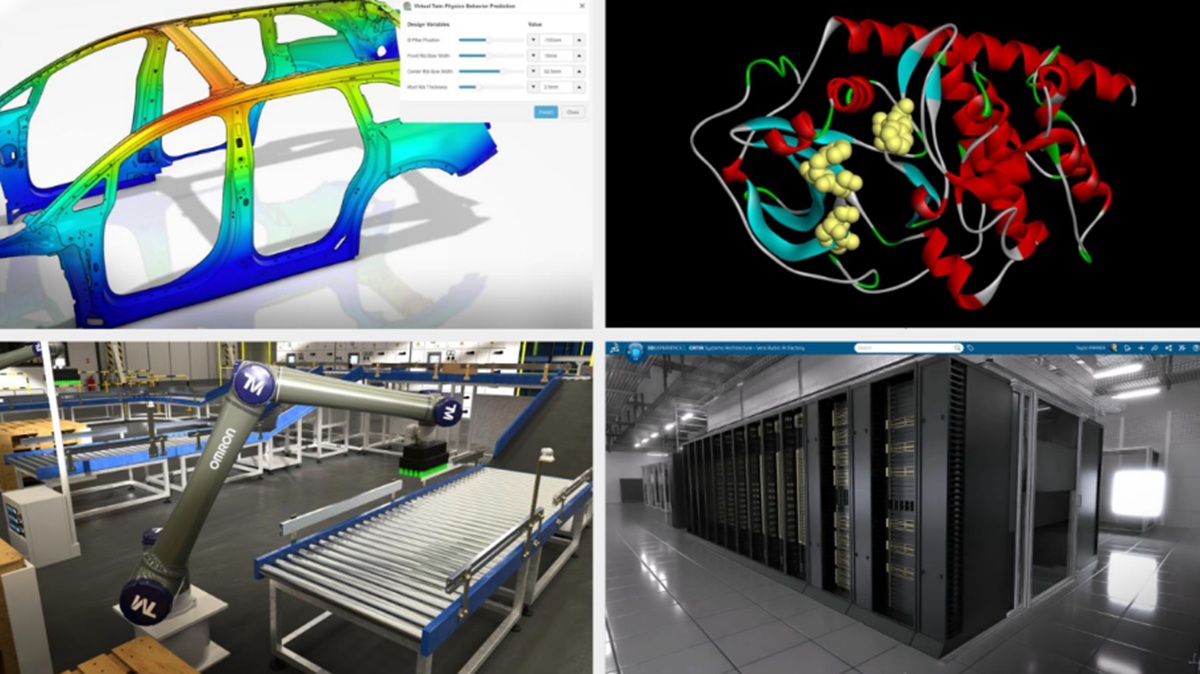
Omniverse DSX Blueprint for large-scale AI factory deployment.
“What we’ve been seeing for the past few years with the introduction of these generative AI tools for general knowledge work has been really amazing. Basically every person who has access to these AIs, which is virtually everyone in the world now, essentially has a team of assistants that can do research, that can organize information for them and process information and augment their knowledge. But largely these AIs have been restricted to things that we have in the knowledge space,” said Lebaredian. “By bringing this into the industrial space, we’re effectively going to make it so anybody who is building and designing anything for the real world can now have a team of assistants that has knowledge about how things are.”
He added, “These kinds of abilities to build virtual twins to simulate the physical world have been restricted to a very small number of people who know how to operate and use these tools. The physical AI, the industrial AI that we are building with Dassault Systemes will allow effectively, every person to be able to use all of these capabilities.”
This infrastructure will power Dassault Systèmes’ industrial Virtual Twins using Nvidia
open models and libraries, unlocking new opportunities across biology, materials science,
engineering and manufacturing:
● Advancing Biology and Materials Research: The Nvidia BioNeMo platform combined with Biovia science-validated world models will accelerate the discovery of new molecules and next-generation materials.
● AI-Driven Design and Engineering: Simulia AI-based Virtual Twin Physics Behavior leveraging Nvidia CUDA-X libraries and AI physics libraries empowers designers and engineers to accurately and instantly predict outcomes.
● Virtual Twins for Every Factory: NVIDIA Omniverse physical AI libraries integrated into the DELMIA Virtual Twin of global production systems enable autonomous, software-defined production systems.
● Virtual Companions Supercharge Dassault Systèmes’ Users: The Experience agentic platform, combining Nvidia AI technologies and Nvidia Nemotron open models with Dassault Systèmes’ Industry World Models, powers Virtual Companions to tap into deep industrial context, delivering trusted, actionable intelligence with industrial-scale efficiency.
The partnership elevates the existing collaboration between Dassault Systèmes and
Nvidia to a shared long-term vision for how industrial AI will be built, validated and
deployed at scale, through a unique combination of Dassault Systèmes’ Virtual Twin
Factories and Nvidia’s AI technologies for all industries.
Global Leaders Build the Future of Industry With Dassault Systèmes and Nvidia
“Bel Group is building a sustainable food future through responsible formulation and
packaging. Through the Nvidia-Dassault Systèmes collaboration, we gain the
computational power to model and optimize our products at scale-accelerating innovation
while delivering on our sustainability commitments,” said Cécile Béliot, CEO of Bel Group.
“To address the growing complexity of modern manufacturing, the industry must move
toward fully autonomous and digitally validated production systems,” said Motohiro Yamanishi, President of Industrial Automation at Omron, in a statement. “By combining Nvidia physical AI frameworks with Dassault Systèmes’ Virtual Twin Factory and Omron’s automation technologies, manufacturers can move from design to deployment with greater confidence and speed.”
“Lucid’s award-winning engineering and technology continues to set new standards in the automotive industry, and Dassault Systèmes remains a key partner, enabling us to stay at the forefront of vehicle and powertrain engineering,” said Vivek Attaluri, Vice President of
Vehicle Engineering at Lucid, in a statement. “Agility, speed of innovation and rapid iteration are at the core of our work flows, and our exploration of multi-physics based Digital Twin simulation models, powered by Nvidia’s open-source physics informed AI models, has the potential to help our teams move from concept to production faster than ever before, without sacrificing predictive accuracy. We look forward to continued collaboration and leveraging these new tools to support Lucid’s future innovations.”
“NIAR empowers the next generation of aircraft. From asset digitization through design
and manufacturing creation and validation, Virtual Twin technology introduces unparalleled capabilities and efficiency,” said said Shawn Ehrstein, director of emerging
technologies and CAD/CAM at the National Institute for Aviation Research at Wichita State
University, in a statement. “Dassault Systèmes’ Virtual Companions for engineering, leveraging the 3D Experience agentic platform using Nvidia Nemotron open models, accelerate the by-design compliant synthesis of aircraft Virtual Twins. Using the platform to align the Virtual Twin to the means of compliance, reduces certification efforts while preserving sovereignty of the information.”
The partnership was announced today at 3D Experience World, Dassault Systèmes’ annual event dedicated to the design and engineering communities. Daloz and Huang were on stage to discuss the future of industry powered by AI.
“We revolutionize how industrial companies design previous one, design and manufacture their products by helping them completely rethink their development and production processes,” Hu-Aubigny said. “The 20th century was a world where industry produced objects.”
Now, the industry’s knowleldge can be used to build virtual twins and the worlds that contain them. The virtual twins are digital replicas that bring in science, engineering, real-world data and more. Now the companies can combine multiple virtual twins into 3D universes with the help of AI while maintaining things like regulatory compliance.
“None of this project would have been possible without a system AI factory. This is where our partnership becomes mission critical,” said Hu-Aubigny. “Nvidia and Outscale are partnering to deploy and operate Dassault Systemes AI factories worldwide in the three continents as part of Outscale sustainable and sovereign cloud infrastructure. Leveraging always the latest Nvidia components and orchestration tasks, these AI factories will support the social system industry, role models, companions, universal universes throughout their life cycle.”