
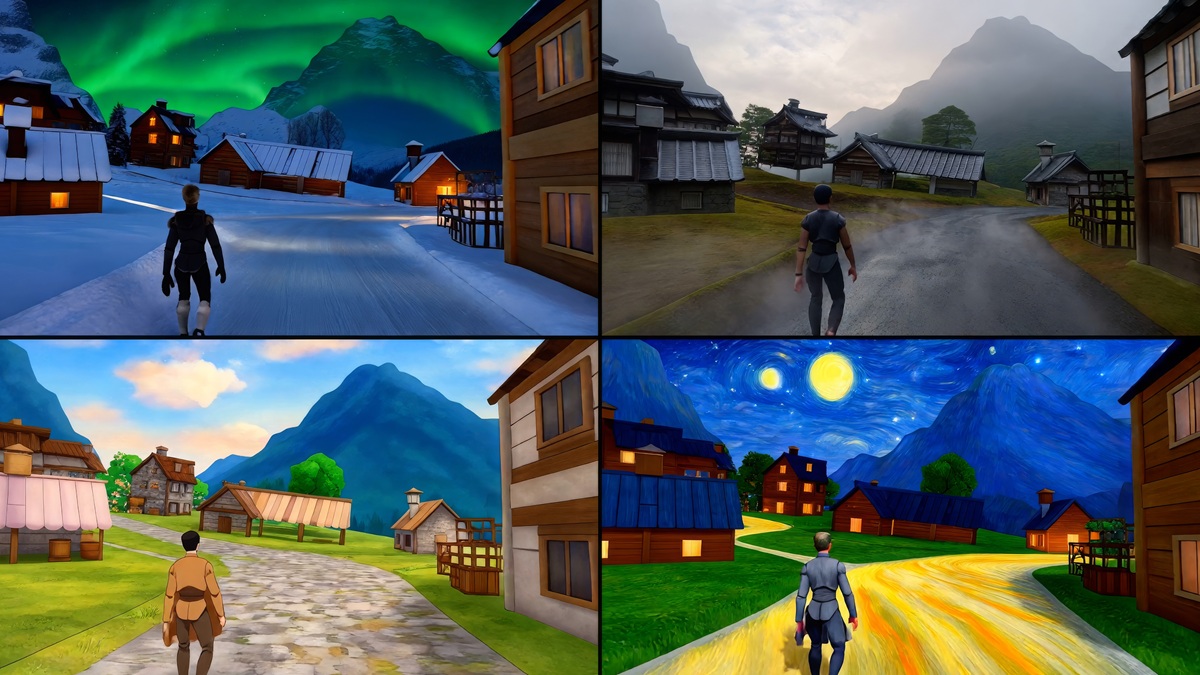
Moonlake AI, an applied research lab building models for real-time interactive content, today unveiled its Generative Game Engine (GGE).
It’s a new AI model for building interactive worlds 100 times faster than ever possible, Moonlake AI said.
The company said the technology has massive promise across video game development, AI training, virtual reality, and robotics, and will be available in Q1 2026 when Moonlake AI opens its beta. You can join the waitlist now at: https://www.moonlakeai.com.
“We’re so excited about this model because it goes beyond reskinning a game. You are able to transform a game into various different styles in real time,” said Fan Yun Sun, cofounder of Moonlake AI, in an interview with GamesBeat. “The really exciting part is that it can transform gameplay in real time.”
Lee said, “This means that, as a user-generated content (UGC) creator, I can, without knowing any 3D graphics or domain knowledge, just say, ‘Okay, I want the character interacting with NPC. [When that happens], I want the NPC to turn to a skeleton.’ These are things that historically just takes an insane amount of effort for studios to do. But by leveraging diffusion, we are able to just do that right. That’s what we’re so excited about.”
When you speak a command to the model using natural language, it can respond in real time, said Lee. If you almost die in one scenario, you could spawn to a hospital, and while you are at it you could reskin the entire area to be like a Pokemon place.
“That’s the type of gameplay we would enable,” Lee said.
Developer problem: Massive time and money to build interactive worlds

Creating rich interactive worlds is slow and expensive because every meaningful change requires specialized 3D artists, engine work, and weeks of iteration. Anyone can create worlds. But creating believable worlds is another thing altogether.
Even when teams can generate great visuals, the results often don’t stay consistent over time. Objects shift, details “reset,” and worlds can’t reliably remember what happened a few moments ago. That makes it hard to build experiences where environments react to gameplay in a controlled, persistent way.
And for most creators without deep technical skills, turning an idea into a world with rules and behavior is still out of reach. The result is a creative bottleneck: worlds are either high-quality but rigid, or dynamic but unpredictable.
“Before handheld video cameras, filmmaking was only reserved for well funded Hollywood studios,” said Sun. “The gaming world is still living a world with large technology and skill moats. This new model brings us one step closer to giving anyone the tools needed to create their own world or game.”
It could be used for conceptualizing professional games, or it could also work for amateurs who make user-generated content and publish their own games.
“We’re really just taking a stab at bridging this gap to allow all AI models to really benefit the gaming community. And no one’s really created this adapter before.”
The team has been working on the tech for the pass three months or so. But research scientists on the team have been thinking about it for years. The tech is based on the company’s own large language model.
“For the underlying tech, you can think of it as a multimodal adapter that allows video models’ understanding be instilled into games in real time,” Lee said. “It’s all of our effort from the ground up.”
The models can do something like crop a piece of an image out and replace it with something else,” Lee said.
The company generates synthetic data for the model and reconstructs 2D or 3D models. The graphics that the model generates is still not up to triple-A quality, but it could be standard for something like a YouTube video’s quality level.
“We’re want to allow the core of this model to have controllability,” Lee said. “We want you to be able to program something just the way that you envision it. You can program it to behave exactly the way you want it to be. And our model acts as the enhancer. You could say it should reskin in for Antarctica or Tokyo.”
The model is not quite done.
“We’re actually not saying in any way that this is perfect. There’s a lot of consistency things that we’re still working on. And it’s frankly just at the frontier of graphics and vision. So we’re still working very hard on it,” Lee said. “The purpose of releasing this to the world is opening it up to people’s ideas. We want them to know they won’t be bottlenecked by what they have today.”
Moonlake AI wants everyone to be able to come up with 100 creative ideas and democratize the process so everyone get through them quickly.
Moonlake’s solution: The first generative game engine

Moonlake’s Generative Game Engine is the first programmable world model for real-time interactive content, built to make world changes controllable, consistent, and persistent. Unlike video-only generation, Sonata can be conditioned on more than pixels, including 3D/structural signals, so edits hold together across frames instead of drifting or snapping back.
Creators can “author” how a world responds, like elemental damage, weather shifts, or story-driven transformations, and have those changes remain coherent as gameplay continues. Because it’s designed to work on top of existing games and interactive experiences, Sonata aims to add generative, reactive world behavior without requiring teams to rebuild their entire pipeline.
“The missing piece in generative worlds is control,” said Sharon Lee, cofounder of Moonlake AI. “Our new GGE will allow creators to specify what changes, why it changes, and how long it persists, so the world feels authored, not random.”
Moonlake AI’s Generative world engine will enter beta access in late Q1 2026.
Moonlake is hosting a game jam/ hackathon, bringing together builders, gamers, and world-crafters together for a day of interactive world creation with its first ever generative game engine.
Winning projects will be debuted on The Dome, a 100-feet immersive park rising in San Jose, an arena where players can step inside Moonlake-built interactive worlds at unprecedented scale. Sign up at: https://luma.com/46xbqgcx.
Based in San Francisco, the team consists of world-class researchers and engineers, including best paper award winners, ACM ICPC medalists, and international Olympiad medalists.
Moonlake builds multi-modal models that empower anyone to create interactive worlds without needing 3D modeling or programming expertise. The company has raised a $28 million seed round from Threshold, AIX, and Nvidia Ventures and other leading AI researchers and founders.
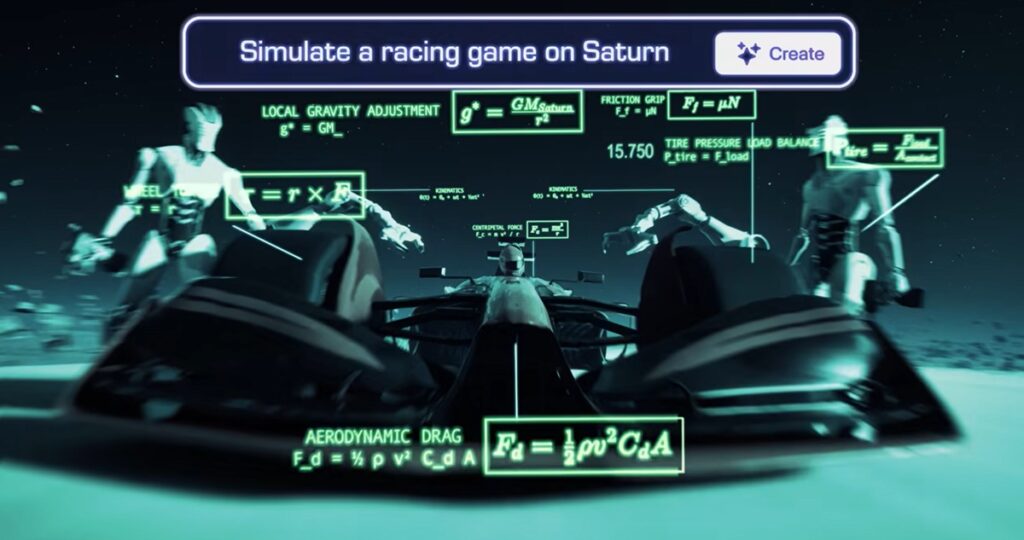
I noted there is some pushback from gamers and developers about using AI in games and impacting whether there will be harm to game jobs. On the flip side, Lee believes that players want to be able to own what they creative.
“We want to make sure that our users will always have ownership of whatever they build, and they also have ownership of the arts and the style, and that’s something that we won’t take away creative control from,” Lee said.
She said many gamers fear AI will create “slop” for them and result in lower quality with random items spread throughout a game scene, where the items don’t make any sense.
“We want the items in this case to be very intentional,” she said.
Lee and Sun hope that their tech can enable games that have not been created before.
“We want to basically take care of all the annoying stuff that the creators don’t want to do. And that’s why we have hackathons and a ton of user interviews to really understand what is what part they don’t want to do,” Lee said. “I think within gaming, each skill is so unique, like a programmer would never want to create images in 3D and then artists would not want to ever code”