
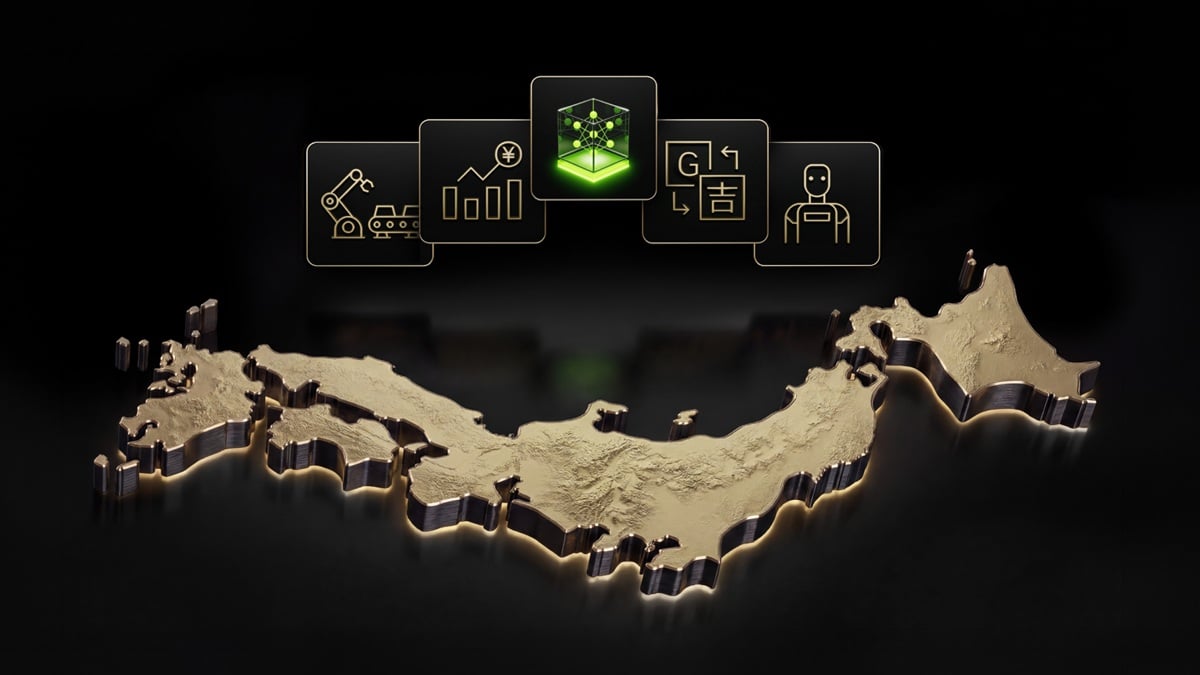
Nvidia said that Japan’s enterprises and startups are building specialized AI with Nvidia Nemotron open models.
The chip maker said the Institution of Science Tokyo, SB Intuitions and Stockmark are adopting Nvidia Nemotron to build locally developed AI models designed to serve Japanese users, businesses and institutions amid the country’s demographic and workforce transition.
Other companies focused on Nemotron include Avatarin, ENEOS Holdings, Hitachi and NTT Data, with a focus on everything from remote-presence robotics to enterprise agents and specialized medical and contact centers. In doing so, they’re accelerating the development of AI tailored to Japan’s language, industries and workforce.
“Agentic AI and Nemotron has been broadly adopted in the industry in the last few months,” said Deepu Talla, vice president of robotics and edge AI at Nvidia, in a press briefing. “Now, in Japan, we have success stories where some of the leading Japanese enterprises have adopted Nemotron. NTT Data, for example, is using Nemotron on open Japanese datasets for its Suzumi 2 model, and it’s improving accuracy on Japanese language legal Q&A by over 60%.”
Open models are the foundation of national AI ecosystems, giving organizations the ability
to customize, deploy and govern AI they control.
In Japan, these capabilities are increasingly important as the country addresses an aging
population and workforce transition, driving demand for AI tailored to local industries that
helps strengthen the workforce, sustain productivity and accelerate innovation.
“Every nation and every company should own and control its intelligence infrastructure. Open models make that possible,” said Jensen Huang, CEO of Nvidia, in a statement. “They give countries, enterprises and researchers the freedom to inspect, improve, adapt, secure and deploy AI for their own needs. Together with Japan’s AI leaders, we are advancing an open AI ecosystem that accelerates discovery, strengthens national capability and ensures every society can participate in — and benefit from — the AI revolution.”
Building specialized AI for Japan with Nvidia Nemotron
Across Japan, developers are building specialized AI with NVIDIA Nemotron open models
and datasets, tailoring them to the country’s industries and public-sector needs.
Institute of Science Tokyo developed its Swallow family of open foundation models using
Nvidia Nemotron datasets and the Nvidia NeMo software stack for continual pretraining and post-training. Swallow models enhance Japanese language and reasoning performance while preserving the underlying models’ core English, math and coding capabilities. Enterprises are customizing and deploying Swallow for specialized use cases, including financial-document translation and asset-management report generation.
SB Intuitions, SoftBank’s subsidiary focused on generative AI research and development and services, developed its Sarashina family of homegrown generative AI models using Nvidia Nemotron, including datasets and Megatron-LM libraries. Sarashina3 mini has been selected by Japan’s Digital Agency for use in specialized AI use cases. SoftBank has also developed and deployed a large telco model, using Nvidia Nemotron, to enable autonomous telecom network operations.
Stockmark’s specialized Japanese-language document-understanding model, released today, is based on the Nvidia Nemotron 3 Nano Omni model. The company is also developing enterprise knowledge applications using Nvidia NeMo Retriever and the Nemotron-Persona-Japan dataset, serving customers across Japan’s manufacturing, energy and chemical industries through Japan’s Generative AI Accelerator Challenge national project.
Transforming Japan’s industries
Japanese enterprises are using Nvidia Nemotron to modernize essential services, improve
productivity and support the country’s workforce.
AI and robotics startup avatarin is using Nvidia Nemotron open models and Nvidia NeMo to develop Japanese-language speech and reasoning capabilities for enterprise AI agents. Nvidia HGX B300 systems provide the private AI infrastructure that enables those agents to securely analyze customer conversations and access enterprise knowledge for more accurate responses, while Nvidia Jetson powers edge AI capabilities, including digital avatar systems being deployed at airports and other locations across Japan.
ENEOS Holdings is using Nvidia Nemotron open models with the Nvidia AI-Q Blueprint and Nvidia Alchemi NIM microservices to advance agentic AI workflows for energy and materials R&D. Researchers are using these technologies to integrate technical document search, vision and language understanding, and simulation-backed molecular screening, helping accelerate materials exploration for applications such as immersion-cooling fluids and advanced catalysts.
NTT Data, an operating subsidiary of NTT, used Nvidia Nemotron-Personas-Japan to augment training data for its proprietary tsuzumi 2 model, improving question-answering accuracy and enhancing responses to questions requiring additional knowledge. The company is also looking to deploy a scalable multi-agent framework harnessing Nvidia Agent Toolkit, including NVIDIA Nemotron, to route tasks to the best models and drive accurate, efficient and autonomous enterprise workflows.
Hitachi is developing physical AI technologies to address real-world operational challenges by using Nvidia Nemotron and Nvidia Cosmos open models, along with its proprietary information technology (IT) and operational technology (OT) domain knowledge. As part of a multi-agent orchestration platform, these technologies are designed to connect and coordinate IT and OT operations, helping transform enterprise-scale business processes across complex workflows.
Sakana AI is collaborating with Nvidia to integrate Nvidia Nemotron into its Fugu model-
orchestration platform, expanding the range of AI models Fugu can intelligently orchestrate to dynamically select the best model for each task in agentic AI workflows. By routing each request to the model best suited for the job, Fugu helps developers balance accuracy, performance and cost across multiple open and proprietary AI models.
Fugu demonstrates how thoughtful orchestration can unlock capabilities beyond what an
individual model achieves on its own. Early performance results on complex, real-world coding tasks reinforce the promise of coordination as a path to more capable AI.
Open and customizable, deployable anywhere
Nemotron models are released with open weights, datasets and recipes, giving organizations the transparency and control to customize models for domain-specific workflows and deploy them where their applications and data reside.
Developers can use Nvidia NeMo to customize, evaluate and optimize models for their use
cases, and deploy them in environments that meet regulatory, sovereignty and data localization requirements.
From its partnership with Sega 30 years ago to the partnership with Toyota today, Nvidia is helping Japan enter the AI age, Talla said.
Talla said that all the top supercomputers in Japan have been built on Nvidia, and the company has been working with Japanese researchers for a long time.
Talla said that over 340,000 developers are on the Nvidia ecosystem in Japan, and there are more than 16,000 students focused on the Nvidia ecosystem. There are more than 20 AI model builders in Japan, 13 cloud partners, and 460 startups in the Nvidia AI-focused Inception program.
“You can see the number of startups and cloud partners,” Talla said. “The whole Japan ecosystem is incredibly, you know, tightly working with Nvidia, and we are extremely, you know, happy and proud of that. So we are building open models, and we are enabling every region, every enterprise, every you know, every company realizes this vision. So Nvidia is helping organizations build fully customizable and controllable AI that they can deploy anywhere.”