
Richard Garfield doesn’t want people to play his new game optimally.
In 2023, Garfield — the game designer best known for creating Magic: The Gathering — founded the game studio Popularium alongside game industry veterans Skaff Elias, Arka Ray and Jon Bankard. The following year, the company launched its first title, Chaos Agents, in a public alpha phase. And at this year’s GDC Festival of Gaming earlier this month, Popularium held the first-ever ChaosCon, a showcase and LAN event intended to mark the end of the alpha phase and the beginning of Chaos Agents’ public debut.
GamesBeat attended ChaosCon at GDC 2026, and spoke to the Popularium co-founders — including Garfield and Elias, who joined the event via video call from their homes in Seattle — to learn how the game has evolved since we covered the launch of Popularium in depth three years ago.
The post-alpha version of Chaos Agents showcased at GDC demonstrated the core philosophy behind the upcoming game — Garfield’s belief that optimized play patterns make for less-fun gameplay. The game is an “auto-battler royale” in which players control a single champion, or “agent,” giving them directions and leveling up their skills and abilities as they face off against other players’ agents in a virtual environment. To ensure a variety of play patterns, Chaos Agents features three vastly different win conditions and plenty of unexpected skill combinations to keep the metagame wide open.
“It’s delightful when you get a system where there’s all sorts of combos floating around, and if you have a lot of hooks in there for different behaviors, then there’s a lot of different, emergent properties that come about,” Garfield said in an interview with GamesBeat. “So, during playtests, we certainly notice when things lead to persistently unfun situations — like if everybody’s getting too much armor, or everybody’s just running away — and we can adjust the situation to those sorts of things pretty easily.”
The open-ended play pattern philosophy behind Chaos Agents was heavily inspired by Garfield’s trading card game KeyForge, which was critically well-received upon its launch in November 2018 but struggled to gain traction amid the COVID-19 pandemic in 2020.
“He was like, ‘hey, I still think there’s something interesting here in the digital space — is there a way to marry that with some of the auto-battler goodness?’” Bankard said in an interview with GamesBeat. “So we sat down and talked about it, and we were like, ‘we think we can take auto-battlers and refocus them a little bit around singular characters, more so than a big, messy army.”
KeyForge associations notwithstanding, Garfield made it clear that Chaos Agents is an entirely new venture, gleaning much of its philosophy — but no direct DNA — from its card game precursor.
“I personally like playing weak Magic decks, but I don’t like playing poorly — I like taking those decks and seeing what I can do with them,” Garfield said. “If there’s a place for weak magic decks to be played competitively, that could be very exciting, and that’s what I’m looking for here. That’s one of the aspects taken from KeyForge, which is less of a mechanic than just understanding how these things work.”
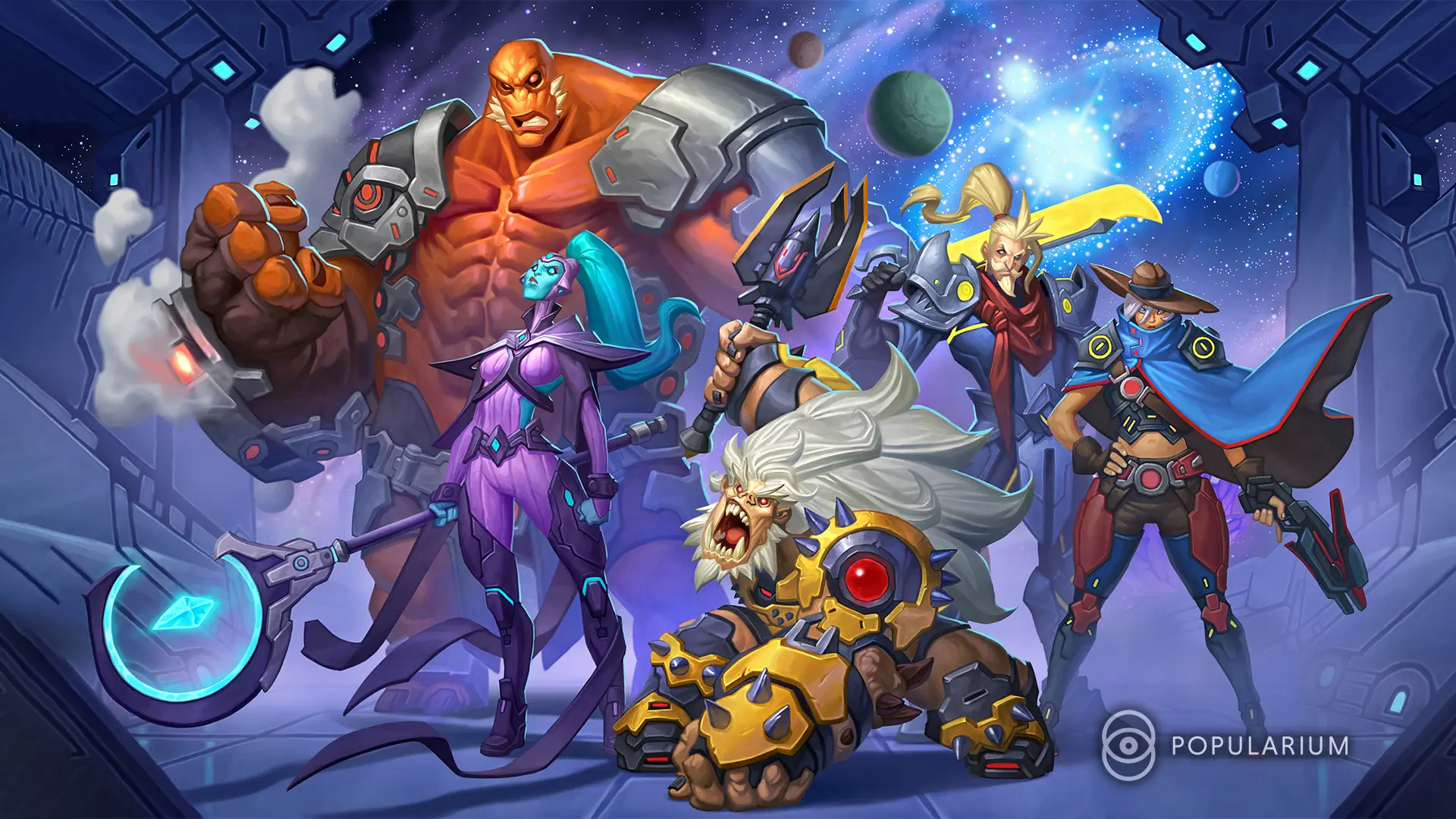
Although Chaos Agents is slated for a public launch later this year, the game still has many changes and updates to come, according to its developers. There are currently four playable character races in the game, but its developers at Popularium are also working on a fifth race that will become available at some point down the line. They also plan to evolve characters’ skill trees into a more detailed hexagonal map, further widening the skill combinations intended to enable emergent gameplay.
“The agents are just really different from each other, and there’s constantly new ones. The skills that you probably saw in the demo just now — the idea is to expand them, so there’s going to be 200 more skills, and they’re going to get wackier and wackier,” Elias said in an interview with GamesBeat. “So, you’re not going to be able to sit down and know what to do, or how to play. It’s going to vary a lot.”