
India’s ministers for electronics and IT have drafted rules for regulation of online gaming and esports.
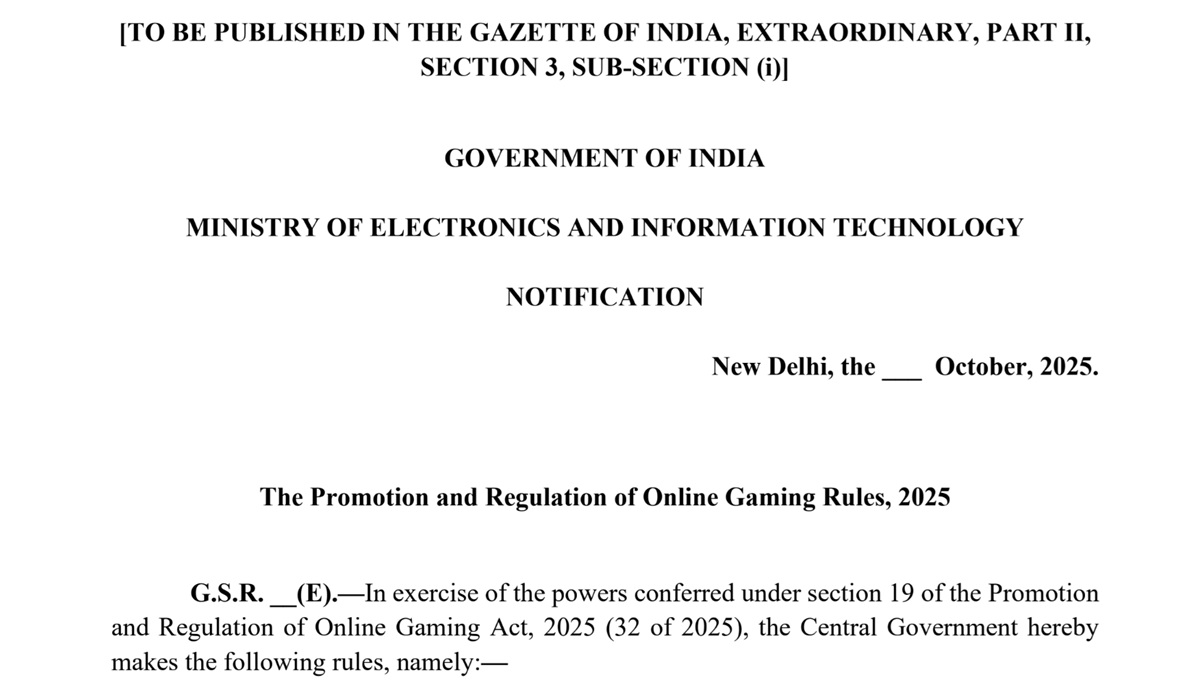
As per a recent development, the Ministry of Electronics and Information Technology (MeitY) has prepared a draft for the Promotion and Regulation of Online Gaming Rules, 2025.
The Ministry of Electronics and Information Technology (MeitY) is also inviting feedback on the draft from stakeholders. This is how the Indian government will distinguish between a game and what constitutes illegal gambling.
India recently banned all real-money online games—including fantasy sports, poker, and rummy—under the 2025 Online Gaming Bill, while promoting esports and social gaming as legal and encouraged activities. That hurt the prospects for companies in India that were valued at billions of dollars.
Key Highlights
- The provisions relating to recognition and promotion of esport, shall be administered by the Central Government through the Ministry of Youth Affairs and Sports.
- The draft establishes the Online Gaming Authority of India to oversee the determination of whether an online game is an online money game or otherwise, recognition and registration of esports and online social games, compliance, grievance redressal, and enforcement.
- The Authority will be composed of a chairperson and five other ex officio members from various government ministries and is empowered to determine if a game is an “online money game.” It will also register games, issue directions, and impose penalties.
- Registration for both esports and social games will be managed by the Online Gaming Authority of India.
- For an esport title to be registered, it must first be recognized under the National Sports Governance Act, 2025.
- The Authority will maintain and publish a National Online Social Games and E-sports Registry containing such details of all registered online social games and e-sports as deemed necessary by the Authority and a list of online games determined as online money games by the Authority.
- Any online game service provider intending to provide an esport, shall make an application to the Authority.
- Upon registering an online game as an esport, the Authority shall issue a certificate of registration to the online game service provider with a unique registration number. The Certificate of Registration shall be valid and subsisting for a period of up to five years as chosen by the online game service provider at the time of making an application.
- If the registration of an esport is cancelled under the rules, the online game service provider of the esport or online social game shall not be eligible to avail of the support or incentives for promotion and development of e-sport or online social game.
- Every online game service provider offering a registered esport, shall establish and maintain a functional grievance redressal mechanism for redressal of grievances from any user in relation to the online social games or esport offered by it.
Given this draft language, a couple of executives have comment on the proposal.
Akshat Rathee, cofounder and managing director at Nodwin Gaming, said in a statement,”By bringing esports firmly under the Ministry of Youth Affairs & Sports, the government has recognised esports as a legitimate sport while creating a framework for structured growth.”
Rathee added, “This should accelerate grassroots programs, open the door for state and district-level championships, and ensure players see a clear career pathway much like traditional sports. It also boosts investor and sponsor confidence, which is critical to scaling prize pools, infrastructure, and IP development.”
At the same time, the composition, impartiality, and industry knowledge of the proposed Online Gaming Authority of India (OGAI) will be of utmost importance. Rathee said he expects that the right stakeholders, those who have worked on this industry since its inception and deeply understand the ecosystem, will be included to guide it forward.
Esports is one of the most aspirational industries for India’s youth, and this step ensures that companies like Nodwin Gaming can continue to build a sustainable, world-class ecosystem that competes globally while remaining rooted in India’s sporting fabric, Rathee said.
Animesh Agarwal, cofounder and CEO of S8UL, said in a statement, “This is a landmark moment for India’s gaming and esports industry. Official recognition and a clear distinction provide much-needed legitimacy and clarity to players, creators, organizations, investors and other stakeholders.”
He siad this distinction is important as it opens the door to greater societal and parental acceptance, encouraging new talent to pursue esports with the same dignity as cricket, football or badminton.
“It also reassures brands and investors that they are entering a structured, regulated ecosystem. This clarity is set to attract more brands and partners, unlocking larger sponsorships, creator collaborations, and grassroots programs. Esports in India is no longer just a trend. It’s a legitimate career path, and S8UL is leading the way,” Agarwal said.
And Vishal Parekh, COO of CyberPowerPC India, said in a statement, “The government’s focus on gaming and esports is an encouraging signal that India sees the sector’s cultural and economic potential. Many games today sit in a grey area between skill-based competition and social entertainment, which can make regulatory jurisdiction complex.”
He added, “In this context, the Online Gaming Authority of India (OGAI) will play a key role in providing clarity, aligning ministries, and ensuring a transparent and predictable registration process, so developers can innovate with confidence.”
And Parekh said, “Beyond registration, building a robust ecosystem, including dedicated infrastructure, training academies, recognition of players as athletes, and supportive policies, will unlock significant opportunities across jobs, startups, content creation, broadcasting, and global tournaments. With the right balance of creativity, compliance, and economic vision, India can emerge as a global hub for competitive gaming and innovation.”