
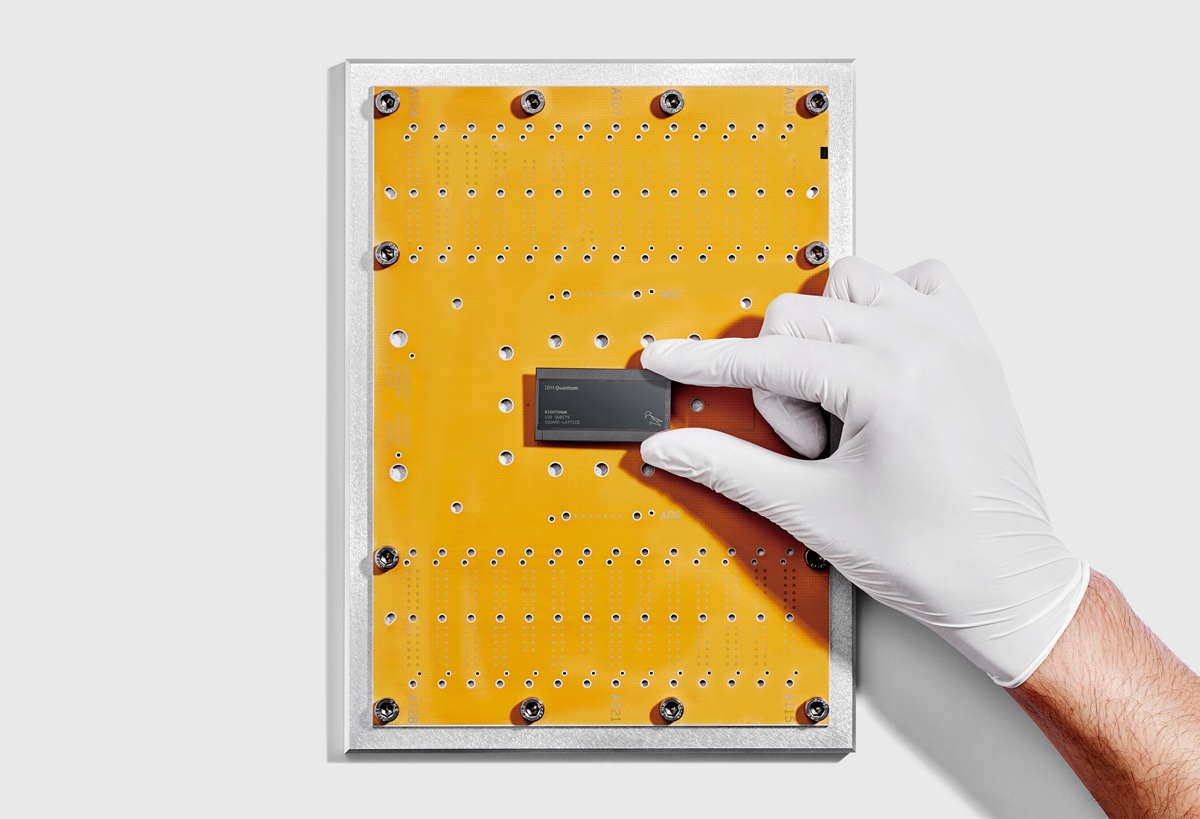
IBM unveiled its new IBM Quantum Nighthawk processor as well as fundamental progress on its path to delivering both quantum advantage by the end of 2026 and fault-tolerant quantum computing by 2029.
At the annual Quantum Developer Conference, IBM unveiled IBM Quantum Nighthawk, its most advanced quantum processor yet and designed with an architecture to complement high-performing quantum software to deliver quantum advantage next year: the point at which a quantum computer can solve a problem better than all classical-only methods.
“There are many pillars to bringing truly useful quantum computing to the world,” said Jay Gambetta, director of IBM Research and IBM Fellow, in a statement. “IBM is the only company that is positioned to rapidly invent and scale quantum software, hardware, fabrication, and error correction to unlock transformative applications. We are thrilled to announce many of these milestones today.”
IBM Quantum Nighthawk is expected to be delivered to IBM users by the end of 2025, and will offer 120 qubits linked together with 218 next-generation tunable couplers, to their four nearest neighbors in a square lattice, an increase of over 20% more couplers compared to IBM Quantum Heron.
This increased qubit connectivity will allow users to accurately execute circuits with 30% more complexity than on IBM’s previous processor while maintaining low error
rates.
This architecture will enable users to explore more computationally demanding problems
that require up to 5,000 two-qubit gates, the fundamental entangling operations critical
for quantum computation. Such a problem could be finding the ground state energy of a
molecule to learn key discoveries about its inner workings.
IBM expects future iterations of IBM Quantum Nighthawk to deliver up to 7,500 gates by the end of 2026 and then up to 10,000 gates in 2027. By 2028, Nighthawk-based systems could support up to 15,000 two-qubit gates enabled by 1,000 or more connected qubits extended through long-range couplers first demonstrated on IBM experimental processors last year.
IBM has stated the first cases of verified quantum advantage will be confirmed by the wider community by the end of 2026. To encourage their rigorous validation and push forward the best quantum and classical approaches, IBM, Algorithmiq, and Blue Qubit are contributing new results to an open, community-led quantum advantage tracker to systematically monitor and verify emerging demonstrations of advantage.

Today, the community tracker supports three experiments for quantum advantage across
observable estimation, variational problems, and problems with efficient classical verification.
Over the next year, IBM encourages the community to contribute to the tracker and push a back-and-forth with the best classical methods.
To pursue verified quantum advantage on breakthrough quantum hardware, developers need to be able to highly control their circuits and use high-performance classical computers (HPC) to mitigate the errors that arise in computation.
IBM is giving developers more control than ever before by scaling dynamic circuit capabilities that deliver a 24% increase in accuracy at the scale of 100+ qubits. IBM is also extending Qiskit with a new execution model that enables fine grain control and a C-API, unlocking HPCaccelerated error mitigation capabilities that decreases cost of extracting accurate results by more than 100 times.
As quantum computers mature, the global quantum community is expanding to HPC and
scientific communities. IBM is delivering a C++ interface to Qiskit, powered by a C-API, to
enable users to program quantum natively in existing HPC environments. IBM continues to lead the way in advanced circuit execution capabilities including dynamic circuits and increasing control over circuit execution for error mitigation.
By 2027, IBM plans to extend Qiskit with computational libraries in areas such as machine
learning and optimization to better solve fundamental physical and chemistry challenges such as differential equations and Hamiltonian simulations.
IBM makes progress toward fault-tolerant quantum computing

In a parallel path, IBM is rapidly delivering milestones towards building the world’s first largescale, fault-tolerant quantum computer by 2029.
The company is announcing IBM Quantum Loon, its experimental processor that, for the first time, shows that IBM has demonstrated all the key processor components needed for faulttolerant quantum computing. Loon validates a new architecture to implement and scale the components needed for practical, high-efficiency quantum error correction.
IBM has already demonstrated the breakthrough features incorporated into Loon, including the introduction of multiple high-quality, low-loss routing layers to provide pathways for longer, on-chip connections (or “c-couplers”) that go beyond nearest-neighbor couplers and physically link distant qubits together on the same chip; as well as technologies to reset qubits between computations.
Delivering on another key pillar of fault-tolerant quantum computing, IBM has proven it is
possible to use classical computing hardware to accurately decode errors in real-time (less than 480 nanoseconds) using qLDPC codes. This engineering feat has been achieved a full year ahead of schedule.
Together with Loon, this demonstrates the cornerstones needed to scale the qLDPC codes on high-speed, high-fidelity superconducting qubits which form the core of IBM quantum computers.
IBM Scales Fabrication to 300mm Facilities to Accelerate Quantum Wafer Development
As IBM scales its quantum computers, it is announcing the primary fabrication of its quantum processor wafers is being undertaken at the Albany NanoTech Complex advanced 300mm wafer fabrication facility in New York.
State-of-the-art semiconductor tooling and always-on capabilities within this facility have already accelerated the speed at which IBM can learn from, improve, and expand the capabilities of its quantum processors; allowing the company to increase their qubit connectivity, density, and performance.
To-date, IBM has been able to double the speed of its research and development efforts by cutting the time needed to build each new processor by at least half; achieve a ten-fold increase in the complexity of its quantum chips; and, enable multiple designs to be researched and explored in parallel.
IBM is further expanding its quantum processor pipeline, which will increase the speed at which the 300mm quantum wafers fabricated in Albany can be transformed into the quantum processors that can be eventually tested and deployed into systems. This lab will bolster IBM’s capacity to rapidly turn wafers into chips and speed up the final stages of processing, assembling, and testing.