
Dungeons & Dragons has existed for fifty years, but few eras have been as transformative as the one Wizards of the Coast is navigating right now.
The tabletop RPG is more visible, more culturally mainstream, and more commercially successful than at any point in its history, and that’s thanks in part to an explosion of actual-play shows, blockbuster games like Baldur’s Gate 3, and a generation of new players discovering the hobby through pop-culture touchpoints like Stranger Things.
For designers at Wizards of the Coast, that rising tide hasn’t just expanded the audience; it has fundamentally reshaped how people learn and engage with D&D in the first place.
Players who watch a streaming campaign or dive into a CRPG adaptation often end up running their own games, inventing their own characters, or exploring decades-old lore. This accessibility, and the feedback loop it creates, is one of D&D’s greatest strengths.
When a player encounters a character in Baldur’s Gate 3 or sees dice rolls dramatized on a livestream, the gap between spectator and participant gets smaller, and Wizards of the Coast tries to meet that energy by ensuring the tabletop ruleset remains easy to understand, easy to DM, and rewarding to customize.
Dungeons & Dragons is in a unique position in that the end goal of the funnel isn’t necessarily to get someone to sit down and play the tabletop version of the game. If someone falls in love with the novels, movies, TV shows, video games, or podcasts, they’re still D&D fans, and that’s special.
In an interview with GamesBeat, managing game designer at Wizards of the Coast, Justice Arman, and D&D Studio senior designer, Amanda Hamon, broke down what it’s like in the current climate for the classic roleplaying setting and how they plan to keep it relevant.
Here is an edited transcript of the interview:
GamesBeat: What do you think are some of the driving forces behind the rise in popularity for D&D as a setting, but also as a tabletop game?
Justice Arman: Our game has always been at its best when we walk in lockstep with our players. And the bigger that D&D gets, the more players that we have, and the more feedback we can get from them about the game. D&D is an interesting medium because, for us on the game design team, there is a smaller barrier between somebody who engages with the game as a fan and what we do in game design. People don’t play a video game or watch a movie and then think, “I know now, I can make a movie.” But we kind of know how we feel about the stories we tell in our games, about the design, the features, the classes, all those sorts of things.
Fifth edition is probably, I would say, the most accessible edition we’ve had. Its rules are very flexible and lean on rulings over rules and interpretation. And then, of course, you have media like Stranger Things helping to widen that fan base for D&D. Then, of course, Baldur’s Gate 3. How many awards did it win? And how many people are coming into this hobby because of that game, and now playing our game for the first time? Now we’re seeing these really cool characters and people wanting to make their own mark on the realms. It’s really exciting.
Amanda Hamon: I agree, I think that D&D stories have a lot of really fun ways that they’ve captured fans’ imaginations across all kinds of media, including Baldur’s Gate, including Stranger Things, and just being in the zeitgeist of pop culture. And the further that fans delve down, I think the more they find that there is a history there. There are characters that have been around for 50 years, in some cases, and they start looking into the game and realizing that the game encourages them to make it their own.
And so I think it’s very exciting to engage with something that becomes so beloved to you as a property, and then realize that you can run your own games with some of these very famous characters. It’s true of myself as well. I got into D&D and the Forgotten Realms through the novels in the late 90s, early 2000s, and then when I realized there were box sets to play games with the Companions of the Hall, I lost my tiny mind. It was so much fun.
GamesBeat: Between the games, movies, shows, novels, tabletop settings, and so on, D&D is such a diverse and varied property. How do you wrangle all of that? How do you keep it cohesive, but also allow for so much flexibility in the storytelling across all the mediums?
Arman: Something our team is reflective on is that no story is the result of just one character. It’s always a party of characters, coming together to tell these stories. The same is true of our teams. As players come together, so do we. We have the game design team, we have a franchise team. We have folks like in PR and tabletop is just one part of it, and in many ways, we do think of it as the heart and soul of our players.
As we look at different expressions, we have so many partners, both internally and outside the studio. We think, especially with where D&D is today and how big it is, we’re asking ourselves, “What is a D&D fan?” And all of them are valid answers. You saw the movie [Dungeons & Dragons: Honor Among Thieves], and I love that movie too. My niece watched that movie around 70 times. Has she ever played D&D, the game? No, not yet. I’m gonna run a game for her, probably this holiday season, but just all these different ways to meet fans where they are and lean into the strengths of all these different departments and teams who work on not just the tabletop game, but the brand D&D.
Hamon: D&D has so so much breadth and so much depth. There are so many different things in the actual stories and in the settings. We have multiple official settings. Most of those settings have 30+ years of history. Greyhawk has 50, of course, because that was Gary Gygax’s original setting. And so there really are so many different types of stories that have the potential to excite people and get people to engage and become part of the community, that I think leaning into that is the way for people to feel as if they have that commonality and that connection that they all love something about.
GamesBeat: We’ve talked about Baldur’s Gate 3 quite a bit already. What are your favorite characters? For me, it’s got to be God’s favorite princess, Shadowheart.
Hamon: Oh, yep, I’m gonna say Shadowheart as well!
Arman: I like Lae’zel. I have always thought the githyanki just have such a cool story. I think that the warrior culture is really neat. We were just watching the latest Predator movie, and there are some cool parallels between how the githyanki society operates, and how the predators do, and she’s just cool, and a little mean, this kind of comparatively alien fighter is just an awesome party member.
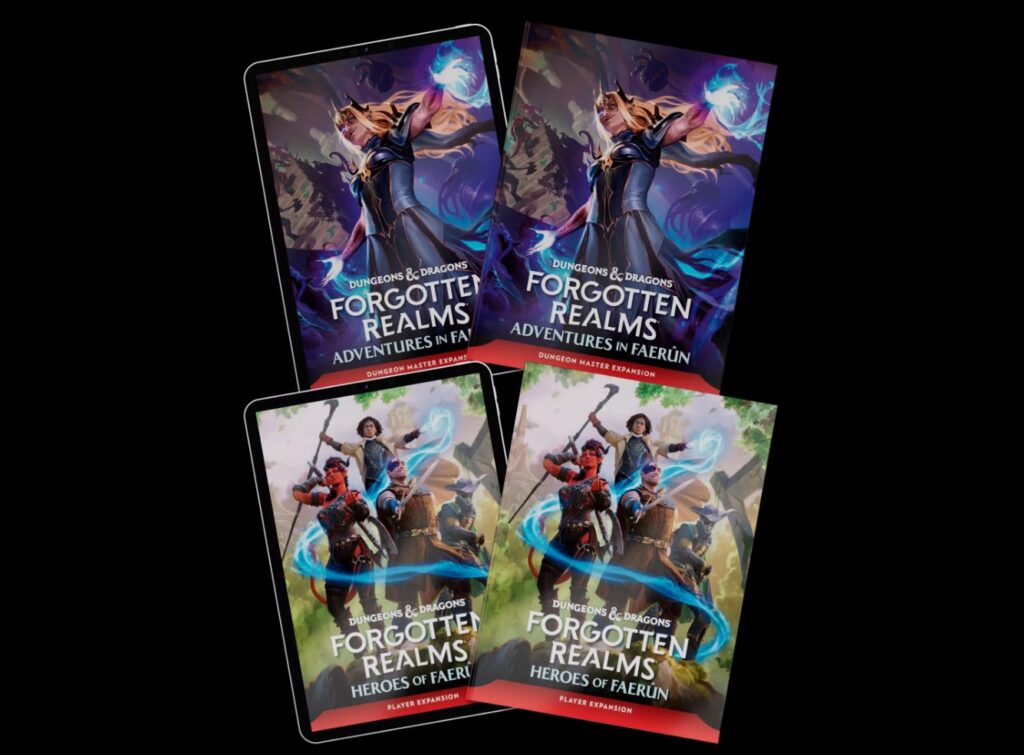
GamesBeat: Let’s shift gears to the new book releases for The Forgotten Realms. We’ve got Heroes of Faerun, primarily for players, and Adventures of Faerun, primarily for Dungeon Masters. Why was it split into two books?
Arman: There were a lot of considerations behind it. We really wanted to give both DMs and players something to really chew on. We visited the Forgotten Realms across different products, and we’ve had several adventures that take place in different areas of the Realms. We have Waterdeep Dragon Heist, Storm King’s Thunder, which goes all over the Sword Coast and beyond. And then we had the Sword Coast Adventures Guide.
We’ve heard from fans that they wanted a little bit more. They wanted to see what other unexplored corners of the Realms there were. So we had this task to give enough meat for both of those types of people, the players and the DMs. This was a cool opportunity to not only expand on the Realms, but also to give a book that players really felt like was for them and focused on their heroes and telling stories of the Realms and leaning into that high fantasy, while also not feeling like they needed to share it.
GamesBeat: I think it’s a good choice, because I think, to your point, there have been a lot of campaigns that have taken place in specific locations around this region, but people can look at the map and zoom out, and realize that there’s so much more there.
Arman: There are memes about how the Sword Coast is the Remembered Realms, and then everything else is the Forgotten [laughs]. The Forgotten Realms was that one setting that had been present but didn’t really get explored on its own, like we had setting books on Eberron, we did Spelljammer, we did Planescape, but the Forgotten Realms never really got that dedicated kind of breathing room the way the others did. And so two books felt really appropriate. And I want to say, like, in terms of content, I think this is the biggest setting we have done in Fifth Edition. It’s over 400 pages, with the two books and all of these awesome digital expansions as well.
GamesBeat: What kind of impact have podcasts and actual play series like Critical Role, or pop culture touchstones like Stranger Things, had on the brand?
Arman: Especially over the pandemic, there was such a surge in all of these different people broadcasting their games. I think the biggest distinction is how people learn D&D. I hear from some people who started with First Edition, and how they learned from playing in a game with somebody, or a relative, or at a game store, and that was it. And nowadays, you know, you can go onto YouTube or Twitch or your favorite podcast, and you can search Dungeons and Dragons and find dozens of really awesome, well-produced, interesting stories that not only are a joy of entertainment on their own, but also to learn the game and get familiar with it.
We’ve done play testing and consumer insight stuff for some of our starter products, and the number of people who have seen an episode of Critical Role but never played and want to play, or played Baldur’s Gate 3 and recognize the dice and then say, “Oh! This D20 is a physical thing! That’s what that spinning thing on the screen means!”
Hamon: I think part of our job when it comes to the large segment of the audience that’s coming from watching actual plays like Critical Role and other popular shows, is really to inspire imagination in the folks who watch those and love them because of the storytelling aspects and because of the way that the gameplay flows. I think our job is to really provide those kinds of details and flesh out those places that they know exist from a mention in the game, but they might not know that much about.
I think our job is to sort of be that library to fill in the information and inspire them for ways that they might want to do that themselves. One of the things that I really love to hear is folks saying, “I’ve seen every single episode of Critical Role, but I didn’t really know how to start.” And this is what made them take that step. And I think that is a very fulfilling and important role that we have to play when it comes to that segment of the audience.
Arman: It’s cool seeing how D&D creates storytellers. It’s very unique to this medium, of planning something out, seeing it in real time, you have an audience in the form of your table, and you’re trying to make sure everybody there has a good time.
GamesBeat: I would love to know about the philosophy of allowing fans and players to create their own ownership, rather than being restrictive about how they interact or how they use the content.
Hamon: I think there’s a good adage that gets repeated around a lot at the office that I believe in very strongly, which is that: “There is no wrong, bad, fun.” There’s no D&D police that comes to your house and tells you that you are running an adventure incorrectly, or that you’ve used a rule wrong. The game fundamentally belongs to the fans, and we, while, of course, have very, very high standards for what we publish and how we balance our rules mechanically, at the end of the day, it’s what works best for your table and for your players.
We don’t want to get into the business of trying to legislate the way that people run their games or what they do, but we want to provide them with very high-quality content and the guidance that they need to have those experiences and make them their own.
Arman: There’s an interesting divide between like true canon and what happens at your table…One of the most magical things about D&D is the shared experience. Take adventures like Curse of Strahd. Every table that plays Curse of Strahd has a slightly different experience. Some of them don’t defeat Strahd at all. Some of them do. Some of them have a player romance with Strahd, and others have Strahd as a tyrant. Like there’s a DM skill supplement, where it’s basically like Weekend at Bernie’s with Strahd. And everybody has their own Strahd story.
We set the stage, but it’s all of the groups who are the actors and the directors and the set designers. They build on it, and it’s them who get to call the curtain at the end, and so it’s just interesting, letting people make their mark on it. Like Amanda said, there’s no D&D police. Once we finish a product and close it, it is now in the hands of the players and the DM, and it is their story to tell.