
As games industry CEOs go, Maya Rogers‘ story is unique. Not only did she grow up with the intellectual property that she now stewards, but she’s also in charge of one of the biggest legacy brands in the history of the medium. Given her experiences, she’s been high on my list for a BOSS Mode interview since I started this project, and I got the chance to speak with her recently.
For those who don’t already know, Maya Rogers is the daughter of Henk and Akemi Rogers. Her father founded The Tetris Company and secured the rights to bring the titular block-dropping phenomenon created by Alexey Pajitnov. It’s one of the game’s industry’s most interesting stories, given the political implications of the time period.
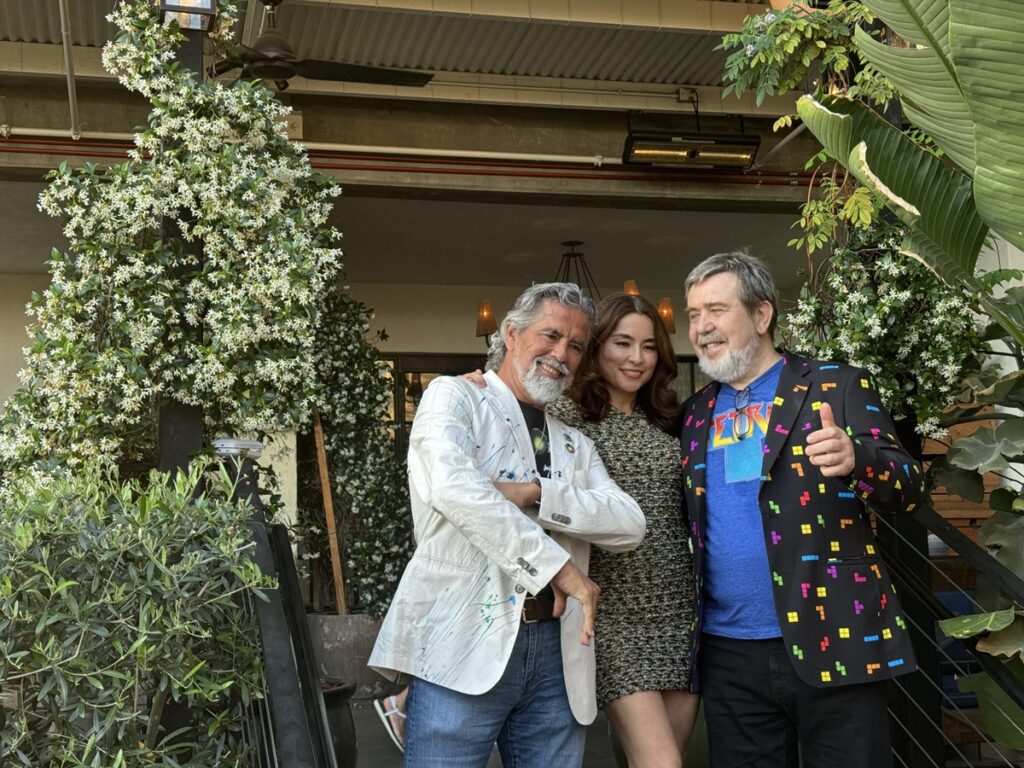
There’s even a movie about the Rogerses’ involvement in the games industry: the biopic Tetris, which depicts Henk Rogers’ borderline comical determination to find the creator of the blocky game and secure the rights. Young Maya Rogers is played in the movie by Kanon Narumi.
Rogers said in a previous interview with Gamesindustry.biz that her mother, Akemi, encouraged her to go for a career in business: “She was all about climbing the corporate ladder.” In addition to her work in gaming, Rogers is also a founding partner at Blue Startups, an accelerator based in Hawaii with the professed goal of “diversifying Hawaii’s economy by leveraging its unique strengths.”
I caught up with Rogers after she appeared in an episode of GamesBeat’s The BIG Show earlier this year. Below is an edited transcript of our interview.
GamesBeat: Usually, when I speak with someone for BOSS Mode, I’m asking them how they joined the games industry. A lot of BOSS Mode interviewees have joined video games from another industry, or their background and education is in other forms of business. You, I think have, deeper roots in the games industry than just about anyone I’ve ever spoken with. What was it like, growing up with the games industry?
Maya Rogers: I think of two things. One, I grew up in Japan until the age of 11, and I grew up in the mid-to-late-80s, where video games were just becoming mainstream. The Nintendo Famicom had just launched, so you can imagine the kind of fandom that was happening in Japan at the time. There wasn’t a single kid in my class who hadn’t played Famicom growing up.
I think that alone, the era in which I grew up, was the birth of the Japanese gaming industry. So video games in general had a huge impact on my upbringing, as did it did on everybody else around me.
Two, yes, my parents were instrumental in actually starting the video game industry in Japan. My father helped create Japan’s first role-playing game [The Black Onyx]. Before that, nothing like that existed, and now look at how big that is today. RPGs are huge, especially in Asia! That was pivotal, so my parents were already in video games.
A few years later, my father discovered Tetris, chased for the rights, and very, very long story short, brought Tetris to the rest of the world. So what was it like? It was a huge influence on me to see my parents being entrepreneurs and creating what is, today, the biggest entertainment industry today.
GamesBeat: And now you’ve inherited — you’re part of that legacy now with being the CEO of Tetris.
Rogers: “Inherit” is a strong word, but yes, I had the opportunity to work in the games industry early on in my career. I stepped into it and never looked back. Yes, today I’m the CEO of Tetris, and I have in some way inherited that role from my father. But I would say it was never something that was handed down to me, or was never something I was groomed to become. I took some opportunities.
My first job out of college was at a division of American Honda that worked on auto parts. Then I worked at Sony Computer Entertainment, and my first job was working on Gran Turismo, so I like to say I went from physical cars to virtual cars. I helped localize games like Gran Turismo and Hot Shots Golf, because I’m bilingual.
To get a little personal, my father had a heart attack when he was 52, and it was a wake-up call for me to learn from him while he was still alive. He’s still very much alive today! But I’d already been in the games industry for many years at that time. I knew in that moment, that I wanted to work for him and learn from him while I still could. I made the big move to join the company 17 years ago, and then 12 years ago, became the CEO.
GamesBeat: You have that perspective of the games industry as it was when you were growing up and when you started working, versus where you are now. In what ways do you think the games industry is different, and in what ways is it the same?
Rogers: Well, there’s still not enough women.
GamesBeat: This is true.
Rogers: I think one of the biggest differences is how games are created and how they’re operated now. Many, many games now are live ops game. So it’s no longer ship a product, be done with it. You’ve got to know what your customers, the players, are looking for. Software as a live service, I think, is the major shift that has happened within the video games industry.
We’re also seeing the consolidation of IPs. People are betting on the games that they know. We’re starting to see the games industry major in similar ways to the movie industry. People want to see the revamp, or the continuation of an IP they grew up playing. I think it’s matured a lot in the last 20 years.
GamesBeat: What was your role in when you started at The Tetris company?
Rogers: I started as the director of special projects. For me, it was about learning the different parts of development. Back then, we did some internal development. We don’t do that today. The business was then, and still is, a licensing business, but we had a dev team at the time and were developing some other IPs. My role was to be involved in all of the different projects, and have the opportunity to learn about the business, including development and licensing.
GamesBeat: I would like to get your insights on being a female leader in this space. How do you lead a company of this size, with this sort of historicity? How do you lead with impact?
Rogers: I get to come to my job and be the champion of what Tetris is and what it should be. For me, it’s not just a job — Tetris is like my family legacy. I come to my job thinking it’s not about me, but more about what Tetris is and what it should be for the world. I’m a humble servant in that process.
Going back to the other part of your question, being a female leader in any industry, especially a male-dominated one, I think it’s hard for women to show up authentically as ourselves. So much of what and how we’re treated and raised in society tells us we’re not good enough, we’re not this, we’re not that. Growing up with a father who believed in me, I was a girl who could get shit done.
I always knew who I was as a person, and I needed to show up authentically as myself. I think it’s harder for women to do that because we live in this male-dominated world, in this male-dominated industry where we think the norm should be how men are in the workplace, but this is not who we are. Showing up as your authentic self and knowing that you don’t have all the answers, and being aware of relationships and community — all of those things, I think women bring to the table more easily.
Even though, in my younger years, probably I had more reservations about being comfortable, being who I am. I always tell other women, you know who you are. We all know who we are, and it’s okay to be you. That’s my message to women leaders, Asian women, just people in general. People react to that. They know when you’re authentic. They connect to you, and that’s the most important thing. Don’t try to be something that you’re not.
GamesBeat: That’s a lesson I had to learn as well: Everyone will clock you if you’re putting on a mask. Even if it’s not conscious, they’ll clock and they’ll never come to you with their authentic selves.
What’s the biggest impact you’ve had on the business? What’s the biggest win that you can celebrate?
Rogers: In terms of being a female leader and being a female CEO in the video game industry, that in itself, right? t’s not about me, but it’s about what this position represents in being part of one of the biggest video game brands and being a female leader, so I think that is so important. Representation is everything.
Looking at what the biggest impact that I would say I’ve made since I become CEO? When I look at Tetris, it’s not just a video game. It was really important for me to explore and expand what the brand could be beyond video games. Today, we don’t just make video games. We’re in everything from merchandising to entertainment.
Saying “No” to things because it’s not what we believe in? I think that’s a Boss Move, right?
So we’ve really — and I say we, because it’s not it’s not just my doing, right? It takes a village to do what I do. We really expanded Tetris beyond just a video game company, and I really believe that Tetris is something that brings joy to people. And how can we spread that joy?
GamesBeat: What do you consider to be your Boss Move? What decision or career move defined everything that came after?
Rogers: A few things come to mind. The first is making the Tetris movie. It was the first movie of its kind that talked about the people behind the video games. Tetris was a story of friendship between two people from very different worlds coming together and bringing this wonderful game to the world.
To be a part of telling that story and making that story, that is forever going to be part of history, is something that I’m very, very proud of. My children and grandchildren and so one will always have that story to watch. That’s one of my proudest moments.
Another one is saying “No” to opportunities that could have had a big impact in terms of revenue, opportunity and awareness of the brand; saying “No” to something because we felt that the company didn’t represent what we represent. We’re an inclusive company, and we’ve had opportunities to work with other businesses that don’t have those same values.
If you’re just looking at it as a business opportunity, maybe somebody would have said “Yes” to that. But saying “No” to things because it’s not what we believe in? I think that’s a Boss Move, right? Whenever you’re really thinking about the impact of not just the short-term but the long-term and what we stand for.
Oh, I had another one. Going back to being authentic, and being yourself. I think the biggest Boss Move is showing up at a place and being vulnerable, accepting and being okay with who you are — I think that’s a Boss Move.
GamesBeat: What is your boss music?
Rogers: “Run the World (Girls)” by Beyonce.