

The AI boom has given a huge boost to the makers of AI processors, graphics processing units and memory chips. But it’s also creating real demand for foundational semiconductors that are part of the infrastructure.
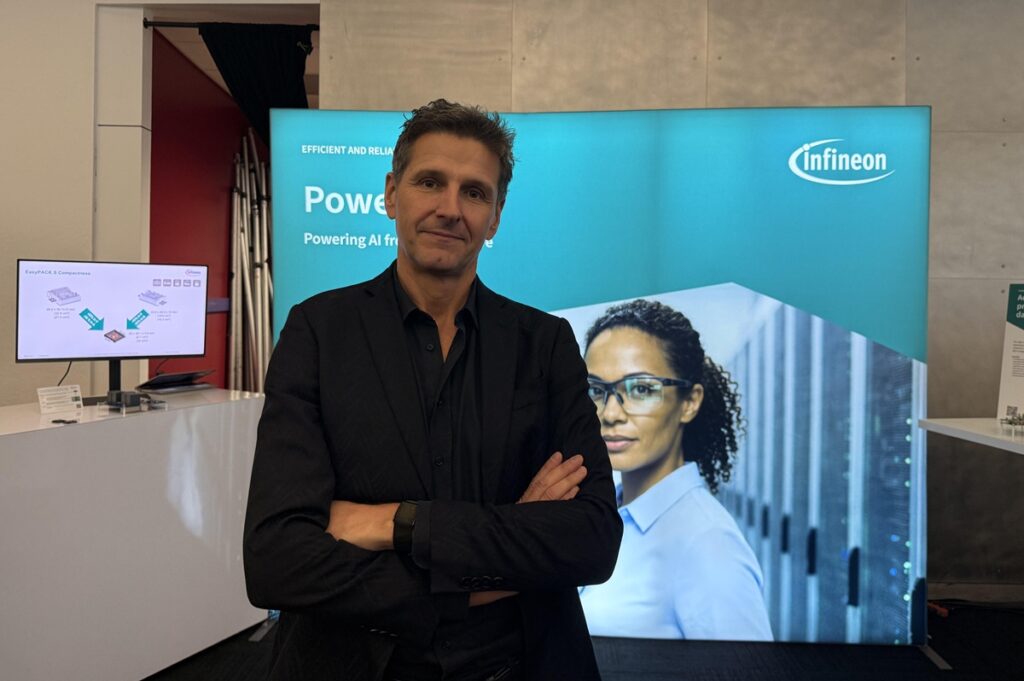
Andreas Urschitz, chief marketing officer at Infineon Technologies, doesn’t want people to underestimate the importance of the foundational chips that matters as well in helping fulfill the AI boom. I interviewed him at Infineon Americas’ recent Infineon OktoberTech event at the Computer History Museum in Mountain View, California.
Urschitz noted that while the industry is pouring billions upon billions of dollars into high-end two-nanometer and three-nanometer chip factories, Infineon is also busy with low-end production of products that accompany those high-end chips. Infineon’s chips include power semiconductors, microcontrollers, sensors, and connectivity chips, which are seeing a surge in demand as physical AI, robotics, drones, autonomous systems — and the data centers that support them — start to scale up in response to demand.
He said the Infineon invested heavily during the previous downturn, spending billions on manufacturing expansions in Dresden and Kulim. Urschitz said that Infineon is also focusing on being a leader in components for Edge AI.
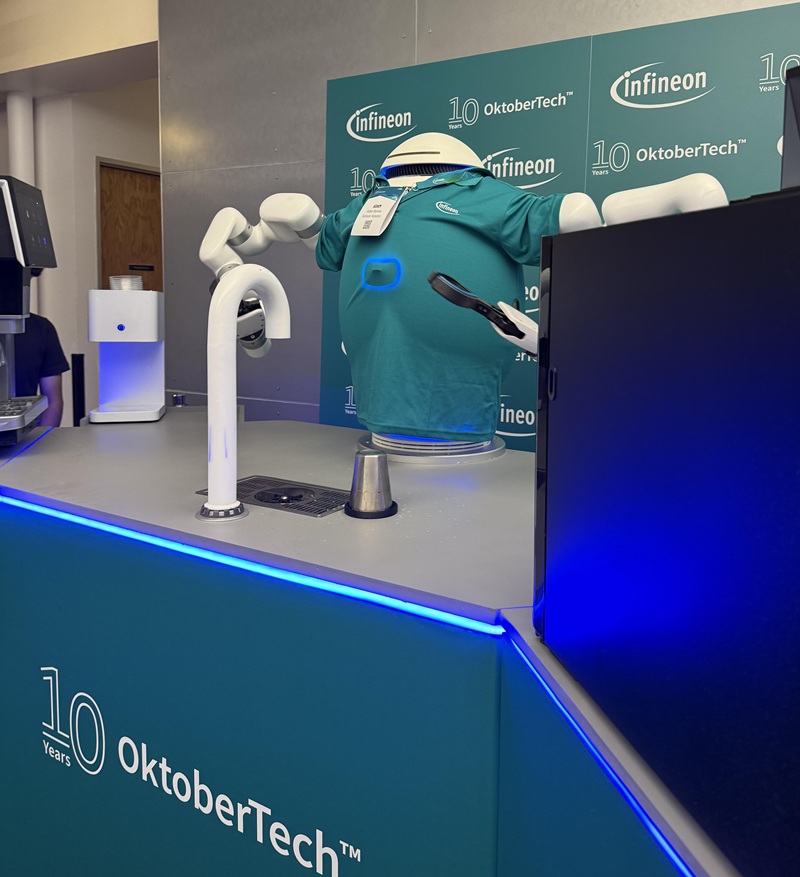
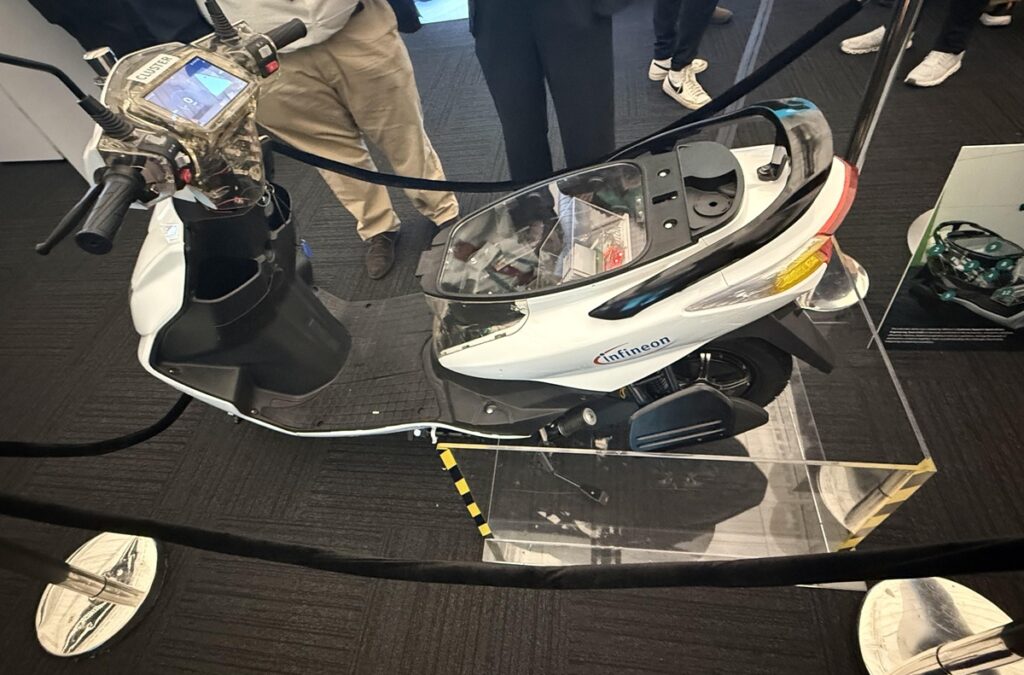
At the 10th annual OktoberTech event, the company showed off lots of demos of AI being applied to segments such as healthcare, cars, robots, and more. And those devices can run on local AI, rather than cloud-based AI, leading to lower costs and better energy efficiency.
Urschitz believes that robotics is reaching a practical inflection point, thanks in part to Infineon improvements in edge AI, sensing, battery management, and power efficiency. He noted that drone-and-robot delivery systems are already operating at scale in China.
And Infineon sees power semiconductors as one of the biggest AI opportunities. He said the company is investing in silicon, silicon carbide, and gallium nitride technologies to improve power efficiency for datacenters, AI processors, industrial systems, and energy infrastructure. Meanwhile, Infineon continues to hold around 30% share in car microcontrollers.
In the long run, quantum computing remains a real opportunity, but it won’t be an immediate payoff. More engineering breakthroughs are needed to make it practical, he said.
Here’s an edited transcript of our interview.
GamesBeat: It’s an interesting beginning to the event. Did Michio Kaku (the physicist and keynote speaker) provoke some thoughts on your side about just how near-term any of the things he was talking about seem to you?
Andreas Urschitz: He was building a very nice bridge from the last two centuries and the evolution of technology, if you will, starting with the steam engine and electrification. The computerization of everything, and now we’re in the fourth revolution called AI. From there on also looking forward. It was a very compact way to present how the future eventually may look, the future of what I would call neuromorphic and quantum computing. People may have a second cognitive layer by being connected to the internet all the time. The element of quantum computing will change the world in terms of compute efficiency. I found what he said intriguing, how he referred to what’s potentially the fifth wave to come.
GamesBeat: He was very good at conveying something complicated in just a sentence or two. Like when he said, “Look at this puzzle. The digital computers will solve it in a serial way, one move at a time. Quantum will solve the entire puzzle all at once.”
Urschitz: I also liked his image of photons instead of electrons. Electrons are floating from one point to another in a two-dimensional space, like on the surface of a chip. But light can go any direction at any point in time. That’s intriguing as an image to convey the message of going from bits and bytes, yes or no decisions using digital technology in today’s compute capability, to quantum compute. A multidirectional room with infinite possibilities where light can spread, relative to electrons that have a limited number of possibilities, just A and B.
GamesBeat: You have this position at the edge of chips and computing now. In that future, you have to have a refrigerator sitting on top of everything. Does that mean we’ll have to wait through another generation of technology for quantum computing to make it to the edge? Or does this mean you would want to move to refrigerator-sized implementations of technology?
Urschitz: It’s difficult to see where the technology will go and fast. A quantum computer today is a massive installation, because of all the cooling that’s required to trap ions to do the compute exercises. Someone far in the future might shrink that to a form factor the size of a cigarette pack, or maybe a PC. But there’s still a long way to go. I don’t yet have an answer about what has to come into play to facilitate this. But I know that engineering will always bring humanity to points that we would never have believed we could reach before. I think quantum computing will come.
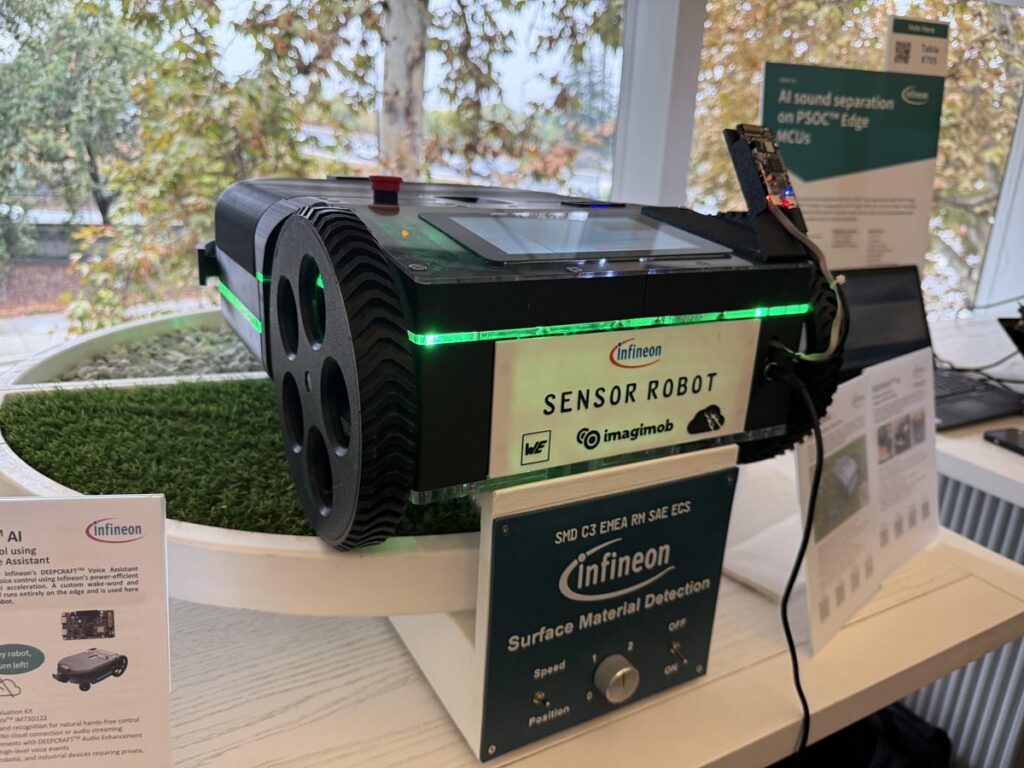
GamesBeat: This week I went to an interesting presentation on a delivery robot that was much more efficient than the robots we saw a year or two ago. The creators think they can get it down to very low wattage, very low power usage. That will improve how much local computing can happen inside a delivery robot, which has to be self-contained.
Urschitz: Absolutely. Intelligence at the edge, or small language models that operate at the edge, that’s a big savings of energy relative to always being connected to the internet and having large models run in the background. Actuation and management of electricity are other big elements of a delivery robot. Loading and charging the battery. A lot of semiconductors are helping make energy use much more efficient. When these things come together – intelligence at the edge, less compute power required, less energy required, plus better management of actuators, making them super energy efficient with semiconductors – all of a sudden these devices get much more efficient.
GamesBeat: Your delivery robot this morning, was it supposed to listen and talk?
Urschitz: That one was supposed to talk, no joke. We checked it out before. It didn’t understand everything I was saying to it, but when I checked using a proper microphone array–you might be aware that Infineon has the world record highest signal to noise ratio, super sensitive microphones that can capture each and every sound of your voice and compute with it accordingly. Whatever was going on here, the robot didn’t have Infineon microphones. It clearly couldn’t hear me. That’s why it didn’t talk to me.
GamesBeat: But it does seem like they’re getting better, getting more advanced every year.
Urschitz: The robot we saw today is probably an entry-level delivery robot or service robot you might use in a restaurant, for example to take dirty dishes from point A to point B. It’s quite a simple tool. Nothing too sophisticated in that regard. Even now, a lot of improvements can and must happen.
GamesBeat: There’s the San Francisco problem, where people are attacking these robots, or stealing them. There seems to be an anti-technology sentiment. The last person I talked to about this said the rates of disablement are under one percent, though. If you compare to something like retail shrinkage, that’s always around two percent. That’s maybe within acceptable limits. But it does make me wonder if flying drones are ultimately a better solution. It’s harder for people to destroy those.
Urschitz: I believe the future is going to bring a combination of both. Flying drones for medium to long distances. Robots on wheels for the last 100, 200, or 300 meters to the point of handing off to the consumer. That’s what we see.
When you look into lower-altitude delivery logistics, as showcased in Shenzhen–the Meituan app is working on getting food delivery into the air. They’re working on using multicopter drones to pick up food at restaurants and deliver it to delivery stations. From those delivery stations – and there are many of them, almost as many as bus stations in Shenzhen – the last couple of hundred meters to the humans is done by robots on wheels. It’s running at scale. I’ve seen it. When I visited Meituan, I think on the very same day they had something like 20,000 deliveries in a single day.
GamesBeat: Air-dropping deliveries into backyards in the suburbs is potentially also very secure.
Urschitz: Yes, that’s also something that’s probably going to come. You have different forms of delivery for rural areas. In urban environments that’s not going to work, where people live in skyscrapers. You need to have a different solution.
GamesBeat: What it points to, you want to design around these capabilities, right? In an apartment building maybe you have a place where robots can roll up and deliver to lockers.
Urschitz: There are lots of possibilities and optionalities. One of the big issues I observe when I speak to startup companies that are working on low-altitude logistics systems, it’s getting permission related to safety and human protection. Letting a drone fly around whatever place, it always has to be compliant with a minimum set of rules that have to do with protecting human beings from any kind of casualties. Technically I believe there’s already much more possible in terms of delivery relative to regulation.
GamesBeat: You mentioned that when you first arrived here it was hard to get anyone’s attention. The contrast to now, how sharp is it?
Urschitz: We didn’t say it explicitly, but when we had the first OktoberTech it was 100 people. Out of that 100, the majority were from Infineon. We had trouble getting customer representatives to join us in the Palo Alto Four Seasons. It was a big effort to convince people to come, and then only a few came. We were thinking about what way to go. We never surrendered. We decided to make ourselves more attractive in how we presented ourselves, in how we presented Infineon’s innovation. We gave unique insights into technology and innovations. We made it feel a bit like you were visiting us at home, a personalized feeling. We felt that could bring us to where we are, and you can see that here now. We have 800 people here.
GamesBeat: I had to go and park down the street.
Urschitz: We were three times overbooked. We had to be selective in who we gave tickets. That’s not always easy. There’s a huge pull factor around OktoberTech, people trying to get on board and be part of it. They see the innovation. They see that this is unique, what we share here, in terms of the information we offer and the better understanding of the unique possibilities of great semiconductors. But it’s also unique in terms of the spirit you can find here, the atmosphere. It makes people open up, be it partners or customers or ourselves. People appreciate that. I think that’s why it’s become so popular.
GamesBeat: The consequences of being so popular–AI is in such demand that we have a short supply of memory chips. In the game industry they can’t introduce new game consoles because they’d cost more than $1000. For you, what’s happening as a result of being downstream from this? Do you have to switch plans to emphasize things without huge amounts of memory?
Urschitz: There’s a couple of aspects to the question. Several of our customers who are mostly in the consumer domain are suffering from the memory crunch. Lots of memory capacity, memory chips, high-bandwidth memory, it’s all being consumed by everything around AI. Memory chip prices over the last two years have probably increased tenfold. I believe that was a quotation from one of our guests. Terrific price increases as a function of the shortage, as well as terrific allocations and supply shortages, particularly into consumer customers. Memory has become the determining component of the overall system cost to a large degree.
How does this affect Infineon? The impact on our business is still digestible. Let me put it like this. The way Infineon is structured in its exposure to consumer, you can say that probably 20% of our revenue is in consumer devices. A large majority of that revenue we’re doing with big customers. System-defining customers or big OEMs. Even though they’re consumer companies in the area of smartphone manufacturing and so on, they have a good hand on memory supply. So, is the memory shortage affecting Infineon’s business? To a minor extent in some sub-categories of consumer segments. But overall the impact is not really that much.
The other point is, what about supply and demand inequalities in foundational semiconductors? Microcontrollers, power conductors, sensors, connectivity devices. What’s happened here is pretty much that–almost all product categories that fit into this basket of, let’s say, non-processing, non-GPU, non-memory products are already in allocation or running into allocation. The point is simply that we have observed, over the last two or three years post-COVID, there was a lot of semiconductor capacity built up, but 80-90% of the investment done for semiconductor capacity expansion globally was done in leading-edge nodes. I’m talking about 3nm and 2nm capacities. Only very minor amounts of the money invested went into foundational semiconductors.
The capacity growth for foundational semiconductors in the last three years was quite limited overall. Thank God, Infineon did the opposite. We heavily invested in the Dresden clean room, a 6 billion euro investment. The biggest 300mm power fab and signal fab on Earth. We invested another 5 billion in our Kulim 8-inch manufacturing facility, in particular into silicon carbide manufacturing. Another couple of hundred million here and there into back end and other front end manufacturing facilities. That’s brought us to a privileged position where Infineon has the clean rooms available to double revenue in the very near future.
Now that we’re growing with this uptick in demand for foundational semis–the demand is upticking far beyond AI-driven power semiconductor demand only. For us, coping with demand is now something that’s doable. We need to ramp machinery. Normally the limiting factor to increase capacity is always clean rooms. We have clean rooms because we were very courageous three or four years ago when we made the decision. Everyone was saying, “Oh, this is a crisis. We can’t invest. You can’t invest in foundational.” We invested, and now we benefit from potential growth stemming from us having capacity to serve power semiconductor demand, which is unprecedented. Microcontroller demand, connectivity demand, sensor demand–everything around physical AI and autonomous mobility needs these kinds of semiconductors. It’s growing as we speak. I believe it’s our time now, as Infineon.
GamesBeat: If you look at Infineon’s outlook a few years from now, what are the highlights of your road map?
Urschitz: In power semiconductors, two or three things to mention. First and foremost, we continue to innovate in silicon-based MOSFETs. Here, relative to industry rumors, which sometimes say the future is only in wide-bandgap – gallium nitride, silicon nitride – and the days of power silicon are over, I can’t confirm. Power silicon still has a lot of innovation ongoing for low-voltage FETs, medium-voltage FETs, high-voltage FETs in terms of making smaller form factors, making whatever kind of electric motor drives or power supplies more power efficient and smaller. Such devices still require a lot of silicon solutions.
We’ll continue to innovate in that arena, all on 300mm super-thin silicon, down to 20 micron, which allows the lowest R(on) resistance. When you’re switching the transistor there’s almost no heat dissipated because the heat is so thin. It’s physics. There’s quite a bunch of innovation still worth mentioning. The market doesn’t talk about this so often, but this market is anything but in a rampdown. It’s the opposite.
Next to this we’re putting a lot of emphasis in the other two material systems in power, which are silicon carbide and gallium nitride. Silicon carbide is well-established. We see going forward that silicon carbide will move into higher voltages – 2,000, 2,500, 3,000. These are voltages in this material system that make a lot of sense in new energy infrastructure, such as solid state transformers or solid state circuit breakers, which are about to replace copper-based systems. The big five-megawatt copper transformers that weigh 40 tons, those have long lead times nowadays because of copper shortages and many other factors. This goes toward active semiconductors. High-voltage silicon carbide will shine. That’s on the way.
The third thing is we’re expanding our footprint in gallium nitride. As you know, we have been nurturing 300mm gallium nitride. Other than that being an art in itself, to manage thin silicon wafers, 300mm ultra-thin, and deposit gallium nitride–the larger the wafer, of course you have mechanical stress on the chip. Gallium nitride may crack off the silicon. We’ve found that through a lot of alchemy we can avoid this. We see 30mm GaN as a key enabler to provide GaN to the market in a cost-efficient way. That’s one of the next big things we’re going to see. GaN is getting to cost points per functionality that are equivalent to silicon-based FETs. This is the point where I believe gallium nitride will start replacing silicon MOSFETs in a bunch of voltage classes for specific applications.
This is for power. One more thing related to power that’s also on the way is what we call vertical power modules. You may have heard about this. Vertical power modules are very high current, very low voltage DC-DC converters. They supply or convert six-volt DC voltage down to .6-volt, as close to a GPU or an inference processor as possible. You can manage this by deploying vertical power delivery, which means we’re building modules that are stuck underneath the processor, the processor PCB. You shorten the copper lines between these DC modules, what we call compact modules, and the processor. That helps get more compute power out of the same processor, because you have less electricity loss from long copper lines that normally stems from lateral power supplies.
When you put power conversion chips to the left and right of the processor, the distance along the copper lines is longer and there’s a lot of loss. We come with these compact modules that you can connect underneath the processor and solve this problem. We can bring many more amperes next to the processor. That helps massively increase the compute output, the amount of compute per watt consumed. In other words, we enable the production of more tokens per watt per second.
This is all in power. To sum it up, compact modules for DC-DC, material system silicon, gallium nitride, silicon carbine. That’s what we’re working on. There are lots of new products coming in all of these categories. Beyond this, we’re working on making our microcontrollers shine. They have neural network capabilities, edge AI capabilities coming, exactly to enable things like this robot being able to speak to me. That requires, in an environment where the connectivity is not good–the robot can use a small MPU. Together with a microcontroller and a microphone, it can understand a human voice and human commands. That’s just one example of edge AI-enabled microcontrollers. This is a portfolio that we’re massively growing as we speak.
GamesBeat: You have a demo out there of voice conversation.
Urschitz: Yes. We also continue proliferating our portfolio for functional, safe auto microcontrollers. That’s worth mentioning, because in automotive microcontrollers Infineon has reached 30% market share last year. We’re by far the biggest microcontroller company on the planet. We’re taking the next step in using open architecture, RISC-V architecture in these products. A functional, safe, highly dependable zone controller microcontroller is on the way incorporating RISC-V. We believe this device will be used much more broadly than even today because of the open source nature of that kind of microcontroller, while still delivering the functional, safe capabilities that are so important for drones and self-driving, autonomous cars.