

Nuuvem is one of the game companies that is leading Brazil up the food chain in the gaming ecosystem.
Founded in 2011 as a digital games store, the company had humble roots at a time when Brazil’s game industry was still growing up from individual game makers and work-for-hire studios.
Led by CEO Fernando Campos, the Rio de Janeiro company has now grown to reach more than 45 million players on its marketing channels and more than 3.4 million users. I spoke with Campos at the recent Dice Summit in Las Vegas about the state of Brazil’s gaming market and Nuuvem’s role within in it.
I wrote this story as part of our Special Report on gaming in Latam, sponsored by Xsolla, and today is the start of the Gamescom Latam event in Sao Paulo, Brazil. At Gamescom Latam in Sao Paulo, Brazil, Nuuvem will have a 100-meter-square two-story booth.
Nuuvem has established direct and official partnerships with some of the world’s leading game publishers, including Nintendo, PlayStation, Microsoft, Konami, Capcom, Warner, Ubisoft, Rockstar, Take-Two, and others. It enables them to reach Latin America’s enthusiastic fans.
At Gamescom Latam, visitors to the Nuuvem booth will be able to test Sega games such as Sonic Racing: CrossWorlds, Shinobi: Art of Vengeance, and Yakuza Kiwami 3 & Dark Ties, as well as titles published by CriticalLeap, such as The Posthumous Investigation, Outlive 25, and Fading Echo.
With a strong focus on offering fair and accessible pricing, Nuuvem features a catalog of thousands of titles across PC, Nintendo, PlayStation, Xbox, and mobile products.
(Check out the special report GamesBeat did on Brazil here, as well as our interviews with Arvore and the Gamescom leaders).
Origins
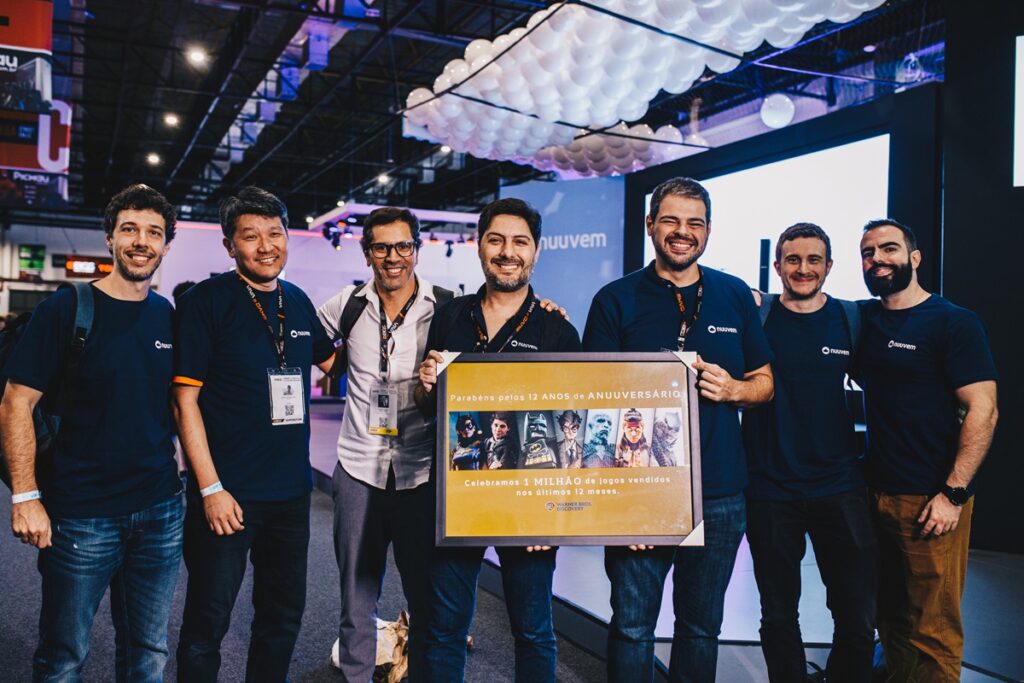
Cofounder Thiago Diniz helped start the company before esports was even an official name. Back then, it was known more as the cyber sports scene. The founders wanted to serve the Brazilian market with a quality digital store with localized content.
“We opened a digital game store to serve publishers and help them enter the market with fair prices for the users,” Campos said.
The company avoided the gray market and it aimed to sell legit PC games in the region.
“At some point in the middle, we had to decide if we’re going to focus on getting the publishers’ trust or growing. We chose path of trust,” Campos said.
Cross-border payments were a mess. So the company set out to solve the problems, improve payments, reduce fraud and provide support.
“We expanded all over Latam and went into console gaming and mobile gaming,” he said. “Today, we work with 450 publishers and 11,000 games from all over the world. We became a game publisher. Recently we launched our CriticalLeap brand.”
The company serves as a regional partner for global publishers like Cygames, and it also takes titles from Latin American and takes them across the world.
Brazil’s growth

Brazil has grown dramatically, just like Nuuvem.
Matthew Ball, CEO of Epyllion, noted in a recent report on the state of gaming that Brazil has a big participation rate when it comes to games. About 73% to 80% of those ages 16 and up are playing regularly, especially mobile games, according to data from Newzoo and Sensor Tower, he said.
And over the last three years, the PC and console market in Brazil has average over 6% annual growth and 7% mobile growth, faster than the global rates. By some estimates, Ball said, Brazil is now a top 10 market globally, with $610 million in sales in 2025.
“Brazil is the most developed country in Latin America,” Campos said. “We have very robust payment systems now. We have robust consumer markets. But the challenge in Latam continues to be the same, where conversion is still a big challenge.”
He added, “We get a lot of publishers and studios that have amazing numbers, like hundreds of millions of downloads. But at the end of the day, the purchase doesn’t come. So that’s a big, biggest complaint because these are countries with lower income.”
He added, “There is also a lot of mistrust, right? So in Brazil, even in other countries like America, you buy something you regret. There were no refunds. Obviously, there are refunds nowadays, but it’s not that easy. That’s true even in Brazil. But the level of maturity is increasing in these countries.”
Campos believes the Abra Games gaming trade group and its alliance with the Brazilian government is progressing well in terms of raising awareness of games with the government. Lines of credit are easier to get. There is a harsh law scheduled to go into effect in terms of protecting children in games. It’s not clear how that will turn out. But there could be a shadow of regulation across the world for social networks and games.
Launching spawnd
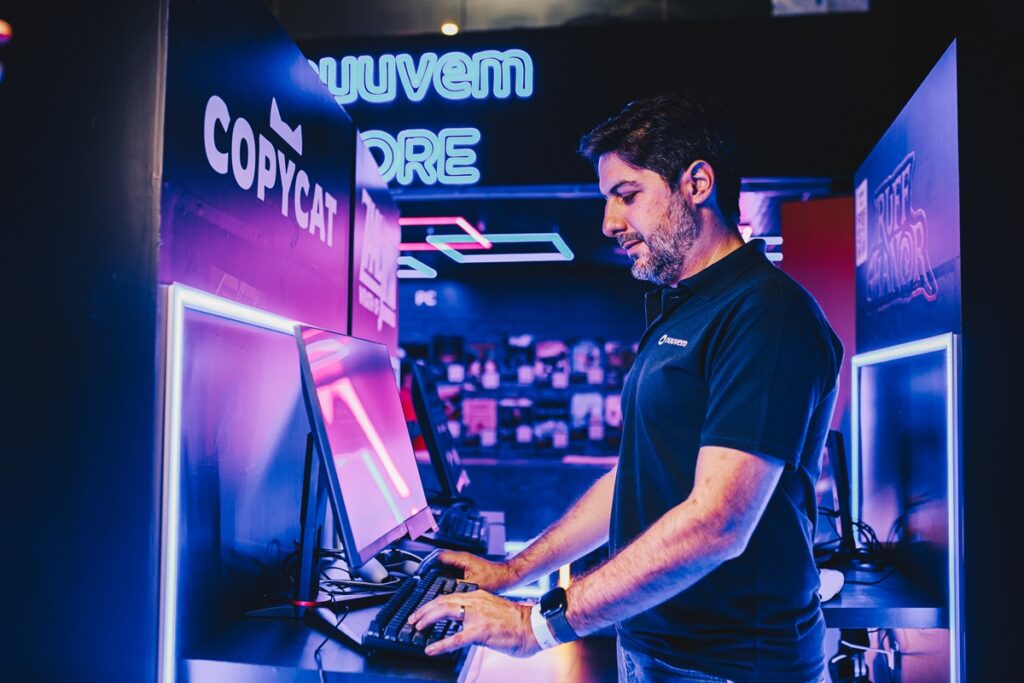
Among its achievements, Nuuvem cut a deal last fall with Square Enix to back spawnd, a new browser-native game discovery platform. The tech delivers native instant-play for premium game demos that can be shared and embedded anywhere on the web.
“That’s been great because Square Enix is an amazing company. We all love it,” Campos said. “It’s been a great partnership. Before that, we were bootstrapped and yet we grew over 40% every year, with only one down year in our history.”
Spawnd is a web gaming platform that allows premium game demos to be played, shared, and embedded anywhere on the web, just like a YouTube video — giving players instant access with no subscriptions or downloads necessary. And spawnd’s unique tech allows demos to be embedded into store pages, media articles, influencer channels, and even social posts. For players, this means instant access to try-before-you-buy, directly in-browser.
For developers and publishers, spawnd offers a frictionless discovery funnel, with one-click trials that directly increase organic wishlists, solving one of the biggest pain points in today’s industry. Most demos remain buried in platforms, never reaching their audiences. spawnd fixes this.
“Spawnd is where we’re investing a lot of our capital to expand. It’s something that’s looks simple at first, but it’s a world of difference when you see the results, when you see users clicking through and playing demos in a single click, rather than going through all the things with Steam,” he said.
Spawnd’s data-driven analytics board gives devs visibility into user behavior during their demo, including a direct CTA to the Steam page. This means developers and publishers can gather real-time engagement data to optimize marketing and design decisions. The deal with Square Enix validated the tech.
Beating slop

The company doesn’t disclose financials, but Campos said he company had a record year last year in terms of operating profits. The company reinvests in itself, as it remains a bootstrapped company.
Campos continues to think a lot about discovery of great games. AI is possibly going to create an even larger bottlnecik in game discovery, as AI tools can be used to accelerate game development and produce too many games for the market.
“We’re going to have a distribution and discovery issue here. I don’t think AI is going to solve that issue itself, because there’s so much content,” he said.
Back in the day, it was a tough decision to focus on legitimate games only, rather than pirated copycats that were rampant in the market. But Nuuvem stayed on the high road, working with official digital sales partners.
Now, some of the same problem is arising with the advent of “AI slop,” or games created by AI with bad gaming experiences for the sake of making a quick buck.
“That’s one of the things we are trying to help solve,” he said. “How do with improve that in some way.”
Future growth
Complementing the spawnd layer of discovery, CriticalLeap is Nuuvem’s publishing label focused on curating, launching, and scaling standout games worldwide. Built on deep regional expertise and global go-to-market execution, CriticalLeap transforms visibility into sustainable commercial growth, supporting developers from positioning and launch strategy to long-term performance across key markets.
Nuuvem’s CriticalLeap publishing division is showing off titles at Gamescom Latam including The Posthumous Investigation, an investigative game that is a true journey through the universe of Machado de Assis, the most famous author in Brazilian literature; Outlive 25, a remastered version of the classic Brazilian RTS; and Fading Echo, a 3rd-person action-adventure game with a “desert punk” theme and fluid-based gameplay mechanics.
Another highlight of the booth will be Capy Castaway, a “cozy game” from Kitten Cup Studio that will soon be released for PC and sold on Nuuvem.
Today, the company is close to 100 people, with many of them working remote across cities like Rio de Janeiro. Campos works in the U.S.
“We have a large market and the entire ecosystem is maturing. I like to say that Latam is not emerging anymore. It’s already emerged. It’s just a matter of understanding what emerged and how to deal with what we’re seeing right now,” he said.
One of the things that makes him optimisitic is that Brazil has strong and enthusiastic social media. WhatsApp exploded in Brazil, but, as noted, conversion into paying customers is not easy. And now Nuuvem is expanding outside of the Americas.
“Our ambitions are global. The goal is to become global. We already started expanding outside of Latam,” Campos said.
Campos has seen a lot of slowdown in the U.S., partly because the industry got too much money and hired too fast. So he is being careful about growing. The company grew in double digits in 2025 — something enviable for U.S. companies.