
GamesBeat: How did you decide you had enough concepts and characters designed that you were ready to launch?
Tucker: I think just from playing the game. We always want to add more stuff. We could go on and on forever and always feel like, “Well, if we just add one more….” The thing is, we intend to carry on supporting the game as long as we have content. It felt in a good position. It’s playing well. There’s a good choice of characters. It’s important to get the game out into everyone’s hands, and then we can work to shape future content with the community. There’s a risk in working in isolation for too long, holding it all back and then releasing everything. You’ve missed that opportunity to collaborate with the community.
GamesBeat: Making a Game Pass game, does that afford you some opportunities that would have been different if it weren’t?
Tucker: Definitely. It allows us to reach players that otherwise might not have put down $30 for our game. Maybe it’s outside the genres they normally play, or they’re less familiar with class-based games. That’s a cool thing about Game Pass.
It’s also one of the reasons why we put a fair bit of effort into onboarding and the new player experience. Once we got acquired by Microsoft — okay, there will be people playing this game that don’t understand what objective mode is, or they don’t know that the healer’s important, or they don’t understand positioning and team comp. We needed to do more to explain that stuff so that when a Game Pass user comes in without any experience, they can understand the game.
GamesBeat: Did many people on the team come from Hellblade at all, or mostly from elsewhere?
Tucker: A couple of people that worked on Hellblade are on the team now. Quite a few people that worked on DmC are on the team — myself, the lead environment artist, our lead coder, a couple of other environment artists. It’s a mix.
GamesBeat: Is there anything in the game that you’d consider inspiration from DmC?
Tucker: A lot of what I learned about how to make the combat feel good. When you press the button, the controls, getting that response, making it feel visceral. The pad rumble, the hit stop, the camera shake, the little camera punches, all the little details that go into making a third-person combat system feel right on the controller. That’s probably the biggest thing that draws from that experience.
Did you play around with the mods very much? The mod system, every time you level up your character or your profile, you unlock mods. They’re not more or less powerful than each other. They just give you more options for tweaking the play style of your character. Every fighter comes equipped with three mods that we think represents the best balanced build for that character, but if you’re playing, say, Daemon, and you don’t care about extra health or any of that, you can go fully into stealth and sneak around behind everyone doing all the damage and running away. If that’s how you like to play, you can mod yourself into that play style a bit more. Each character can store three mod builds and you can change that in the spawn room. It gives you a little bit more in the way of options.
GamesBeat: Does that affect what special power you’re choosing at the beginning?
Tucker: No, you can choose either super with any of your three mod builds. There are mods that affect the supers. Obviously if you’re going to choose a different super to the mods you have, you’d be wasting it. But it’s up to the player to do as they wish.
GamesBeat: How big a tree is there to unlock eventually?
Tucker: Each fighter has about 20 mods right now. You can only ever equip three at once, but when you think about the way it combines with the rest of your team, it starts to become quite complex. There’s a lot to choose from. Even myself, when I play — I played solo queue in the last beta. I saw quite a lot of people running double heal comps. I have a build made especially for dealing with that. Whenever I see that, I go to my anti-healing build. It gives you a few different ways to deal with whatever situation the enemy team is going to throw at you.
GamesBeat: That’s where some of the mastery of the game lies.
Tucker: It’s a bit more meta, I guess, a bit more into strategy and planning. If you have a pre-made four, you can go pretty deep in trying to plan — okay, you take those mods with that character, you take these mods with this character, you take this or that super. You can come up with very specific combos to deal with something in particular. We’re going to focus all on AoE, or we’re going to focus on CC chains so we can take one guy down really fast. You can do some interesting stuff.
GamesBeat: Is there ever a time where you would say that splitting up the team is a good idea?
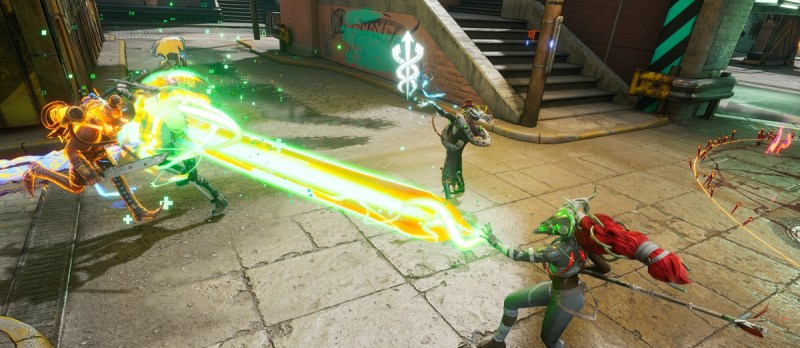
Tucker: Usually staying together is a good idea. When three objectives are active, that can be a time to split up, but you need to be careful. If the enemy team is in a ball of four, you need to make sure you don’t engage. But you can definitely win that phase by splitting up.
Poon: When you collect the power cells as well, in that game mode sometimes you split up to collect different clusters. You get more cells in that time.
Tucker: Splitting up to get power-ups can be a good idea as well.
GamesBeat: You could sometimes get a couple of people up on top and a couple of them below, and trick the other team into thinking half the team was split off and alone. It seemed like taking advantage of the vertical was an interesting thing to add to the game. Do you think adding even more verticality could make the game more interesting?
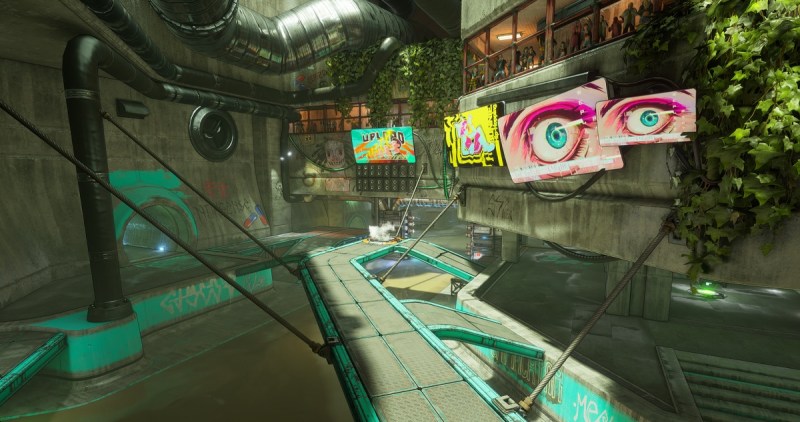
Poon: It’s difficult, because our characters can only shoot so far. At the moment there’s generally the ground floor, if you want to call it that, and then the second level. It’s fairly consistent. That second level is about six meters higher than the ground floor, because that’s what we felt was a comfortable height. You could stand on the edge and not have to flip the camera all the way down to see what you’re doing. That’s generally how far the characters can shoot.
We did try adding even more verticality, but then the problem is, if there’s a fight on the ground floor and you’re up two levels, your weapons don’t reach, so why would you go up so high? It makes for interesting visual variety, but in terms of gameplay, it doesn’t really work.